Gold faces selling pressure on profit-taking, US Dollar strength
- Gold price attracts some sellers in Wednesday’s early European session.
- Worries over the Fed’s independence might support the Gold price.
- Traders await the US July PCE inflation report later on Friday for fresh impetus.

The Gold price (XAU/USD) remains under selling pressure during the early European trading hours on Wednesday. The precious metal retreats from a two-week high of $3,395 amid the profit-taking and modest rebound in the US Dollar (USD). The potential downside for the yellow metal might be capped amid concerns over the US Federal Reserve’s (Fed) independence as US President Donald Trump doubled down on his efforts to oust a Fed governor. This could boost the Gold price as it is considered a traditional safe-haven asset.
Traders will keep an eye on the Russia-Ukraine conflict. Any signs of escalating tensions might lift the Gold price, while a peace deal could undermine the precious metal in the near term. Gold traders brace for the US Personal Consumption Expenditures (PCE) Price Index report for July later on Friday. The headline PCE is expected to show an increase of 2.6% YoY in July, while the core PCE is projected to show a rise of 2.9% YoY during the same report period. The hotter-than-expected inflation could limit the Fed’s ability to lower rates.
Daily Digest Market Movers: Gold price edges lower despite concerns about the future of Fed independence
- Donald Trump said on Tuesday that he will soon have a “majority” of his own nominees on the Fed board of governors who will back his desire to cut the interest rates.
- In response, Fed Governor Lisa Cook said Trump has no authority to fire her from the central bank, and she will not resign.
- Trump said he was ready for a legal fight with Cook after he moved to oust her from her post following allegations that she falsified mortgage documents, per Bloomberg.
- "Overnight you had the news that Trump fired one of the Fed governors accused of mortgage fraud. It gave a little life to gold because the Fed's kind of been the driver in gold right now," said RJO Futures market strategist Bob Haberkorn.
- Last week, Fed Chair Jerome Powell signalled a possible interest rate cut at the US central bank's meeting in September, saying that risks to the job market were rising.
- Traders are now pricing in nearly an 85% chance for a cut of at least a quarter-point at the Fed’s September meetin
- g, up from 75% last week, according to the CME FedWatch tool.
Gold clings to a bullish stance in the longer term despite profit-taking
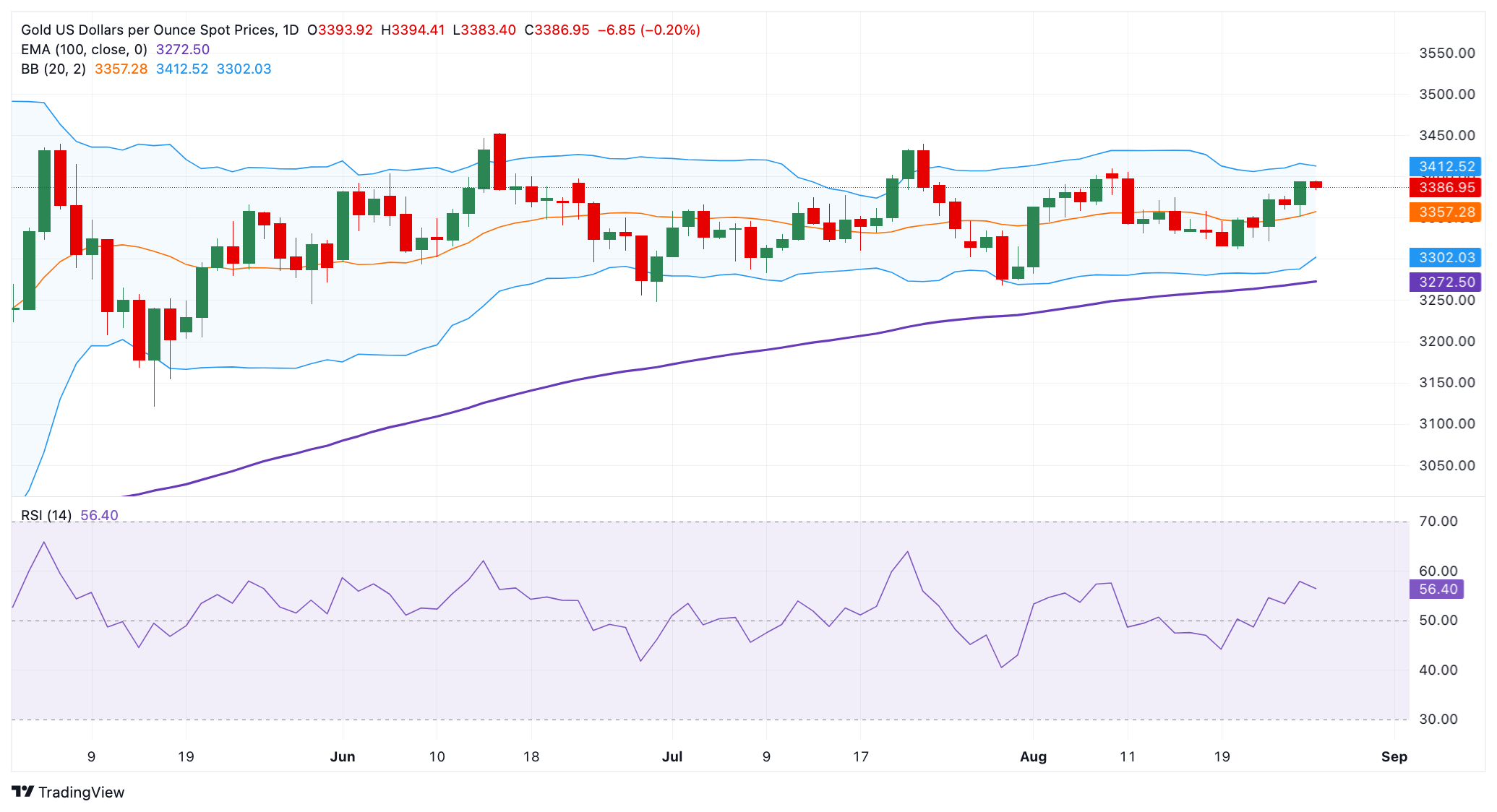
The Gold price edges lower on the day. Technically, the constructive outlook of the precious metal remains in play, with the price holding above the key 100-day Exponential Moving Average (EMA) on the daily chart. The path of least resistance is to the upside, as the 14-day Relative Strength Index (RSI) stands above the midline near 56.80. This indicates bullish momentum in the near term.
The crucial resistance level for Gold emerges in the $3,400-3,410 zone, representing the psychological level, the upper boundary of the Bollinger Band, and the high of August 8. A run of green candles and steady trading above the mentioned level could open the door for a move toward $3,439, the high of July 23. The additional upside filter to watch is $3,500, the round figure, and the high of April 22.
On the flip side, if the XAU/USD continues to draw in sellers and more red candlesticks show up, the price could head right back to $3,325, the low of August 21. Sustained trading below this level could expose $3,200, the lower limit of the Bollinger Band and round mark.
Gold FAQs
Gold has played a key role in human’s history as it has been widely used as a store of value and medium of exchange. Currently, apart from its shine and usage for jewelry, the precious metal is widely seen as a safe-haven asset, meaning that it is considered a good investment during turbulent times. Gold is also widely seen as a hedge against inflation and against depreciating currencies as it doesn’t rely on any specific issuer or government.
Central banks are the biggest Gold holders. In their aim to support their currencies in turbulent times, central banks tend to diversify their reserves and buy Gold to improve the perceived strength of the economy and the currency. High Gold reserves can be a source of trust for a country’s solvency. Central banks added 1,136 tonnes of Gold worth around $70 billion to their reserves in 2022, according to data from the World Gold Council. This is the highest yearly purchase since records began. Central banks from emerging economies such as China, India and Turkey are quickly increasing their Gold reserves.
Gold has an inverse correlation with the US Dollar and US Treasuries, which are both major reserve and safe-haven assets. When the Dollar depreciates, Gold tends to rise, enabling investors and central banks to diversify their assets in turbulent times. Gold is also inversely correlated with risk assets. A rally in the stock market tends to weaken Gold price, while sell-offs in riskier markets tend to favor the precious metal.
The price can move due to a wide range of factors. Geopolitical instability or fears of a deep recession can quickly make Gold price escalate due to its safe-haven status. As a yield-less asset, Gold tends to rise with lower interest rates, while higher cost of money usually weighs down on the yellow metal. Still, most moves depend on how the US Dollar (USD) behaves as the asset is priced in dollars (XAU/USD). A strong Dollar tends to keep the price of Gold controlled, whereas a weaker Dollar is likely to push Gold prices up.
Author

Lallalit Srijandorn
FXStreet
Lallalit Srijandorn is a Parisian at heart. She has lived in France since 2019 and now becomes a digital entrepreneur based in Paris and Bangkok.
















