Gold drifts lower ahead of US PCE release
- Gold price declines in Friday’s early European session.
- Profit-taking and a firmer US Dollar undermine the Gold price, but rising Fed rate cut expectations might limit its losses.
- Traders will closely monitor the US July PCE inflation report later on Friday.

The Gold price (XAU/USD) edges lower during the early European trading hours on Friday. The yellow metal retreats from near a five-week high of $3425 in the previous session amid some profit-taking. Additionally, the upbeat US economic data, including the US Gross Domestic Product (GDP) and weekly Initial Jobless Claims data, provide some support to the US Dollar (USD) and weigh on the USD-denominated commodity price.
Nonetheless, rising bets that the US Federal Reserve (Fed) will cut interest rates in the September meeting and dovish remarks from New York Fed chief John Williams might underpin the precious metal. Lower interest rates could reduce the opportunity cost of holding Gold.
The release of the US Personal Consumption Expenditures (PCE) Price Index report for July will take center stage later on Friday. The headline PCE is projected to show an increase of 2.6% YoY in July, while the core PCE is estimated to show a rise of 2.9% during the same period.
Daily Digest Market Movers: Gold declines on profit-taking and stronger US Dollar
- "The precious metal remains a popular pick with investors ahead of what is expected to be a period of looser monetary policy in the U.S. starting next month," said KCM Trade chief market analyst, Tim Waterer.
- Fed Governor Christopher Waller said on Thursday that he would support an interest-rate cut in the September meeting and further reductions over the next three to six months to prevent the labor market from collapsing, per Reuters.
- The US GDP grew at an annual rate of 3.3% in Q2, compared to the initial estimate of 3.0%, the US Bureau of Economic Analysis (BEA) showed Thursday. This figure came in better than the estimation of 3.1%.
- The US Initial Jobless Claims for the week ending August 23 declined to 229K versus 234K prior (revised from 235K). This reading came in below the market consensus of 230K.
- New York Fed President John Williams said on Wednesday that it is likely interest rates can fall at some point, but policymakers will need to see what upcoming data indicate about the economy to decide if it is appropriate to make a cut next month.
- Traders are currently pricing in nearly an 85% possibility of a quarter-point Fed rate cut next month, according to the CME FedWatch tool.
Gold's constructive outlook prevails above the 100-day EMA.
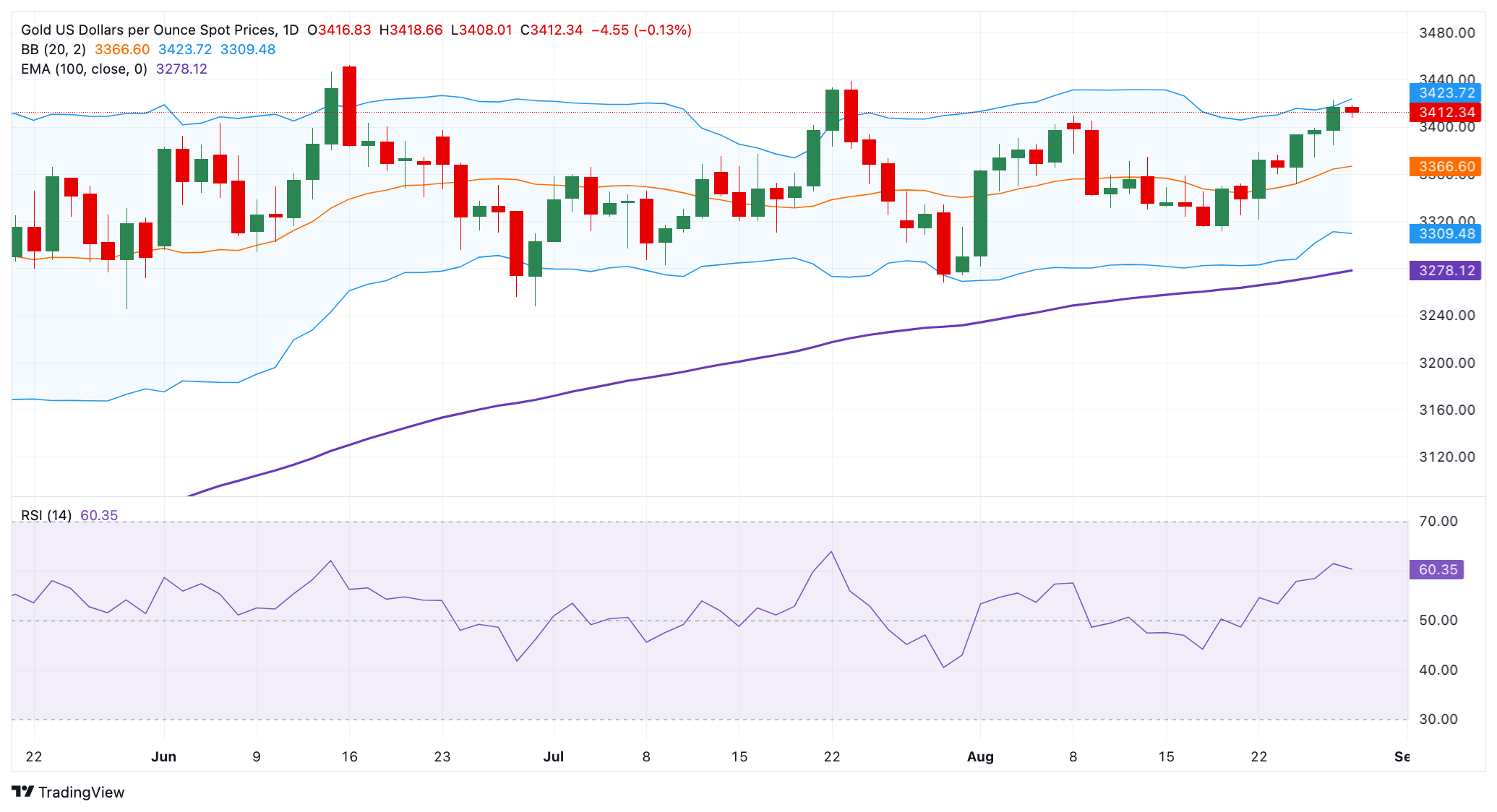
The Gold price trades in negative territory on the day. The bullish tone of the precious metal remains intact in the longer term, with the price holding above the key 100-day Exponential Moving Average (EMA) on the daily chart. The upward momentum is supported by the 14-day Relative Strength Index (RSI), which stands above the midline near 60.50. This displays the bullish momentum in the near term.
The upper boundary of the Bollinger Band of $3,425 acts as an immediate resistance level for XAU/USD. Sustained trading above this level could take the yellow metal to $3,439, the high of July 23. The next upside target to watch is $3,500, the psychological level and the high of April 22.
On the downside, the initial support level for Gold is seen at $3,373, the low of August 27. Red candlesticks closing below the mentioned level could expose $3,351, the low of August 26. The additional downside filter is located at $3,310, the lower limit of the Bollinger Band.
Gold FAQs
Gold has played a key role in human’s history as it has been widely used as a store of value and medium of exchange. Currently, apart from its shine and usage for jewelry, the precious metal is widely seen as a safe-haven asset, meaning that it is considered a good investment during turbulent times. Gold is also widely seen as a hedge against inflation and against depreciating currencies as it doesn’t rely on any specific issuer or government.
Central banks are the biggest Gold holders. In their aim to support their currencies in turbulent times, central banks tend to diversify their reserves and buy Gold to improve the perceived strength of the economy and the currency. High Gold reserves can be a source of trust for a country’s solvency. Central banks added 1,136 tonnes of Gold worth around $70 billion to their reserves in 2022, according to data from the World Gold Council. This is the highest yearly purchase since records began. Central banks from emerging economies such as China, India and Turkey are quickly increasing their Gold reserves.
Gold has an inverse correlation with the US Dollar and US Treasuries, which are both major reserve and safe-haven assets. When the Dollar depreciates, Gold tends to rise, enabling investors and central banks to diversify their assets in turbulent times. Gold is also inversely correlated with risk assets. A rally in the stock market tends to weaken Gold price, while sell-offs in riskier markets tend to favor the precious metal.
The price can move due to a wide range of factors. Geopolitical instability or fears of a deep recession can quickly make Gold price escalate due to its safe-haven status. As a yield-less asset, Gold tends to rise with lower interest rates, while higher cost of money usually weighs down on the yellow metal. Still, most moves depend on how the US Dollar (USD) behaves as the asset is priced in dollars (XAU/USD). A strong Dollar tends to keep the price of Gold controlled, whereas a weaker Dollar is likely to push Gold prices up.
Author

Lallalit Srijandorn
FXStreet
Lallalit Srijandorn is a Parisian at heart. She has lived in France since 2019 and now becomes a digital entrepreneur based in Paris and Bangkok.