Gold stalls near $3,300 as robust US job market weighs on gains
- Gold stays firm as US jobless claims beat forecasts, reducing odds of a July rate cut.
- High Treasury yields and firm Greenback keep Gold in a tight range.
- Trump slams Brazil with 50% tariffs, raising trade war uncertainty.

Gold price (XAU/USD) remained firm during Thursday’s North American session as the US Dollar remained solid following the release of robust jobs data, along with uncertainty about the latest tariffs imposed by Washington. At the time of writing, XAU/USD trades above the $3,300 figure, virtually unchanged.
Data revealed by the US Department of Labor showed that the number of Americans filing for unemployment benefits was below estimates and the previous print, indicating a solid economy. Consequently, market players' optimism remains high, capping the advance of the yellow metal, which is also pressured by high US Treasury yields.
Expectations that the Federal Reserve (Fed) would cut interest rates in July have diminished despite the latest Fed Minutes showing a couple of officials aiming for a reduction in borrowing costs at that time. However, most of the Fed members seem worried aboutinflationary pressure and fear a jump in prices spurred by tariffs.
Meanwhile, Daniel Pavilonis, Senior Market at RJO Futures, commented that he does not see Gold above $3,400, "Unless there’s a major geopolitical escalation.” He expects prices to remain range-trading.
Regarding trade news, US President Donald Trump delivered his most significant blow on Wednesday, adding Brazil to the list, imposing a high 50% rate as he said, “Brazil, as an example, has not been good to us, not good at all.”
Ahead in the week, traders will eye further Fed speakers on Thursday, amid a scarce economic docket.
Daily digest market movers: Gold price glued to $3,300 as strong US jobs data exerts pressure
- Gold price steadied after the latest Initial Jobless Claims report for the week ending July 5 revealed that 227,000 people filed for claims, below forecasts of 235,000 and the previous reading of 232,000. Even though the data suggests some strength in the labor market, Continuing Claims rose to its highest level in three and a half years, up at 1.97 million in the previous week.
- Lately, Fed Chair Jerome Powell pointed out that in the current low-hiring and low-firing environment, any increase in layoffs could rapidly push up the Unemployment Rate.
- St. Louis Fed President Alberto Musalem said that the economy is in a good place and that the labor market is at or near full employment. He added that risks on inflation are tilted to the upside due to tariffs, that their effect has not been seen, and a weakened US Dollar could add to inflation.
- The latest FOMC Minutes revealed that some Fed officials do not anticipate a rate cut in 2025, although the majority see one rate cut as appropriate. Board members cited inflation pressure remaining high, along with inflation expectations edging up and ongoing economic resilience. All participants viewed the current policy rate as appropriate. Participants agreed that stagflationary risks had diminished, though they remain elevated.
- On Wednesday, the US President Donald Trump emphasized that he would apply 10% additional tariffs to countries aligning themselves with anti-American policies of the BRICS.
- Another reason for halting Bullion’s drop is that Gold ETFs presented their most significant inflow, according to the World Gold Council. “Gold ETFs recorded an inflow of $38 billion in the first half of 2025, with their collective holdings rising by 397.1 metric tons of Gold,” with inflows seeing the most significant jump since August 2022.
- Data from the Chicago Board of Trade revealed that market players are eyeing 50 basis points (bps) of easing in 2025.
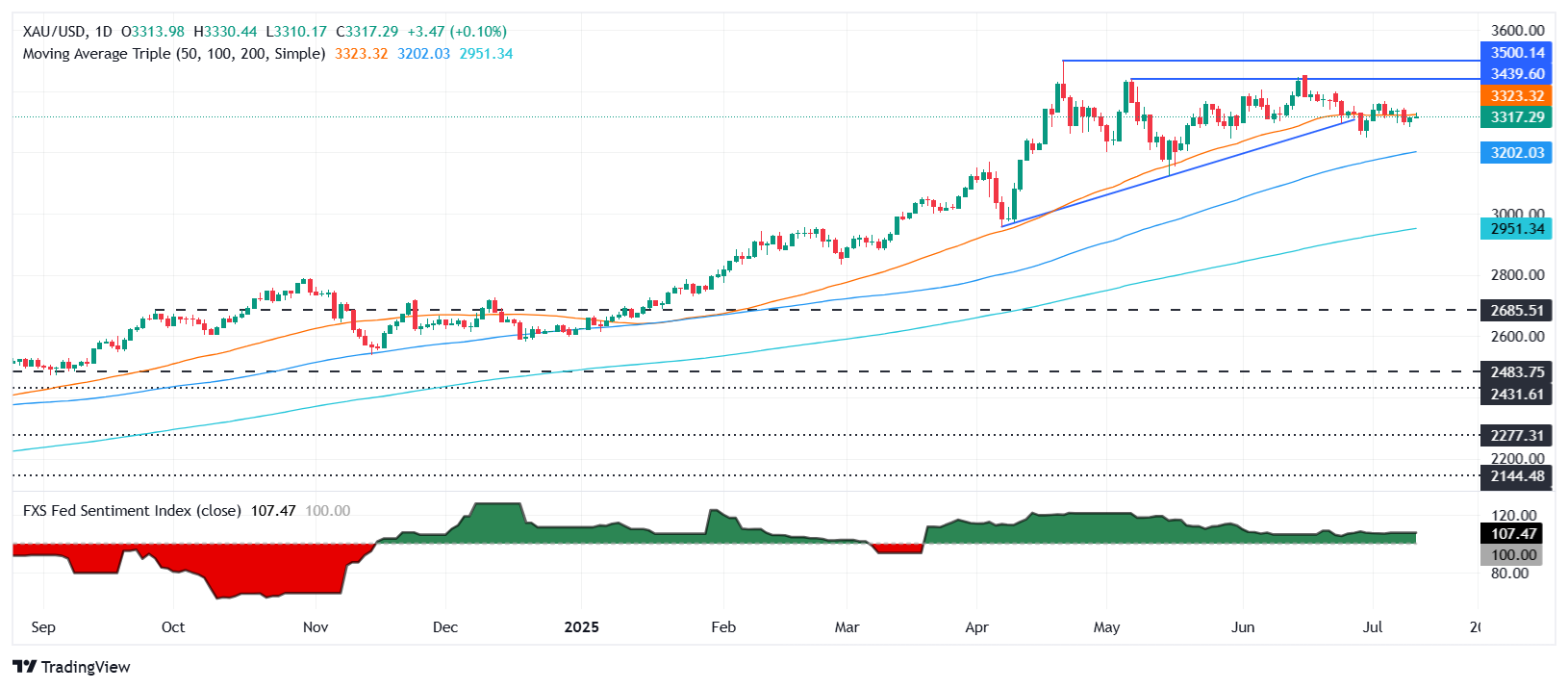
XAU/USD technical outlook: Gold price remains steady near $3,300
Gold price uptrend remains in place, although buyers are struggling to drive prices higher, as they are capped by the 20-day and 50-day Simple Moving Averages (SMAs) near $3,345 and $3,319, respectively. The Relative Strength Index (RSI) is flat, hovering on its neutral level, indicating that further consolidation lies ahead.
Therefore, the first resistance level for the XAU/USD would be $3,319. A breach of the latter will expose the 20-day SMA at $3,345, then $3,350 and $3,400.
Conversely, if XAU/USD tumbles below $3,300, the first support would be the June 30 low of $3,246. Then the 100-day Simple Moving Average (SMA) sits at $3,185, followed by the May 15 low of $3,120.
Tariffs FAQs
Tariffs are customs duties levied on certain merchandise imports or a category of products. Tariffs are designed to help local producers and manufacturers be more competitive in the market by providing a price advantage over similar goods that can be imported. Tariffs are widely used as tools of protectionism, along with trade barriers and import quotas.
Although tariffs and taxes both generate government revenue to fund public goods and services, they have several distinctions. Tariffs are prepaid at the port of entry, while taxes are paid at the time of purchase. Taxes are imposed on individual taxpayers and businesses, while tariffs are paid by importers.
There are two schools of thought among economists regarding the usage of tariffs. While some argue that tariffs are necessary to protect domestic industries and address trade imbalances, others see them as a harmful tool that could potentially drive prices higher over the long term and lead to a damaging trade war by encouraging tit-for-tat tariffs.
During the run-up to the presidential election in November 2024, Donald Trump made it clear that he intends to use tariffs to support the US economy and American producers. In 2024, Mexico, China and Canada accounted for 42% of total US imports. In this period, Mexico stood out as the top exporter with $466.6 billion, according to the US Census Bureau. Hence, Trump wants to focus on these three nations when imposing tariffs. He also plans to use the revenue generated through tariffs to lower personal income taxes.
Author

Christian Borjon Valencia
FXStreet
Markets analyst, news editor, and trading instructor with over 14 years of experience across FX, commodities, US equity indices, and global macro markets.

















