Gold rallies above $5,070 as China treasury shift batters US Dollar
- Gold surges as China urges institutions to reduce US Treasury exposure, weakening the US Dollar.
- Bullion supported by steady PBoC buying, extending China’s reserve diversification trend.
- Focus shifts to NFP and CPI to assess a more or less dovish Fed outlook.
Gold price (XAU/USD) remains bid during the North American session on Monday following reports that Chinese authorities recommended institutions to reduce exposure to US Treasuries or pare down their positions due to increased volatility. At the time of writing, XAU/USD trades at $5.074, up 2.16%.
XAU/USD surges as reports of reduced Chinese Treasury exposure
Markets’ mood is mixed, with the Greenback extending its losses, pushing Bullion prices higher, due to be denominated in US Dollars. Also, US Treasury bond yields, which are inversely correlated to yields, remain unchanged after pairing previous gains.
Physical buying of the non-yielding metal is another factor pushing Gold higher, as the People’s Bank of China (PBoC) added Bullion to its reserves for the 15th month in January. The debasement trade continues with more central banks diversifying from Dollar reserves to other assets.
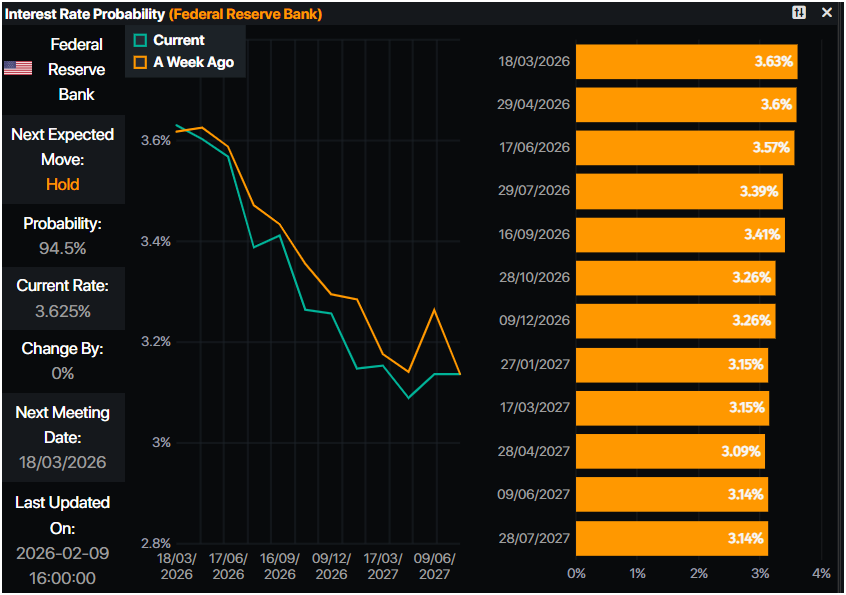
Further bullish reasons, like expectations for further rate cuts by the Federal Reserve (Fed), are likely to weigh on the Dollar. This week’s January Nonfarm Payrolls report and the revisions for the employment data would be crucial in setting the path for interest rates
An upbeat jobs report could trigger a leg down in Gold prices if the markets priced in a less-dovish Fed. On the other hand, XAU/USD could accelerate its uptrend, yet traders would need to deal with Friday’s US Consumer Price Index (CPI) data.
Daily market movers: US Dollar weakness boosts Gold’s haven appeal
- The US Dollar Index, which measures the buck’s performance against a basket of six peers, is down 0.76% at 96.94. Conversely, steady US Treasury yields are capping Gold’s advance. The US 10-year T-note yield is flat at 4.208%.
- The New York Fed Survey of Consumer Expectations revealed that inflation expectations for one year dipped from 3.4% to 3.1% in January. For three- and five-year periods, it was unchanged at 3%.
- The Survey revealed that expectations for credit declined relative to December, while views of the labor market improved.
- Eyes turn to Fed officials crossing the wires. Fed Governors Christopher Waller and Stephen Miran, most likely remain dovish. Atlanta’s Fed President Raphael Bostic, who would be retiring this year, would stick to his hawkish stance as he said that inflation remains too high, closer to the 3% threshold.
- Money markets had priced in nearly 57 basis points of easing towards the year’s end, according to Prime Market Terminal data.
Technical outlook: Gold continues to consolidate, yet bulls are looming
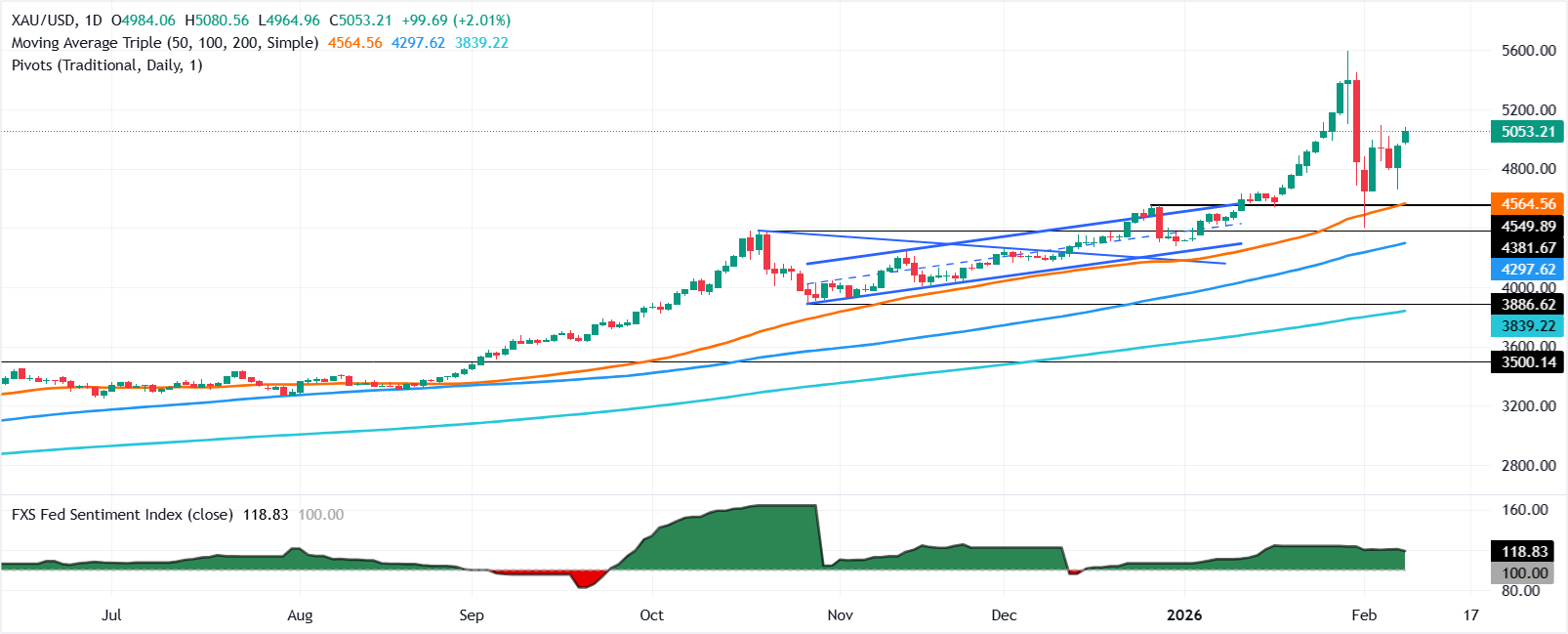
Gold price is neutral to upward biased, with bulls remaining unable to clear the February 4 high near $5,100. However, it should be said that in the last six days, Bullion printed a higher low, an indication that prices seem to be at equilibrium and Gold to consolidate within the $4,800-$5,100 range.
If the top of the range is cleared, the next resistance would be $5,200, followed by the January 30 high at $5,451 and the record high near $5,600. On the flip side, a drop below $4,800 exposes the February 2 low of $4,402 ahead of the October 17 cycle high at $4,381.
Gold FAQs
Gold has played a key role in human’s history as it has been widely used as a store of value and medium of exchange. Currently, apart from its shine and usage for jewelry, the precious metal is widely seen as a safe-haven asset, meaning that it is considered a good investment during turbulent times. Gold is also widely seen as a hedge against inflation and against depreciating currencies as it doesn’t rely on any specific issuer or government.
Central banks are the biggest Gold holders. In their aim to support their currencies in turbulent times, central banks tend to diversify their reserves and buy Gold to improve the perceived strength of the economy and the currency. High Gold reserves can be a source of trust for a country’s solvency. Central banks added 1,136 tonnes of Gold worth around $70 billion to their reserves in 2022, according to data from the World Gold Council. This is the highest yearly purchase since records began. Central banks from emerging economies such as China, India and Turkey are quickly increasing their Gold reserves.
Gold has an inverse correlation with the US Dollar and US Treasuries, which are both major reserve and safe-haven assets. When the Dollar depreciates, Gold tends to rise, enabling investors and central banks to diversify their assets in turbulent times. Gold is also inversely correlated with risk assets. A rally in the stock market tends to weaken Gold price, while sell-offs in riskier markets tend to favor the precious metal.
The price can move due to a wide range of factors. Geopolitical instability or fears of a deep recession can quickly make Gold price escalate due to its safe-haven status. As a yield-less asset, Gold tends to rise with lower interest rates, while higher cost of money usually weighs down on the yellow metal. Still, most moves depend on how the US Dollar (USD) behaves as the asset is priced in dollars (XAU/USD). A strong Dollar tends to keep the price of Gold controlled, whereas a weaker Dollar is likely to push Gold prices up.
Author

Christian Borjon Valencia
FXStreet
Markets analyst, news editor, and trading instructor with over 14 years of experience across FX, commodities, US equity indices, and global macro markets.














