Gold price tumbles below $3,200 on trade optimism and rising US yields
- Gold fails to benefit from softer USD as markets eye upcoming US PPI and Retail Sales for inflation clues.
- Risk appetite improves on US trade diplomacy; safe-haven flows unwind, pushing Gold to its lowest level since April 11.
- Rising US Treasury yields and the Fed’s cautious stance reduce bets on aggressive rate cuts.

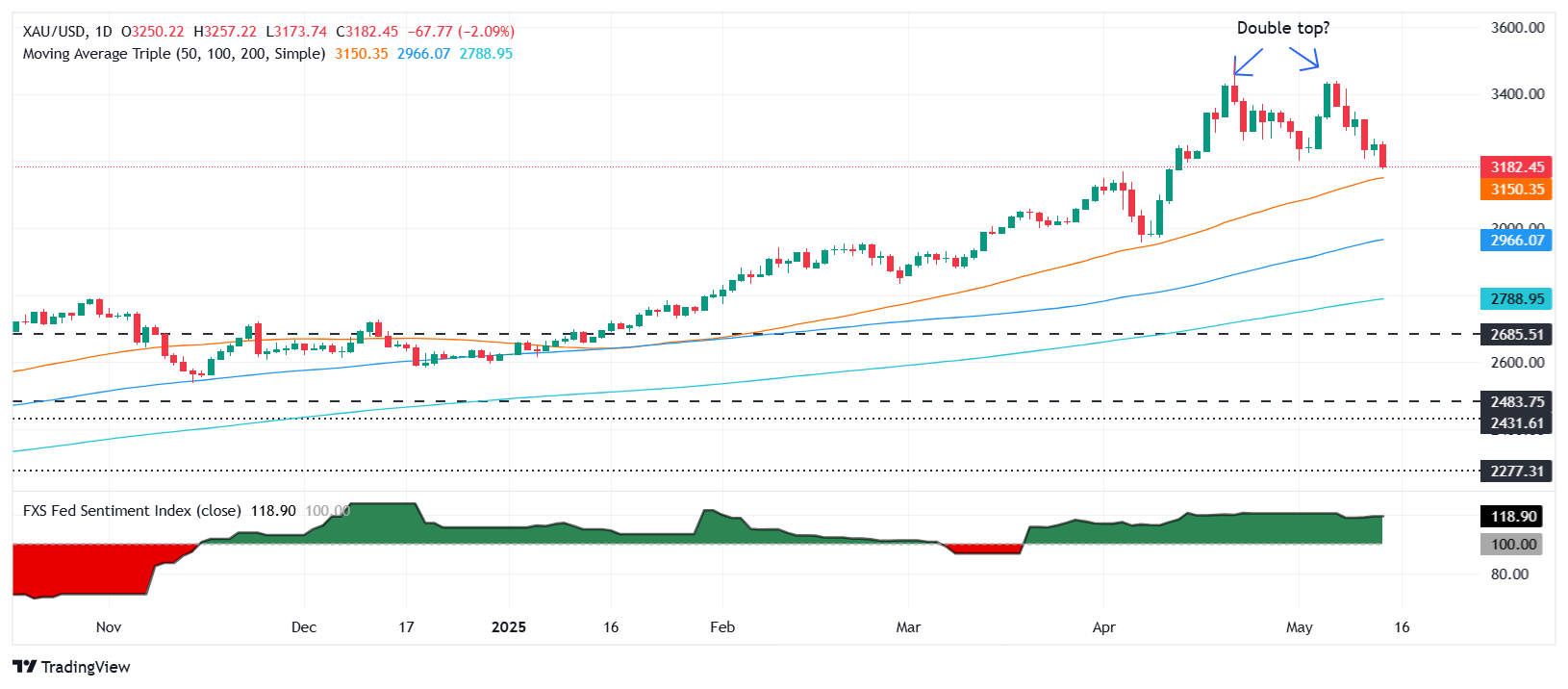
Gold price plummeted for the second day out of three on Wednesday, driven mainly by an improvement in risk appetite following positive trade news linked to the United States (US). This, along with a bearish technical chart pattern, pushed the yellow metal below the $3,200 figure for the first time since April 11.
At the time of writing, XAU/USD trades at $3,182, down by more than 2%, as the trade war truce between Washington and Beijing has lifted traders' spirits amid some uncertainty about the global economic outlook.
US President Donald Trump’s tour in the Middle East has kept the market mood positive as he strikes deals with various countries. News that deals with Japan and South Korea seem to be close has weighed on the safe appeal of Bullion, as investors shift capital toward riskier assets.
This weighed on the non-yielding metal, which has failed to capitalize on US Dollar weakness, as rumors circulated that the Trump administration favors a weaker Greenback. Reports suggested that the White House could pressure other countries to let their currencies appreciate.
US Treasury bond yields rose sharply on Wednesday, despite the latest inflation report showing that price measures in April were unchanged on an annual basis compared to March figures.
Usually, lower inflation environments push central banks to ease monetary policy. Nevertheless, the Federal Reserve’s (Fed) wait-and-see stance was further reaffirmed by officials appearing in the news since last Friday. This prompted investors to reduce their bets that the Fed would lower rates two times instead of three.
Ahead this week, traders are eyeing the release of the Producer Price Index (PPI) and US Retail Sales data.
Daily digest market movers: Gold price retreats weighed by high US Treasury yields
- US Treasury bond yields are climbing, with the US 10-year Treasury note yield edging up 5.5 basis points to 4.526%. Meanwhile, US real yields are also surging at 2.234%, up five bps as indicated by the US 10-year Treasury Inflation-Protected Securities yields.
- The US CPI in April expanded by 2.3% YoY, a tenth below estimates and the previous month's reading, and core metrics remained unchanged at 2.8% YoY.
- The US-China tariff agreement improved risk appetite and sent Bullion prices plunging. Nevertheless, traders should be aware of recent developments regarding US trade policies and geopolitics, as new catalysts could emerge and push Gold prices in either direction.
- The US Producer Price Index (PPI) in April is expected to rise from -0.4% to 0.2% MoM. Core PPI, which excludes volatile items, is projected to increase by 0.3%, up from -0.1%.
- US Retail Sales for April are also eyed, with economists projecting a 0% increase, down from a 1.5% MoM expansion in March.
XAU/USD technical outlook: Gold price to retreat towards $3,000 as double top pattern emerges
Gold price uptrend has paused due to a ‘double top’ chart pattern forming. Although XAU/USD fell below $3,202, sellers need to protect this level at all costs. If they do, the yellow metal could slip towards the next key support levels at the 50-day Simple Moving Average (SMA) of $3,150, followed by the $3,100 figure. On further weakness, the next target would be $3,000, followed by the “double top” target at $2,950.
Conversely, if XAU/USD edges back above $3,200, buyers will face the next resistance at $3,250. If surpassed, the next ceiling level would be $3,300 and beyond.
Gold FAQs
Gold has played a key role in human’s history as it has been widely used as a store of value and medium of exchange. Currently, apart from its shine and usage for jewelry, the precious metal is widely seen as a safe-haven asset, meaning that it is considered a good investment during turbulent times. Gold is also widely seen as a hedge against inflation and against depreciating currencies as it doesn’t rely on any specific issuer or government.
Central banks are the biggest Gold holders. In their aim to support their currencies in turbulent times, central banks tend to diversify their reserves and buy Gold to improve the perceived strength of the economy and the currency. High Gold reserves can be a source of trust for a country’s solvency. Central banks added 1,136 tonnes of Gold worth around $70 billion to their reserves in 2022, according to data from the World Gold Council. This is the highest yearly purchase since records began. Central banks from emerging economies such as China, India and Turkey are quickly increasing their Gold reserves.
Gold has an inverse correlation with the US Dollar and US Treasuries, which are both major reserve and safe-haven assets. When the Dollar depreciates, Gold tends to rise, enabling investors and central banks to diversify their assets in turbulent times. Gold is also inversely correlated with risk assets. A rally in the stock market tends to weaken Gold price, while sell-offs in riskier markets tend to favor the precious metal.
The price can move due to a wide range of factors. Geopolitical instability or fears of a deep recession can quickly make Gold price escalate due to its safe-haven status. As a yield-less asset, Gold tends to rise with lower interest rates, while higher cost of money usually weighs down on the yellow metal. Still, most moves depend on how the US Dollar (USD) behaves as the asset is priced in dollars (XAU/USD). A strong Dollar tends to keep the price of Gold controlled, whereas a weaker Dollar is likely to push Gold prices up.
Author

Christian Borjon Valencia
FXStreet
Markets analyst, news editor, and trading instructor with over 14 years of experience across FX, commodities, US equity indices, and global macro markets.

















