Gold price clings to modest recovery gains ahead of US CPI, not out of the woods yet
- Gold price staged a modest recovery from a nearly two-month low touched on Tuesday.
- Elevated US bond yields and bullish USD cap gains for the non-yielding XAU/USD.
- Traders now look forward to the key US Consumer Price Index for a fresh impetus.

Gold price (XAU/USD) gains some positive traction on Wednesday and for now, seems to have snapped a three-day losing streak to its lowest level since September 20, around the $2,590-$2,589 region touched the previous day. A generally weaker tone around the equity markets is seen as a key factor offering some support to the safe-haven precious metal through the first half of the European session. Any meaningful appreciating move, however, seems elusive in the wake of a bullish US Dollar (USD).
Hopes that US President-elect Donald Trump's proposed expansionary policies will boost inflation and limit the scope for the Federal Reserve (Fed) to cut interest rates aggressively remain supportive of elevated US Treasury bond yields. This, in turn, assists the USD to stand tall near its highest level since early May and keeps a lid on the non-yielding yellow metal. Traders also seem reluctant to place aggressive bets and opt to move to the sidelines ahead of the release of the US consumer inflation figures.
Gold price lacks bullish conviction amid a bullish USD as investors keenly await US CPI report
- The US Dollar climbed to its highest level since early May on Tuesday amid optimism over US President-elect Donald Trump’s proposed expansionary policies and dragged the Gold price below the $2,600 mark for the first time since September.
- Furthermore, the likelihood of Trump's protectionist tariffs being implemented should put upward pressure on inflation and limit the scope for the Federal Reserve to cut interest rates, which remain supportive of elevated US bond yields.
- Richmond Fed President Tom Barkin said Tuesday that inflation might be coming under control, though the path remains uncertain and that the core gauge might give a signal that it risks getting stuck above the central bank's 2% target.
- Separately, Minneapolis Fed President Neel Kashkari noted that any upside surprise in inflation in the weeks leading up to the December FOMC monetary policy meeting could encourage the central bank to pause interest rate cuts.
- The yield on the benchmark 10-year US government bond remains close to a multi-month peak touched after Trump's victory in the US presidential election amid reduced bets for aggressive interest rate cuts by the Fed going forward.
- The USD bulls take a brief pause for a breather and look to the release of the latest US consumer inflation figures, which will play a key role in influencing market expectations about the Fed's rate-cut path and provide a fresh impetus.
- The headline Consumer Price Index (CPI) is expected to have risen by 0.2% in October and by 2.6% over the past 12 months, up from 2.4% in the prior month, fueling doubts over how much headroom the Fed has to keep cutting rates.
Gold price could accelerate the corrective decline once the $2,600 mark is broken decisively
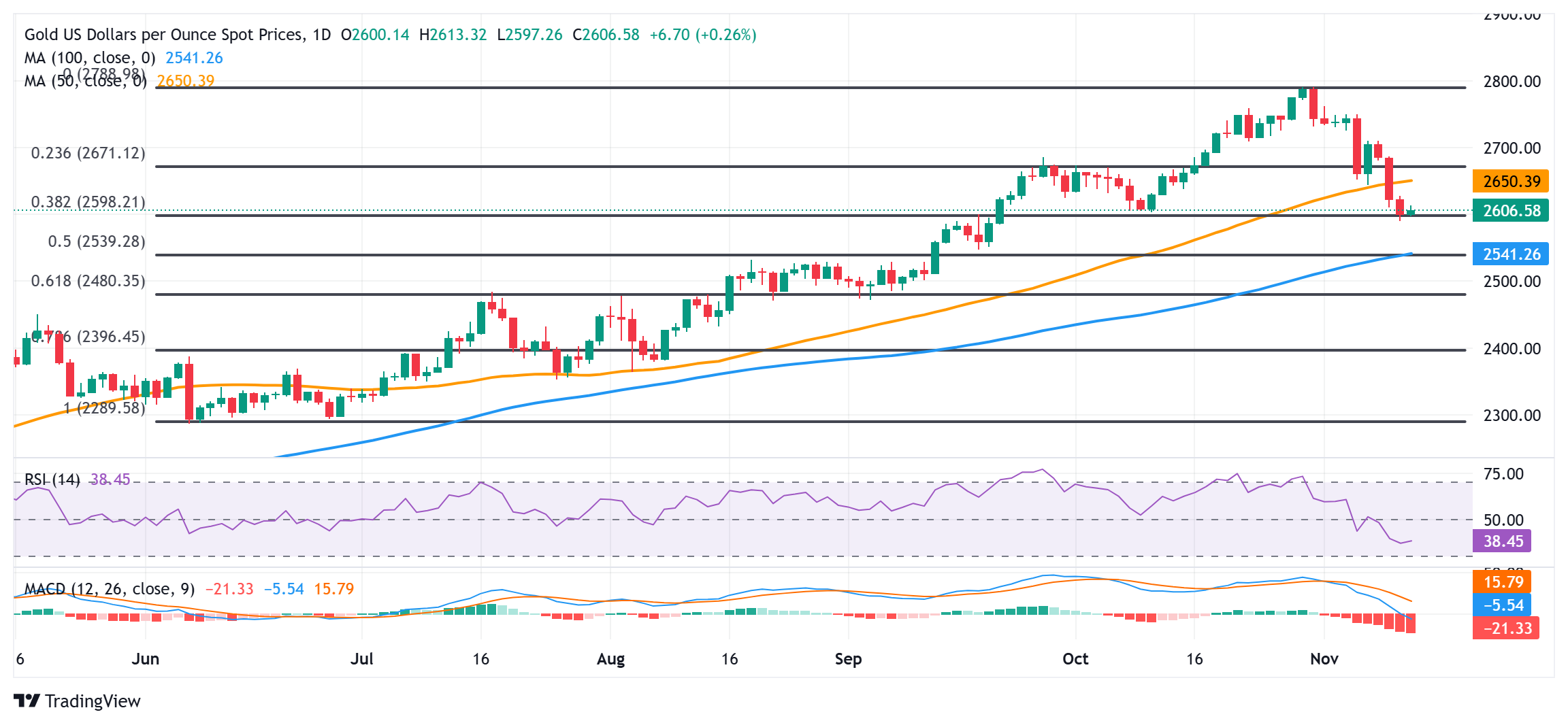
From a technical perspective, the overnight resilience below the 38.2% Fibonacci retracement level of the June-October rally and the subsequent move-up warrants caution for bearish traders. That said, oscillators on the daily chart are holding deep in negative territory and are still away from being in the oversold zone. This, in turn, suggests that the path of least resistance for the Gold price is to the downside.
Hence, any subsequent move up could be seen as a selling opportunity and remain capped near the $2,630-2,632 resistance. That said, some follow-through buying could lift the Gold price to the next relevant hurdle near the $2,650-2,655 region, en route to the $2,670 level. This is followed by the $2,700 mark, which if cleared decisively will suggest that the recent corrective fall from the all-time peak has run its course.
On the flip side, bearish traders need to wait for acceptance below the $2,600 mark and the 38.2% Fibo. level before placing fresh bets. The subsequent fall might then drag the Gold price to the $2,540 confluence – comprising the 100-day Simple Moving Average (SMA) and the 50% Fibo. level. This could act as a strong near-term base for the XAU/USD, which if broken will be seen as a fresh trigger for bearish traders.
Economic Indicator
Consumer Price Index (YoY)
Inflationary or deflationary tendencies are measured by periodically summing the prices of a basket of representative goods and services and presenting the data as The Consumer Price Index (CPI). CPI data is compiled on a monthly basis and released by the US Department of Labor Statistics. The YoY reading compares the prices of goods in the reference month to the same month a year earlier.The CPI is a key indicator to measure inflation and changes in purchasing trends. Generally speaking, a high reading is seen as bullish for the US Dollar (USD), while a low reading is seen as bearish.
Read more.Next release: Wed Nov 13, 2024 13:30
Frequency: Monthly
Consensus: 2.6%
Previous: 2.4%
Source: US Bureau of Labor Statistics
The US Federal Reserve has a dual mandate of maintaining price stability and maximum employment. According to such mandate, inflation should be at around 2% YoY and has become the weakest pillar of the central bank’s directive ever since the world suffered a pandemic, which extends to these days. Price pressures keep rising amid supply-chain issues and bottlenecks, with the Consumer Price Index (CPI) hanging at multi-decade highs. The Fed has already taken measures to tame inflation and is expected to maintain an aggressive stance in the foreseeable future.
Author

Haresh Menghani
FXStreet
Haresh Menghani is a detail-oriented professional with 10+ years of extensive experience in analysing the global financial markets.

















