Gold price slips beneath $2,910 as US yields rebound
- US Nonfarm Payrolls show steady job growth, but Fed remains in no rush to cut rates.
- Powell reiterates that inflation path will be "bumpy," keeping policy steady for now.
- PBoC adds 10 tonnes of Gold in early 2025, while Poland’s NBP purchases 29 tonnes.

Gold prices fell on Friday as the Greenback trims some of its losses and US Treasury bond yields recover following the release of a US jobs market report. At the time of writing, the XAU/USD trades at $2,907, down 0.11%.
The US Bureau of Labor Statistics (BLS) released the February Nonfarm Payrolls (NFP) report, which showed that the economy added more people to the workforce than in January despite missing the mark. The same data showed that the Unemployment Rate remained within familiar levels with Federal Reserve (Fed) Governor Adriana Kugler saying that hiring remains above the breakeven level.
Kugler added that uncertainty is difficult for all parts of the economy. Earlier, she stated that monetary policy would remain steady for some time and added that wages are not a source of inflationary pressure.
Recently, Fed Chair Jerome Powell reiterated that the central bank is not in a hurry to lower rates. Powell added that getting inflation to 2% would be bumpy and that the central bank doesn’t need to overreact to one or two readings. Powell said the Fed is well-positioned regarding monetary policy.
When asked about tariffs, Powell said it remains to be seen if they would be inflation-prone.
Easing geopolitical tensions capped Bullion’s advance as there’s some progress in a possible ceasefire agreement between Ukraine and Russia. In the Middle East, US President Trump continued to exert pressure on Hamas to release hostages.
Central banks buy Gold
In the meantime, the People’s Bank of China (PBoC) continues to purchase Gold, according to the World Gold Council (WGC). The PBoC increased its holdings by 10 tonnes in the first two months of 2025. However, the largest buyer was the National Bank of Poland (NBP), which increased its reserve by 29 tonnes, its largest purchase since June 2019, when it bought 95 tonnes.
Daily digest market movers: Gold advance halts as US real yields climb
- The US 10-year Treasury bond yield rises three basis points to 4.318%.
- US real yields, as measured by the US 10-year Treasury Inflation-Protected Securities (TIPS) yield that correlates inversely to Gold prices, edge up three-and-a-half basis points to 1.981%, a headwind for XAU/USD prices.
- US NFP for February came in at 151K, an improvement from January’s 125K but falling short of the 160K forecast.
- The Unemployment Rate edged up to 4.1%, slightly above the expected 4.0%, indicating some softening in the labor market.
- The Atlanta Fed GDPNow Model projects the GDP for Q1 2025 at -2.4%, up from the -2.8% contraction estimated on Wednesday.
- Money market traders had priced in 69 basis points of easing in 2025, down from 80 bps on Thursday, via data from the Prime Market Terminal.
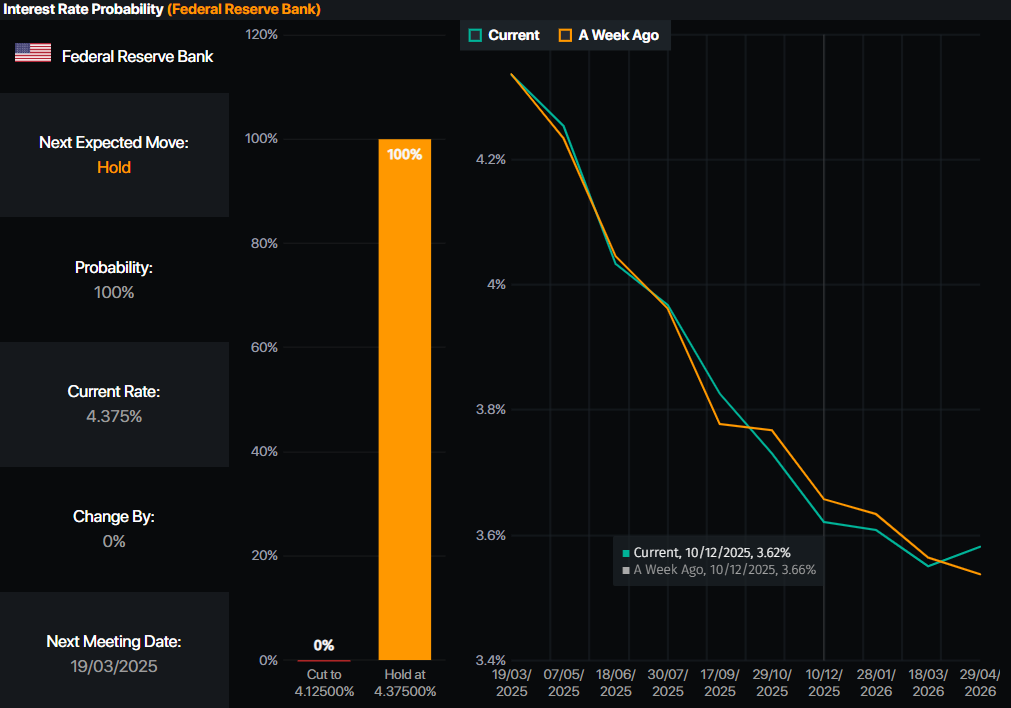
- Source: Prime Market Terminal
XAU/USD technical outlook: Gold price drops, sellers eye $2,900
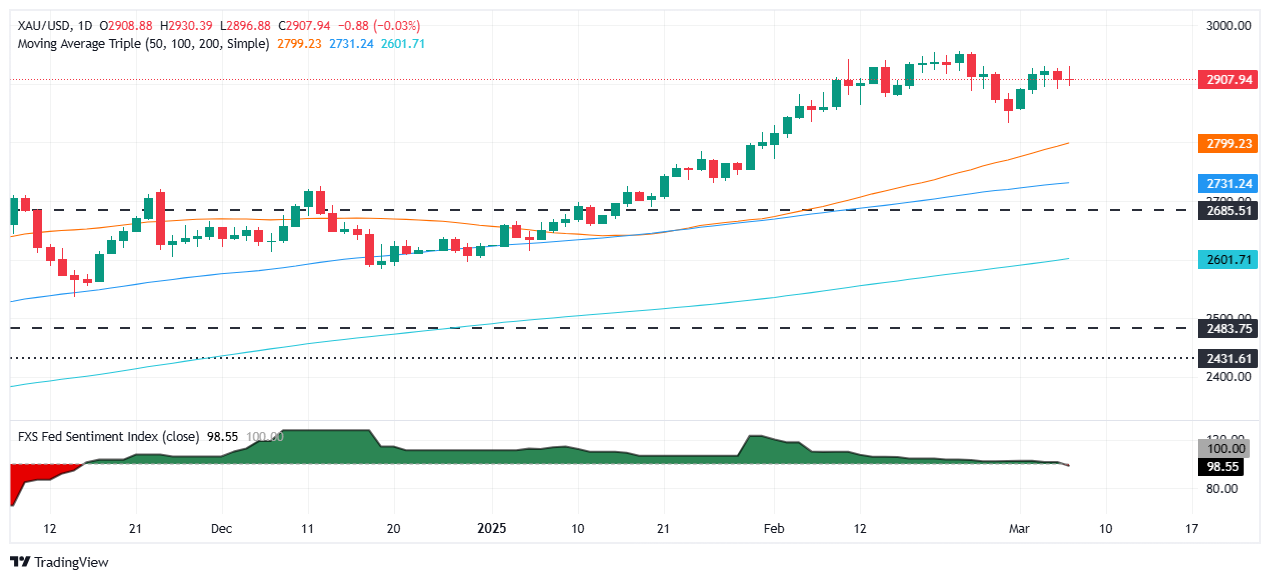
Gold prices remain trading sideways, unable to clear $2,930 following a stellar advance of over 1.72% in the month. The Relative Strength Index (RSI) hints that further upside is seen as the RSI remains bullish.
Therefore, XAU/USD's next resistance would be $2,950, followed by the record high at $2,954. A breach of the latter would expose the $3,000 mark. Conversely, a drop below $2,900 would expose the February 28 low of $2,832, followed by the $2,800 figure.
Gold FAQs
Gold has played a key role in human’s history as it has been widely used as a store of value and medium of exchange. Currently, apart from its shine and usage for jewelry, the precious metal is widely seen as a safe-haven asset, meaning that it is considered a good investment during turbulent times. Gold is also widely seen as a hedge against inflation and against depreciating currencies as it doesn’t rely on any specific issuer or government.
Central banks are the biggest Gold holders. In their aim to support their currencies in turbulent times, central banks tend to diversify their reserves and buy Gold to improve the perceived strength of the economy and the currency. High Gold reserves can be a source of trust for a country’s solvency. Central banks added 1,136 tonnes of Gold worth around $70 billion to their reserves in 2022, according to data from the World Gold Council. This is the highest yearly purchase since records began. Central banks from emerging economies such as China, India and Turkey are quickly increasing their Gold reserves.
Gold has an inverse correlation with the US Dollar and US Treasuries, which are both major reserve and safe-haven assets. When the Dollar depreciates, Gold tends to rise, enabling investors and central banks to diversify their assets in turbulent times. Gold is also inversely correlated with risk assets. A rally in the stock market tends to weaken Gold price, while sell-offs in riskier markets tend to favor the precious metal.
The price can move due to a wide range of factors. Geopolitical instability or fears of a deep recession can quickly make Gold price escalate due to its safe-haven status. As a yield-less asset, Gold tends to rise with lower interest rates, while higher cost of money usually weighs down on the yellow metal. Still, most moves depend on how the US Dollar (USD) behaves as the asset is priced in dollars (XAU/USD). A strong Dollar tends to keep the price of Gold controlled, whereas a weaker Dollar is likely to push Gold prices up.
Author

Christian Borjon Valencia
FXStreet
Markets analyst, news editor, and trading instructor with over 14 years of experience across FX, commodities, US equity indices, and global macro markets.

















