Gold creeps up as Dollar softens ahead of NFP report
- Gold bounces from $3,246 as the US Dollar nears February 2022 lows amid uncertainty over Fed leadership.
- Citi sees Gold consolidating between $3,100 and$3,500 in Q3; Middle East calm caps safe-haven flows.
- Bullion rose but remained capped by calm geopolitical risks.
- Traders brace for ISM, ADP, Jobless Claims and NFP in holiday-shortened week.

Gold (XAU) price advances modestly on Monday, up 0.58%, as the US Dollar (USD) extended its losses ahead of a busy economic calendar in the United States (US). Speculations that US President Donald Trump could pick the new Federal Reserve (Fed) Chair by September or October hurt the Greenback, which trades near February 2022 lows.
The XAU/USD pair trades at $3,292 after bouncing off daily lows of $3,246, poised to end June with gains of over 0.18%. Easing geopolitical tensions in the Middle East, along with the likely announcement of trade deals, capped Bullion’s advancement. Meanwhile, Citi revealed that Gold might consolidate within $3,100 - $3,500 an ounce in Q3.
The US Treasury Secretary, Scott Bessent, said that he is confident the “One Big Beautiful Bill” will progress in the coming hours. The legislation, which narrowly passed the Senate over the weekend, proposes a sweeping overhaul of the tax code, including broad deductions funded by cuts to Medicaid and green energy programs.
This shortened week, ahead of the US Independence Day on July 4, will feature ISM Manufacturing PMI data, ADP employment figures, Initial Jobless Claims, and the Nonfarm Payrolls report for June.
Daily digest market movers: Gold price climbs as US yields and US Dollar tumble
- XAU/USD is boosted by the decline in US Treasury yields, with the 10-year US Treasury note yielding 4.242%, a three-basis-point decrease. US real yields, which are calculated by subtracting inflation expectations from the nominal yield, are also down three basis points to 1.952%.
- Regarding trade, the US and China are resolving previous issues related to the rare earth minerals deal, and Canada has scrapped its digital services tax for US tech firms, contributing to an upbeat market sentiment that is putting a lid on Gold prices.
- Expectations that the Federal Reserve will ease policy by over 60 basis points (bps) in 2025, most likely underpinning Gold prices, which thrive in periods of lower interest rates and geopolitical uncertainty.
- Citi expects Gold prices to return to $2,500 - $2,700 by the second half of 2026.
- The approval of Trump's “One Big Beautiful Bill” is likely to increase the fiscal deficit by a substantial $3.8 trillion, which could further weaken the Dollar and boost the appetite for the precious metal.
- The ISM Manufacturing PMI for June is expected to improve from 48.5 to 48.8. Regarding employment data, the ADP Employment Change is projected to improve from 37K private jobs added to the workforce to 85K.
- Analysts estimate that June’s Nonfarm Payrolls figures will likely show the labor market is indeed cooling down, projected at 110K down from May’s 139K.
- Money markets suggest that traders are pricing in 63.5 basis points of easing toward the end of the year, according to Prime Market Terminal data.
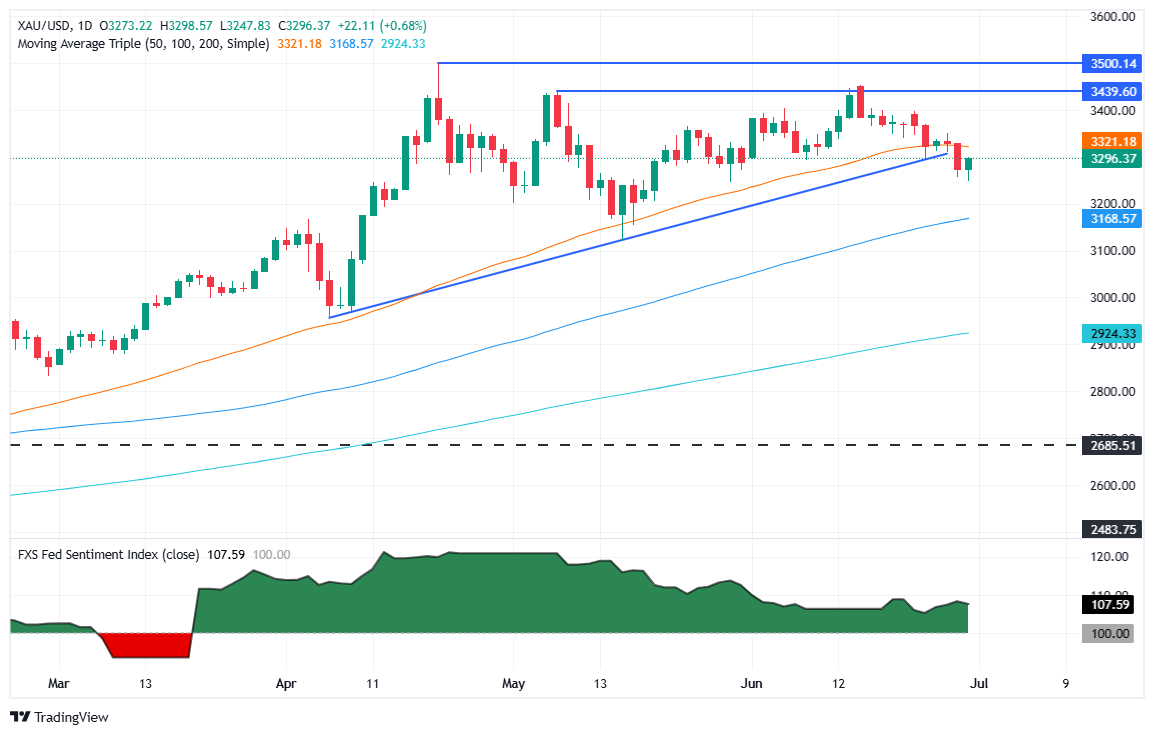
XAU/USD technical outlook: Gold price set for a pullback to $3,200
Gold price is upward biased, but in the near term has shifted to neutral to slightly bearish. Once XAU/USD fell below the 50-day Simple Moving Average (SMA) of $3,322, it opened the door for a pullback, without it remaining far from testing the $3,200 mark.
The Relative Strength Index (RSI) has also turned bearish, indicating that bullish momentum has stalled.
However, if XAU/USD climbs past $3,300, buyers could challenge the 50-day SMA, followed by $3,350 and the $3,400 mark.
Fed FAQs
Monetary policy in the US is shaped by the Federal Reserve (Fed). The Fed has two mandates: to achieve price stability and foster full employment. Its primary tool to achieve these goals is by adjusting interest rates. When prices are rising too quickly and inflation is above the Fed’s 2% target, it raises interest rates, increasing borrowing costs throughout the economy. This results in a stronger US Dollar (USD) as it makes the US a more attractive place for international investors to park their money. When inflation falls below 2% or the Unemployment Rate is too high, the Fed may lower interest rates to encourage borrowing, which weighs on the Greenback.
The Federal Reserve (Fed) holds eight policy meetings a year, where the Federal Open Market Committee (FOMC) assesses economic conditions and makes monetary policy decisions. The FOMC is attended by twelve Fed officials – the seven members of the Board of Governors, the president of the Federal Reserve Bank of New York, and four of the remaining eleven regional Reserve Bank presidents, who serve one-year terms on a rotating basis.
In extreme situations, the Federal Reserve may resort to a policy named Quantitative Easing (QE). QE is the process by which the Fed substantially increases the flow of credit in a stuck financial system. It is a non-standard policy measure used during crises or when inflation is extremely low. It was the Fed’s weapon of choice during the Great Financial Crisis in 2008. It involves the Fed printing more Dollars and using them to buy high grade bonds from financial institutions. QE usually weakens the US Dollar.
Quantitative tightening (QT) is the reverse process of QE, whereby the Federal Reserve stops buying bonds from financial institutions and does not reinvest the principal from the bonds it holds maturing, to purchase new bonds. It is usually positive for the value of the US Dollar.
Author

Christian Borjon Valencia
FXStreet
Markets analyst, news editor, and trading instructor with over 14 years of experience across FX, commodities, US equity indices, and global macro markets.