Gold price approaches weekly low amid notable USD demand
- Gold price attracts fresh sellers amid renewed USD buying and reduced Fed rate cut bets.
- A generally positive risk tone is seen as another factor undermining the precious metal.
- Persistent trade-related uncertainties could limit losses for the safe-haven commodity.

Gold price (XAU/USD) extends the overnight retracement slide from a multi-week top and continues to lose ground through the first half of the European session on Thursday. US President Donald Trump denied reports that he was unlikely to fire Federal Reserve (Fed) Chair Jerome Powell. Adding to this, bets that the Fed would keep interest rates elevated for an extended period push the US Dollar (USD) back closer to its highest level since June 23, touched on Wednesday, and weigh on the non-yielding yellow metal.
Apart from this, a generally positive tone around the equity markets is seen as another factor denting demand for the Gold price and contributing to the intraday slide. Meanwhile, investors remain on edge amid persistent uncertainties surrounding Trump's erratic trade policies and their impact on the global economy. This might hold back the XAU/USD bears from placing aggressive bets and help limit any further losses. Investors now look to US macro data and speeches from influential FOMC members for a fresh impetus.
Daily Digest Market Movers: Gold price bears retain intraday control as USD retests monthly peak
- Investors turned nervous on Wednesday, prompting heavy US Dollar selling and pushing the safe-haven Gold price to a fresh multi-week top amid reports that US President Donald Trump was seeking to remove Federal Reserve Chair Jerome Powell. The market volatility, however, subsided after Trump told reporters that he was unlikely to fire the central bank chief.
- On the economic data front, the US Producer Price Index (PPI) fell short of market expectations and remained flat in June. This marked a notable deceleration in the price of goods sold by manufacturers. Adding to this, comments from influential FOMC members suggest that the Fed would probably wait at least until September before resuming its rate-cutting cycle.
- Meanwhile, New York Fed President John Williams warned that the impact of trade tariffs is modest so far but will increase over time. Williams added that the economy is in a good place, the labor market is solid, and the current modestly restrictive monetary policy is in the right place to allow policymakers to monitor the economy before taking the next steps.
- Adding to this, Dallas Fed President Lorie Logan said that the US central bank will probably need to leave interest rates for a while longer to ensure inflation stays low. Logan further noted that tariff increases appear likely to create inflationary pressure, and June CPI data suggests that the PCE inflation, which the Fed targets to be at a 2% annual rate, will rise.
- Nevertheless, traders are still pricing in the possibility of 50 basis points worth of easing by the Fed this year. This, along with worries about the potential economic fallout from Trump's erratic trade policies, could underpin the safe-haven precious metal. In fact, Trump last week notified leaders of 25 countries about new tariff rates set to take effect on August 1.
- Thursday's US economic docket features the release of monthly Retail Sales figures, the usual Weekly Initial Jobless Claims, and the Philly Fed Manufacturing Index. Apart from this, comments from influential FOMC members will be scrutinized for cues about the Fed's rate-cut path, which will drive the USD and provide some impetus to the XAU/USD pair.
Gold price weakness below $3,322-3,320 could stall near short-term trading range support
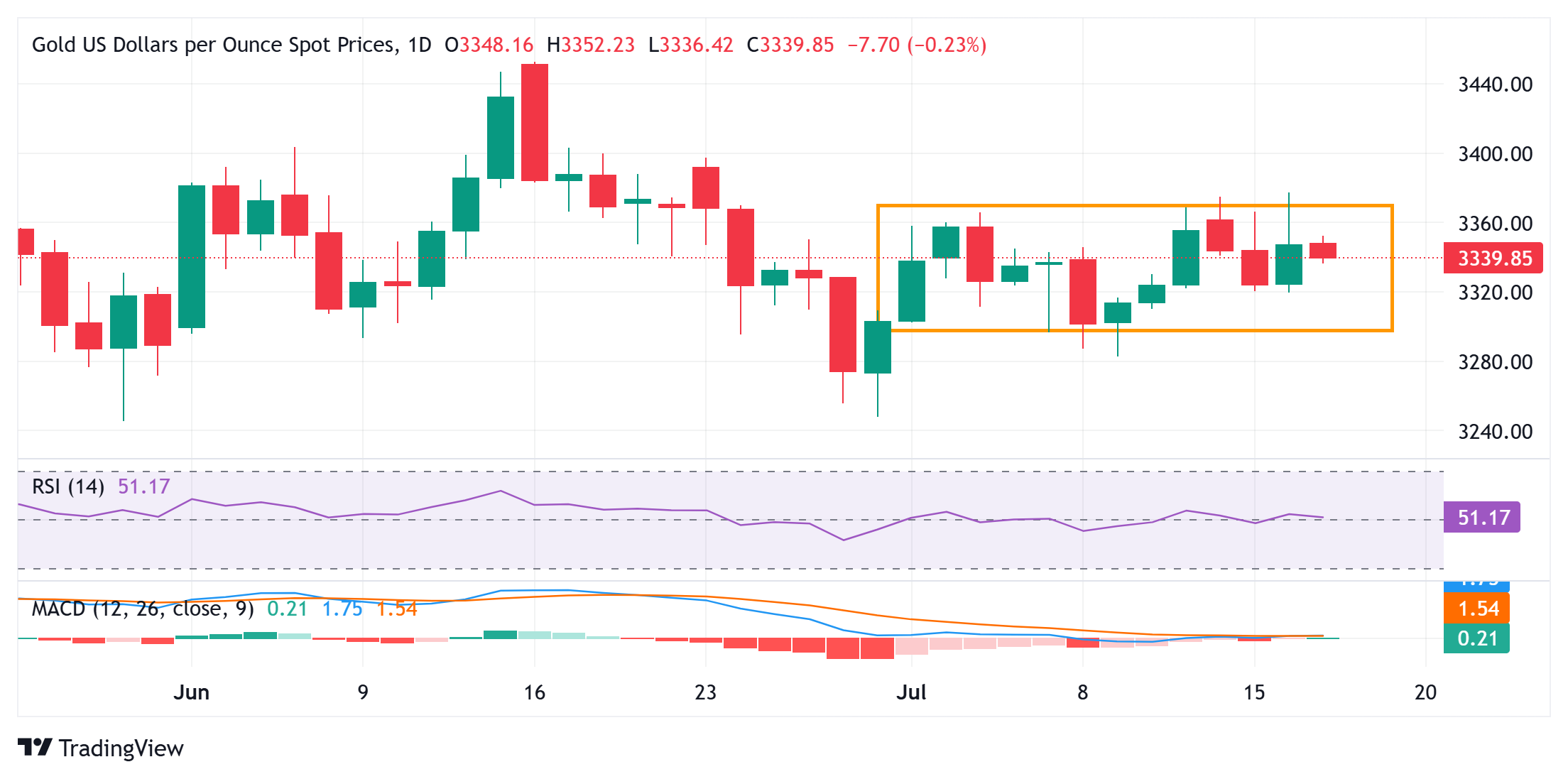
From a technical perspective, the recent range-bound price action since the beginning of this month points to indecision among traders. Furthermore, neutral oscillators on the daily chart warrant some caution before positioning for the next leg of a directional move. Hence, any further slide is more likely to find some support near the $3,322-$3,320 horizontal zone ahead of the $3,300 round figure. Some follow-through selling below the $3,283-3,282 region, or a one-week low touched last Tuesday, would lead to the Gold price accelerating the corrective fall towards the July swing low, around the $3,248-3,247 zone.
On the flip side, the $3,365-3,366 region could act as an immediate hurdle ahead of the $3,377 area, or the overnight high, above which the Gold price could aim to reclaim the $3,400 round figure. Some follow-through buying has the potential to lift the commodity further towards the next relevant hurdle near the $3,434-3,435 area.
Fed FAQs
Monetary policy in the US is shaped by the Federal Reserve (Fed). The Fed has two mandates: to achieve price stability and foster full employment. Its primary tool to achieve these goals is by adjusting interest rates. When prices are rising too quickly and inflation is above the Fed’s 2% target, it raises interest rates, increasing borrowing costs throughout the economy. This results in a stronger US Dollar (USD) as it makes the US a more attractive place for international investors to park their money. When inflation falls below 2% or the Unemployment Rate is too high, the Fed may lower interest rates to encourage borrowing, which weighs on the Greenback.
The Federal Reserve (Fed) holds eight policy meetings a year, where the Federal Open Market Committee (FOMC) assesses economic conditions and makes monetary policy decisions. The FOMC is attended by twelve Fed officials – the seven members of the Board of Governors, the president of the Federal Reserve Bank of New York, and four of the remaining eleven regional Reserve Bank presidents, who serve one-year terms on a rotating basis.
In extreme situations, the Federal Reserve may resort to a policy named Quantitative Easing (QE). QE is the process by which the Fed substantially increases the flow of credit in a stuck financial system. It is a non-standard policy measure used during crises or when inflation is extremely low. It was the Fed’s weapon of choice during the Great Financial Crisis in 2008. It involves the Fed printing more Dollars and using them to buy high grade bonds from financial institutions. QE usually weakens the US Dollar.
Quantitative tightening (QT) is the reverse process of QE, whereby the Federal Reserve stops buying bonds from financial institutions and does not reinvest the principal from the bonds it holds maturing, to purchase new bonds. It is usually positive for the value of the US Dollar.
Author

Haresh Menghani
FXStreet
Haresh Menghani is a detail-oriented professional with 10+ years of extensive experience in analysing the global financial markets.