Gold price stays subdued below $3,400 despite looming trade concerns
- Gold price may attract some buyers amid persistent trade-related uncertainties.
- Traders remain focused on this week’s trade negotiations between the US and the EU.
- US Treasury Secretary Bessent warned that the Fed’s independence in monetary policy is at risk due to its mandate creep.

Gold price (XAU/USD) edges lower on Tuesday after two days of gains. However, the price of the safe-haven metal may appreciate due to prevailing uncertainty ahead of US President Donald Trump's August 1 tariff deadline. Additionally, market sentiment deepens due to increasing worries about the Federal Reserve's (Fed) independence.
Traders keep their eyes on the trade negotiations between the United States (US) and the European Union (EU) this week, expecting to finalize a trade deal before the August 1 deadline, when Trump has threatened to hit the bloc’s exports with 30% tariffs. The EU is exploring a broader set of possible counter-measures against the US as prospects for an acceptable trade agreement with Washington fade, Reuters cited EU diplomats.
US Treasury Secretary Scott Bessent said the Fed’s independence on monetary policy is under threat by its "mandate creep" into non-policy areas. Bessent urged the central bank to undertake a comprehensive review of those activities. He also called for a reassessment of the Fed as an institution. President Trump’s renewed criticism of Fed Chair Jerome Powell for not lowering interest rates has intensified speculation about a possible dismissal.
The European Central Bank (ECB) is expected to hold interest rates steady at 2.0% on Thursday after a series of cuts. Focus will shift toward the US Federal Reserve’s policy decision, which is scheduled for next week.
Daily Digest Market Movers: Gold price depreciates as US Dollar advances amid market caution
- The US Dollar Index (DXY), which measures the value of the US Dollar (USD) against six major currencies, is holding ground after losing more than 0.50% in the previous session and trading at around 97.90 at the time of writing. The Greenback finds support from market caution, which weighs on dollar-denominated Gold by making it more expensive for buyers using other currencies.
- A White House official said that US President Donald Trump is likely to fire Fed Chairman Jerome Powell soon. However, Trump denied it in a Truth Social post on Sunday, calling it “typically untruthful.”
- Republican Congresswoman Anna Paulina Luna has formally accused the Fed Chair Powell of committing perjury on two separate occasions, both related to discussions about the Federal Reserve's long-planned renovations of its headquarters in Washington, D.C.
- FOMC Governor Adriana Kugler said that the US central bank should not lower interest rates "for some time" since the effects of Trump administration tariffs are starting to show up in consumer prices. Kugler added that restrictive monetary policy is essential to keep inflationary psychology in line.
- San Francisco Fed President Mary Daly said last week that expecting two rate cuts this year is a "reasonable" outlook, while warning against waiting too long. Daly added that rates will eventually settle at 3% or higher, which is higher than the pre-pandemic neutral rate.
- Fed Governor Christopher Waller said that he believes that the US central bank should reduce its interest rate target at the July meeting, citing mounting economic risks. Waller added that delaying cuts runs the risk of needing more aggressive action later.
Gold price pulls back from $3,400 despite prevailing bullish bias
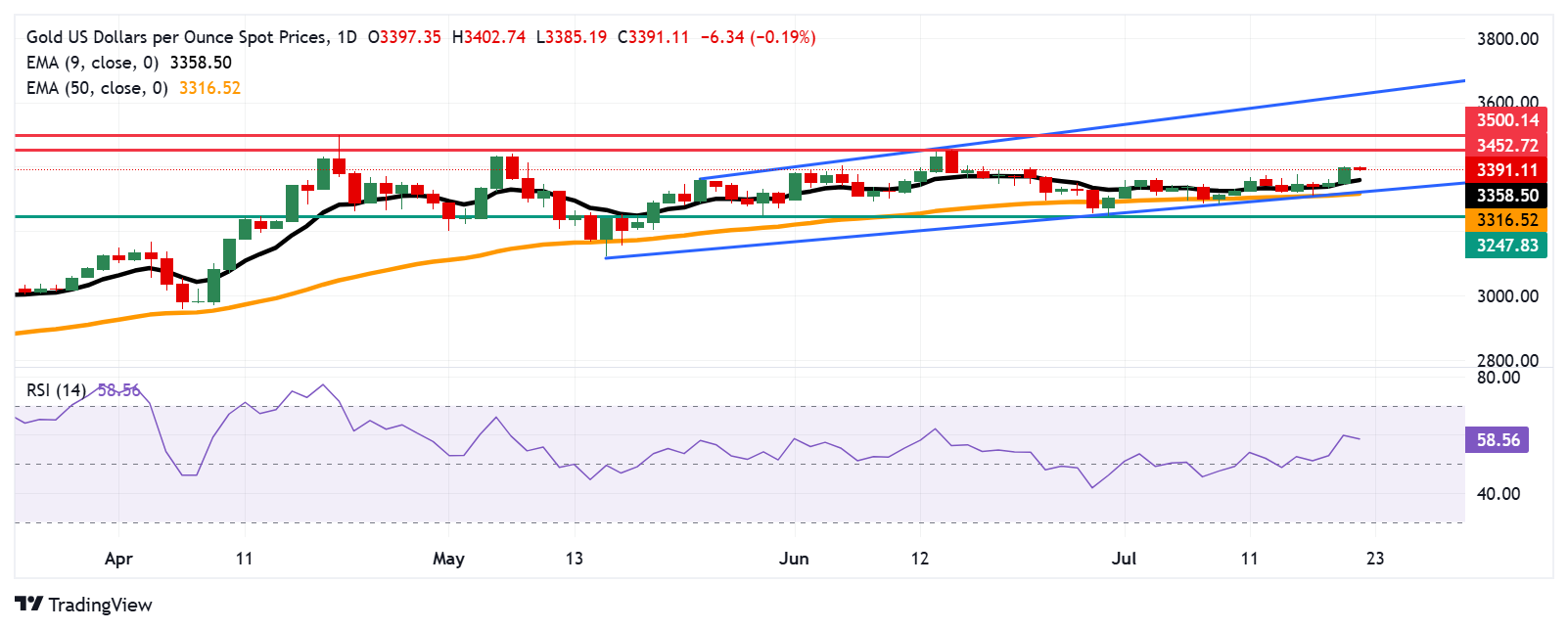
Gold price (XAU/USD) is trading around $3,390 per troy ounce on Tuesday. Technical analysis of the daily chart suggests that the metal price consolidates within an ascending channel pattern, suggesting a prevailing bullish bias. Additionally, the 14-day Relative Strength Index (RSI) stays above 50, reinforcing a bullish outlook.
The XAU/USD could approach the primary resistance at the three-month high at $3,452, which was reached on June 16, followed by the all-time high at $3,500, recorded on April 22. A break above this level could support the pair to test the ascending channel’s upper boundary around $3,630.
On the downside, the immediate support appears at the nine-day Exponential Moving Average (EMA) of $3,358. A break below this level could weaken the short-term price momentum and lead the price to test the lower boundary of the ascending channel, aligned with the 50-day EMA of $3,316.
XAU/USD: Daily Chart
Gold FAQs
Gold has played a key role in human’s history as it has been widely used as a store of value and medium of exchange. Currently, apart from its shine and usage for jewelry, the precious metal is widely seen as a safe-haven asset, meaning that it is considered a good investment during turbulent times. Gold is also widely seen as a hedge against inflation and against depreciating currencies as it doesn’t rely on any specific issuer or government.
Central banks are the biggest Gold holders. In their aim to support their currencies in turbulent times, central banks tend to diversify their reserves and buy Gold to improve the perceived strength of the economy and the currency. High Gold reserves can be a source of trust for a country’s solvency. Central banks added 1,136 tonnes of Gold worth around $70 billion to their reserves in 2022, according to data from the World Gold Council. This is the highest yearly purchase since records began. Central banks from emerging economies such as China, India and Turkey are quickly increasing their Gold reserves.
Gold has an inverse correlation with the US Dollar and US Treasuries, which are both major reserve and safe-haven assets. When the Dollar depreciates, Gold tends to rise, enabling investors and central banks to diversify their assets in turbulent times. Gold is also inversely correlated with risk assets. A rally in the stock market tends to weaken Gold price, while sell-offs in riskier markets tend to favor the precious metal.
The price can move due to a wide range of factors. Geopolitical instability or fears of a deep recession can quickly make Gold price escalate due to its safe-haven status. As a yield-less asset, Gold tends to rise with lower interest rates, while higher cost of money usually weighs down on the yellow metal. Still, most moves depend on how the US Dollar (USD) behaves as the asset is priced in dollars (XAU/USD). A strong Dollar tends to keep the price of Gold controlled, whereas a weaker Dollar is likely to push Gold prices up.
Author

Akhtar Faruqui
FXStreet
Akhtar Faruqui is a Forex Analyst based in New Delhi, India. With a keen eye for market trends and a passion for dissecting complex financial dynamics, he is dedicated to delivering accurate and insightful Forex news and analysis.

















