Gold plunges nearly 2% as markets cheer tariff delays, embrace risk
- XAU/USD drops below $3,300 as Trump's EU tariff pause boosts sentiment and US Dollar.
- Trump delays 50% EU tariffs to July 9, improving market mood and weighing on safe-haven demand.
- DXY surges 0.62% to 99.54, driven by four-year high in US Consumer Confidence.

Gold prices posted losses of nearly 2%, falling below the $3,300 figure, as market participants cheered US President Donald Trump's decision to delay tariffs on European Union goods. Consequently, an improvement in risk appetite and the Greenback trimming some of last week’s losses weighed on the non-yielding metal.
Over the weekend, a call between Trump and the EU chief, Ursula von der Leyen, ended with Washington's decision to postpone 50% tariffs on EU goods until July 9. This shift in investors' mood triggered outflows from haven assets, except for the US Dollar, and pushed global equities higher.
The US Dollar Index (DXY), which tracks the buck’s value against a basket of six currencies, rises over 0.62% to 99.54, fueled by an improvement in Consumer Confidence, which according to the Conference Board (CB) rose the most in four years.
News that Washington could be on the brink of securing additional trade deals in the near term added to the positive sentiment among traders. Fox Business News Gasparino, in a post on X, revealed that a framework between the US and India is close to being announced.
Other economic data in the US revealed that Durable Goods Orders fell in April the most since October, with business equipment diving sharply due to uncertainty about tariffs and US tax policy.
Bullion’s faith for the remainder of the week rests on the upcoming US economic docket. They will eye the Federal Reserve’s (Fed) last meeting minutes, the second estimate for Gross Domestic Product (GDP) in Q1 2025, and the Fed’s preferred inflation gauge, the Core Personal Consumption Expenditures (PCE) Price Index.
Gold daily market movers: Bullion plummets on strong US Dollar and solid US Consumer Confidence
- US Treasury bond yields remain steady. The 10-year Treasury note yield falls six basis points (bps) down to 4.446%. Meanwhile, US real yields also declined by six basis points to 2.116%.
- US Consumer Confidence in May improved from 85.7 to 98.0, with the recovery attributed to the truce on tariffs. Stephanie Guichard, senior economist at The Conference Board, said, “The rebound was already visible before the May 12 US-China trade deal but gained momentum afterward.”
- US Durable Goods Orders disappointed investors, plunged -6.3% MoM in April, down from March's 7.6% increase but exceeded forecasts of -7.8% contraction.
- Minneapolis Fed President Neel Kashkari said that interest rates should remain on hold until there is clarity on how higher duties affect price stability.
- Despite the backdrop, the Gold price outlook remains optimistic due to the still fragile market mood on US assets, ignited by the growing fiscal deficit in the United States, which prompted Moody’s to downgrade US government debt from AAA to AA1.
- Besides this, Reuters revealed that “China's net gold imports via Hong Kong more than doubled in April from March, and were the highest since March 2024, data showed.”
- Money markets suggest that traders are pricing in 46.5 basis points of easing toward the end of the year, according to Prime Market Terminal data.
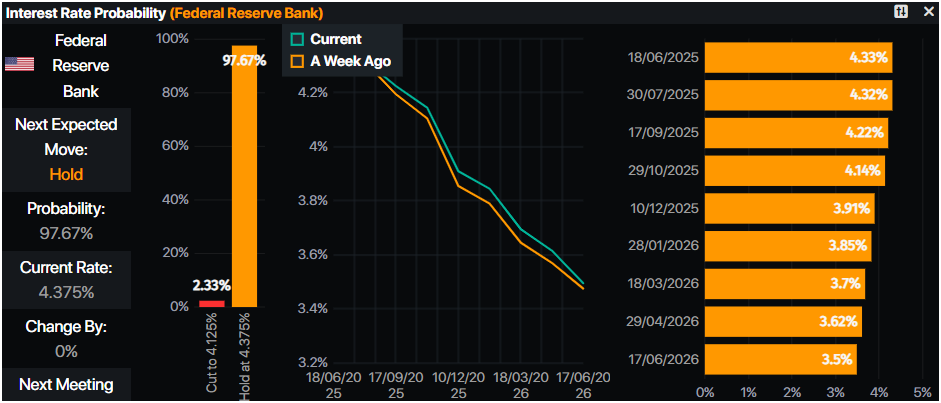
Source: Prime Market Terminal
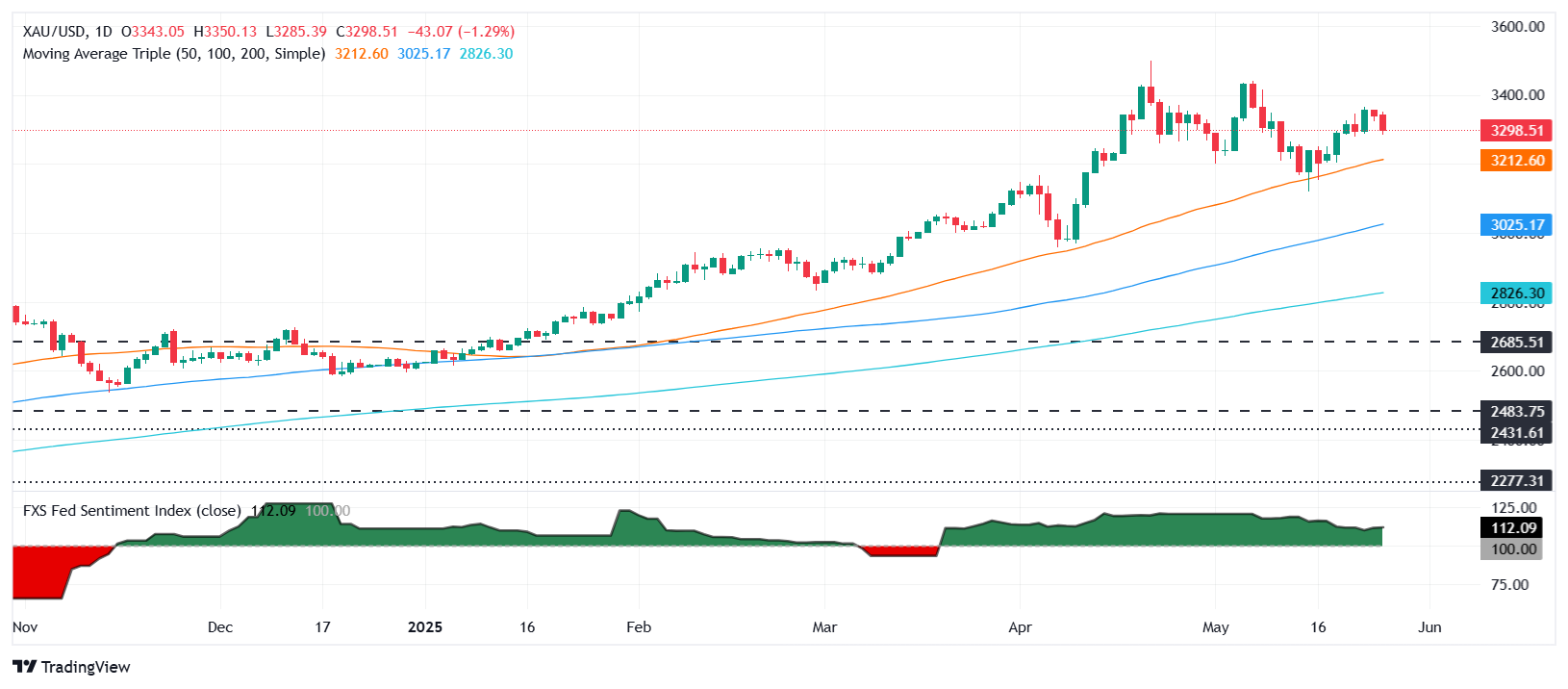
XAU/USD technical outlook: Gold price pullback to challenge $3,250
Gold price remains steady, hovering on the bottom of the $3,300 figure but set to consolidate within the $3,250-$3,300 range ahead. Nevertheless, the uptrend remains intact, with buyers eyeing a decisive break above $3,300, which could pave the way for testing last week’s peak of $3,365 ahead of a challenging $3,400. Further upside lies above the May 7 high of $3,438.
On the bearish side, if Gold drops below $3,250, expect a move to the confluence of the May 20 daily low and the 50-day Simple Moving Average (SMA) near $3,204/05.
Fed FAQs
Monetary policy in the US is shaped by the Federal Reserve (Fed). The Fed has two mandates: to achieve price stability and foster full employment. Its primary tool to achieve these goals is by adjusting interest rates. When prices are rising too quickly and inflation is above the Fed’s 2% target, it raises interest rates, increasing borrowing costs throughout the economy. This results in a stronger US Dollar (USD) as it makes the US a more attractive place for international investors to park their money. When inflation falls below 2% or the Unemployment Rate is too high, the Fed may lower interest rates to encourage borrowing, which weighs on the Greenback.
The Federal Reserve (Fed) holds eight policy meetings a year, where the Federal Open Market Committee (FOMC) assesses economic conditions and makes monetary policy decisions. The FOMC is attended by twelve Fed officials – the seven members of the Board of Governors, the president of the Federal Reserve Bank of New York, and four of the remaining eleven regional Reserve Bank presidents, who serve one-year terms on a rotating basis.
In extreme situations, the Federal Reserve may resort to a policy named Quantitative Easing (QE). QE is the process by which the Fed substantially increases the flow of credit in a stuck financial system. It is a non-standard policy measure used during crises or when inflation is extremely low. It was the Fed’s weapon of choice during the Great Financial Crisis in 2008. It involves the Fed printing more Dollars and using them to buy high grade bonds from financial institutions. QE usually weakens the US Dollar.
Quantitative tightening (QT) is the reverse process of QE, whereby the Federal Reserve stops buying bonds from financial institutions and does not reinvest the principal from the bonds it holds maturing, to purchase new bonds. It is usually positive for the value of the US Dollar.
Author

Christian Borjon Valencia
FXStreet
Markets analyst, news editor, and trading instructor with over 14 years of experience across FX, commodities, US equity indices, and global macro markets.