Gold price intraday move up remains uninterrupted amid broad-based USD selling, weaker risk tone
- Gold price attract fresh buyers on Monday amid modest USD weakness.
- US fiscal concerns and Fed rate cut bets keep the USD bulls on the defensive.
- Trade uncertainties and geopolitical risks further benefit the XAU/USD pair.


Gold price (XAU/USD) builds on its intraday positive move and advances to over a one-week high, around the $3,359 area during the first half of the European session on Monday. Concerns about the worsening US fiscal situation, along with the growing acceptance that the Federal Reserve (Fed) will lower borrowing costs again in 2025, drag the US Dollar (USD) back closer to the monthly low. This, in turn, is seen as a key factor acting as a tailwind for the non-yielding yellow metal.
Meanwhile, investors remain on edge amid persistent trade-related uncertainties and rising geopolitical tensions. This is evident from a generally weaker tone around the equity markets and contributes to driving flows toward the safe-haven Gold price. Apart from this, the momentum could further be attributed to some technical buying above the $3,325-3,326 barrier, which seems to have set the stage for further gains. Traders now look to the US ISM Manufacturing PMI for a fresh impetus.
Daily Digest Market Movers: Gold price remains well supported by notable USD supply and the global flight to safety
- The US Bureau of Economic Analysis reported on Friday that the Personal Consumption Expenditures (PCE) Price Index cooled to the 2.1% YoY rate in April, or the lowest since February 2021. Meanwhile, the core PCE Price Index, which excludes volatile food and energy prices, came in at 2.5%, down from the 2.7% increase registered in March.
- Traders continued to bet that the Federal Reserve will lower borrowing costs in September and are pricing in the possibility of another rate cut in December. Fed Governor Christopher Waller said on Monday that rate cuts remain possible later this year even with the Trump administration's tariffs likely to push up price pressures temporarily.
- Investors now await speeches from several FOMC members this week, including Fed Chair Jerome Powell's appearance later this Monday, for cues on the monetary policy outlook. This will play a key role in influencing the near-term US Dollar price dynamics and determining the next leg of a directional move for the non-yielding Gold price.
- Ukraine ramped up the war with one of the biggest drones attracted to Russia ahead of the second round of direct peace talks in Istanbul later today. Ukraine conducted major drone strikes against Russian military airfields across five regions on Sunday and hit over 40 Russian military aircraft, which included nuclear-capable long-range bombers.
- Israel strongly denied its involvement in the deadly incident that claimed at least 30 Palestinian lives and accused Hamas of firing on hungry civilians gathered to receive humanitarian aid in southern Gaza. This comes amid a flurry of conflicting reports and keeps geopolitical risks in play, further lending support to the safe-haven XAU/USD.
- Traders now look forward to important US macro releases scheduled at the beginning of a new month, starting with the ISM Manufacturing PMI on Monday. Apart from this, Fed Chair Jerome Powell's speech might influence the USD price dynamics and contribute to producing short-term trading opportunities around the commodity.
Gold price seems poised to appreciate further and aim towards reclaiming the $3,400 round-figure mark
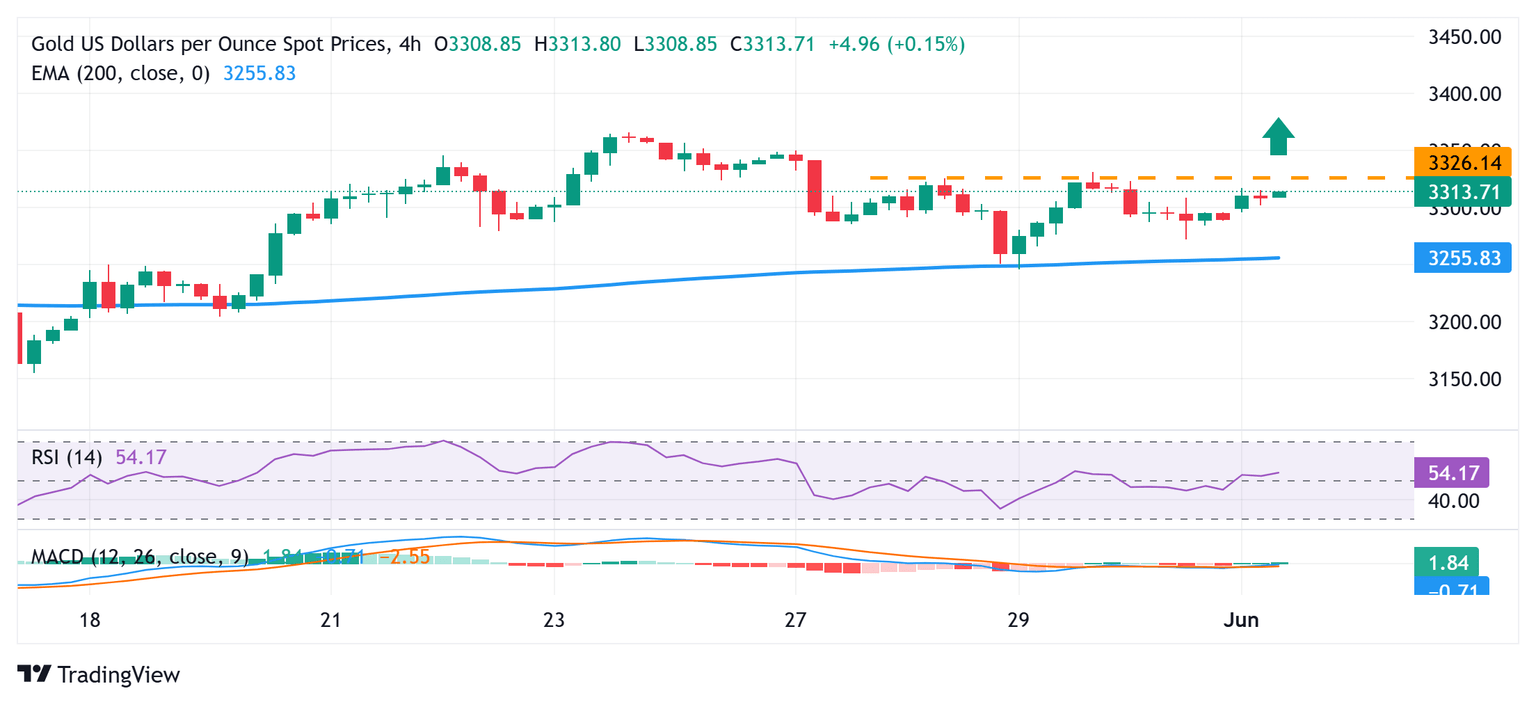
From a technical perspective, a sustained strength beyond the $3,326-3,328 supply zone could be seen as a fresh trigger for the XAU/USD bulls against the backdrop of last week's bounce from the 200-period Exponential Moving Average (EMA) pivotal support on the 4-hour chart, The subsequent move up beyond the $3,345-3,350 intermediate resistance might now allow the Gold price to reclaim the $3,400 mark. The momentum could extend further towards the next relevant barrier near the $3,432-3,434 region.
On the flip side, weakness below the $3,300 round figure could find some support near the $3,280-3,278 zone. Any further slide could be seen as a buying opportunity and remain limited near the $3,258-3,257 region. The latter represents the 200-period EMA on the 4-hour chart, which if broken decisively could make the Gold price vulnerable to accelerate the fall further towards the $3,200 mark.
Fed FAQs
Monetary policy in the US is shaped by the Federal Reserve (Fed). The Fed has two mandates: to achieve price stability and foster full employment. Its primary tool to achieve these goals is by adjusting interest rates. When prices are rising too quickly and inflation is above the Fed’s 2% target, it raises interest rates, increasing borrowing costs throughout the economy. This results in a stronger US Dollar (USD) as it makes the US a more attractive place for international investors to park their money. When inflation falls below 2% or the Unemployment Rate is too high, the Fed may lower interest rates to encourage borrowing, which weighs on the Greenback.
The Federal Reserve (Fed) holds eight policy meetings a year, where the Federal Open Market Committee (FOMC) assesses economic conditions and makes monetary policy decisions. The FOMC is attended by twelve Fed officials – the seven members of the Board of Governors, the president of the Federal Reserve Bank of New York, and four of the remaining eleven regional Reserve Bank presidents, who serve one-year terms on a rotating basis.
In extreme situations, the Federal Reserve may resort to a policy named Quantitative Easing (QE). QE is the process by which the Fed substantially increases the flow of credit in a stuck financial system. It is a non-standard policy measure used during crises or when inflation is extremely low. It was the Fed’s weapon of choice during the Great Financial Crisis in 2008. It involves the Fed printing more Dollars and using them to buy high grade bonds from financial institutions. QE usually weakens the US Dollar.
Quantitative tightening (QT) is the reverse process of QE, whereby the Federal Reserve stops buying bonds from financial institutions and does not reinvest the principal from the bonds it holds maturing, to purchase new bonds. It is usually positive for the value of the US Dollar.
Author
Haresh Menghani
FXStreet
Haresh Menghani is a detail-oriented professional with 10+ years of extensive experience in analysing the global financial markets.

















