Gold rally takes a breather, still heading for eight straight weekly advance
- Gold touches all-time high of $2,954 amid trade policy uncertainty.
- Trump expands tariffs to lumber and soft commodities, adding market jitters.
- US data mixed: Manufacturing PMI improves, but Services PMI contracts.

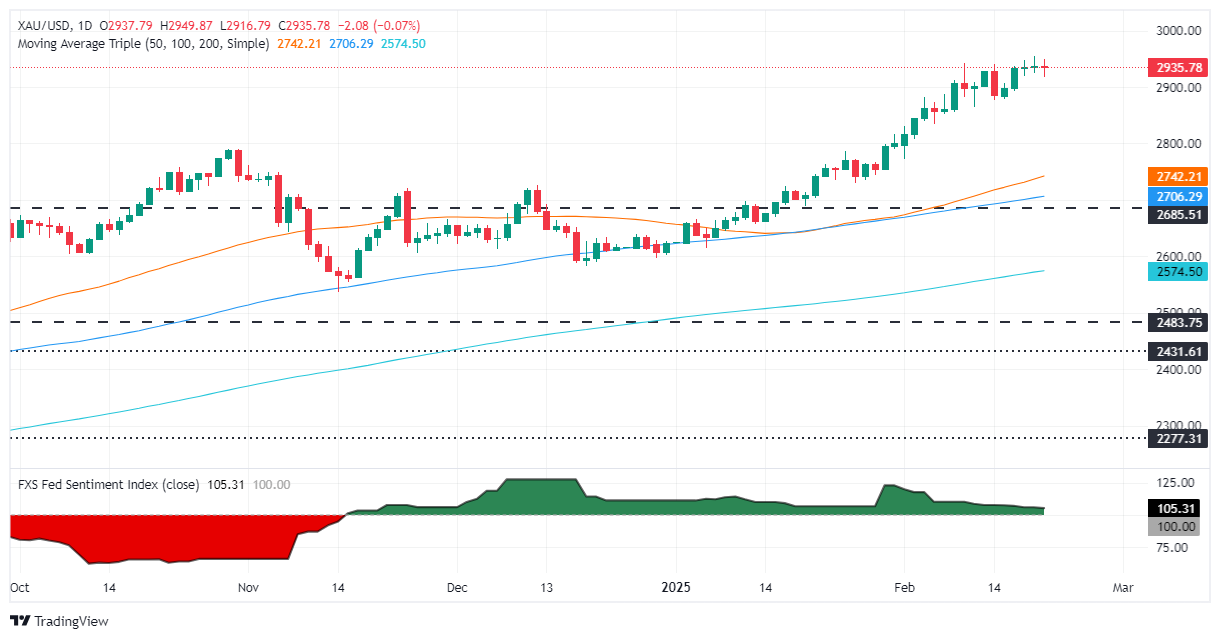
Gold price slides late on Friday, poised to end the week positively, accumulating eight straight weeks of gains that pushed the yellow metal to all-time highs of $2,954. At the time of writing, the XAU/USD trades at $2,940, down 0.15%.
The financial markets' narrative has not changed as US President Donald Trump continues with rhetoric related to tariffs. In addition to imposing 25% tariffs on cars, pharmaceuticals and chips, Trump broadened duties to lumber and other soft commodities.
This fueled the rally in Bullion prices as investors seeking safety drove prices higher amidst uncertainty about US trade policies. Meanwhile, geopolitics took a second stage as there was some progress in the discussion to end the Russia-Ukraine war, which relieved the markets.
Data-wise, business activity in the United States was mixed. The manufacturing PMI improved. Conversely, the Services PMI plunged for the first time since January 2023.
Other data showed that Existing Home Sales plunged, and the University of Michigan (UoM) Consumer Sentiment Final reading for February deteriorated further.
Daily digest market movers: Gold price fails to capitalize on US yields drop
-
The US 10-year Treasury bond yield falls nine basis points (bps) and yields 4.416%.
- US real yields, which correlate inversely to Bullion prices, drop four basis points to 1.996%, a tailwind for Bullion prices.
- US S&P Global revealed the Manufacturing PMI in February expanded by 51.6, up from 51.2, exceeding forecasts. The Services PMI plummeted from 52.9 to 49.7.
- The University of Michigan Consumer Sentiment Index in February dipped from 71.1 to 64.7. American consumers’ inflation expectations for one year rose from 3.3% to 4.3% as foreseen, and for a five-year period, they are anchored at 3.5%, up from 3.2% revealed in the previous month.
- The Federal Reserve’s Meeting Minutes from Wednesday revealed that Trump’s trade and immigration policies fueled concerns over rising prices.
- The World Gold Council revealed that central bank purchases rose more than 54% YoY to 333 tonnes following Trump’s victory.
- Money market fed funds futures are pricing in 50 basis points of easing by the Fed in 2025.
XAU/USD technical outlook: Gold price faces resistance and retreats
Gold price remains upwardly biased, yet the trend seems exhausted. The Relative Strength Index (RSI) suggests that buyers are losing ground with the RSI’s exiting from overbought territory opening the door for a retracement in Bullion prices.
The first key support area to look at is $2,900. Once surpassed, sellers would target the February 14 swing low of $2,877, followed by the February 12 daily low of $2,864. Conversely, if XAU/USD rises past $2,954, the first resistance would be the psychological $2,950, followed by $3,000.
Gold FAQs
Gold has played a key role in human’s history as it has been widely used as a store of value and medium of exchange. Currently, apart from its shine and usage for jewelry, the precious metal is widely seen as a safe-haven asset, meaning that it is considered a good investment during turbulent times. Gold is also widely seen as a hedge against inflation and against depreciating currencies as it doesn’t rely on any specific issuer or government.
Central banks are the biggest Gold holders. In their aim to support their currencies in turbulent times, central banks tend to diversify their reserves and buy Gold to improve the perceived strength of the economy and the currency. High Gold reserves can be a source of trust for a country’s solvency. Central banks added 1,136 tonnes of Gold worth around $70 billion to their reserves in 2022, according to data from the World Gold Council. This is the highest yearly purchase since records began. Central banks from emerging economies such as China, India and Turkey are quickly increasing their Gold reserves.
Gold has an inverse correlation with the US Dollar and US Treasuries, which are both major reserve and safe-haven assets. When the Dollar depreciates, Gold tends to rise, enabling investors and central banks to diversify their assets in turbulent times. Gold is also inversely correlated with risk assets. A rally in the stock market tends to weaken Gold price, while sell-offs in riskier markets tend to favor the precious metal.
The price can move due to a wide range of factors. Geopolitical instability or fears of a deep recession can quickly make Gold price escalate due to its safe-haven status. As a yield-less asset, Gold tends to rise with lower interest rates, while higher cost of money usually weighs down on the yellow metal. Still, most moves depend on how the US Dollar (USD) behaves as the asset is priced in dollars (XAU/USD). A strong Dollar tends to keep the price of Gold controlled, whereas a weaker Dollar is likely to push Gold prices up.
Author

Christian Borjon Valencia
FXStreet
Markets analyst, news editor, and trading instructor with over 14 years of experience across FX, commodities, US equity indices, and global macro markets.