Gold Price Forecast: XAU/USD refreshes daily gains above $1,760 as USD retreats
- Gold reversed an Asian session dip to the $1,750 area and refreshed daily tops in the last hour.
- The risk-off impulse was seen as a key factor that extended support to the safe-haven XAU/USD.
- Hawkish Fed expectations, sustained USD buying might cap any meaningful gains for the metal.
- Gold Price Forecast: On pause, but sellers outpace buyers

Update: Gold prices spike higher after the initial subdued session trading in the familiar trading range as USD retreats and risk-off mood. The US Dollar Index after hovering near to one year high amid surging energy prices and Fed’s tapering expectations slides on a mild pullback. The concerns over slower economic growth due to soaring oil prices supported the precious metal near the lower levels. Investors remained pessimistic after China’s Evergrande missed its third consecutive round of bond payments in three weeks, thus intensifying contagion default risk. Furthermore, the European Central Bank (ECB) Chief Economist Philip Lane shrugged off the rout of the current rout of inflation in the eurozone to trigger monetary policy action as wages and service sector growth remains weak. Gold is seen as a hedge against inflation on its safe-haven appeal.
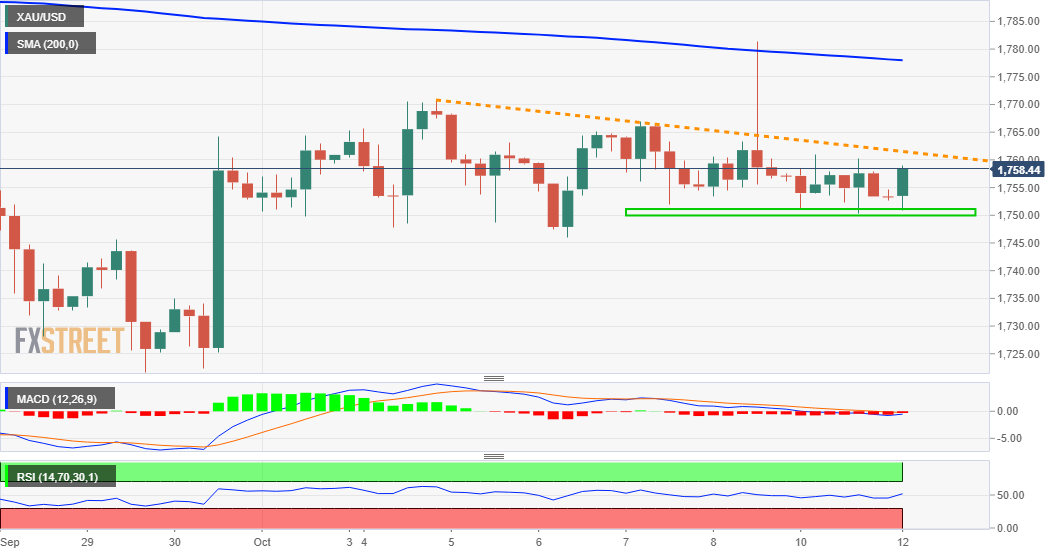
Gold attracted some dip-buying near the $1,750 area during the Asian session on Tuesday and climbed to fresh daily tops in the last hour. Currently hovering around the $1,759 region, the risk-off impulse in the markets was seen as a key factor that extended some support to the safe-haven XAU/USD. Worries that the recent surge in crude oil/energy prices will stoke inflation and derail the global economic recovery have been fueling fears about stagflation. This, in turn, tempered investors' appetite for perceived riskier assets, like equities, and benefitted traditional safe-haven assets. That said, prospects for an early policy tightening by the Fed should keep a lid on any further gains for the non-yielding yellow metal.
Despite Friday's disappointing headline NFP print, investors seem convinced that the Fed remains on track to begin rolling back its massive pandemic-era stimulus as soon as November. The markets have also started pricing in the possibility of an interest rate hike in 2022 amid concerns about a faster than expected rise in inflation. This was reinforced by elevated US Treasury bond yields, which continued underpinning the US dollar and might further act as a headwind for the dollar-denominated gold. In fact, the yield on the benchmark 10-year US government bond shot to 1.612%, or four-month tops on Friday as the market focus now shifts to this week's release of the latest US consumer inflation figures.
A stronger than expected CPI print will reaffirm hawkish Fed expectations and could bring further gains for the US currency. Apart from this, investors will further take cues from the FOMC monetary policy meeting minutes on Wednesday and the US monthly Retail Sales data on Friday. This will play a key role in influencing the greenback in the near term and provide a fresh directional impetus to gold. In the meantime, the broader market risk sentiment, along with the US bond yields and the USD price dynamics, will be looked upon for some short-term trading opportunities around the XAU/USD.
Technical levels to watch
From current levels, any subsequent move up is likely to confront stiff resistance near the $1,770 area. Some follow-through buying has the potential to lift gold prices back closer towards the $1,783-84 horizontal barrier. A sustained strength beyond should allow bulls to aim back to reclaim the $1,800 round-figure mark.
On the flip side, the $1,750 area now seems to have emerged as immediate strong support. A convincing break below might prompt aggressive technical selling and accelerate the slide towards September monthly swing lows, around the $1,722-21 region. Gold could eventually drop to test the $1,700 mark en-route August monthly swing lows, around the $1,687 region.
Author

Haresh Menghani
FXStreet
Haresh Menghani is a detail-oriented professional with 10+ years of extensive experience in analysing the global financial markets.