|

Gold Price Forecast: XAU/USD shines as US yields drop amid an upbeat market mood

  • Gold prices see a recovery, achieving gains of 0.25%, driven by a reversal in US bond yields, with the 10-year note coupon dropping from a 16-year high of 4.51% to 4.44%.
  • Federal Reserve officials express a cautious stance, emphasizing the need for patience despite the necessity for further rate hikes to control inflation.
  • The US Dollar Index (DXY) continues to print modest gains, sitting at 105.56, potentially impacting gold’s rally, with
  • Next week, US data includes Consumer Confidence, Durable Goods Orders, and Initial Jobless Claims to provide further direction.

Gold price recovers some ground after hitting a weekly low of $1913.99, though it remains shy of breaking solid resistance at around the 50-day moving average (DMA) at $1929.79. Factors like dropping US T-bond yields and an upbeat market sentiment drive XAU/USD’s price toward the current spot at $1924.56, achieving gains of 0.25%.

Gold price nudges upwards despite a firm US Dollar

XAU/USD prices is being driven up by the reversal in US bond yields. The US 10-year benchmark note coupon reversed from a 16-year high of 4.51% towards 4.44%. Consequently, US real yields are edging lower from five basis points from 2.11% to 2.06%.

In the meantime, Federal Reserve officials had turned cautiously, led by Boston and San Francisco Fed Presidents Susan Collins and Mary Daly, stressing that although inflation is cooling down and further rate hikes would be needed, the Fed must be patient. Fed Governor Michelle Bowman commented that more increases are needed to control inflation.

Data-wise, S&P Global announced the final PMI readings in the United States (US). Manufacturing PMI improved to 48.9 but stood at recessionary territory. Contrarily, Services and Composite PMI showed signs of losing steam, though it expanded but continued to aim towards the 50 expansion/contraction threshold.

Meanwhile, the US Dollar Index prints modest gains of 0.17%, stalling Gold’s rally. The DXY sits at 105.56, set to print solid gains for the tenth straight week.

On the US front, Consumer Confidence, Durable Goods Orders, Initial Jobless Claims, and the Fed’s preferred gauge for inflation the core PCE.

XAU/USD Price Analysis: Technical outlook

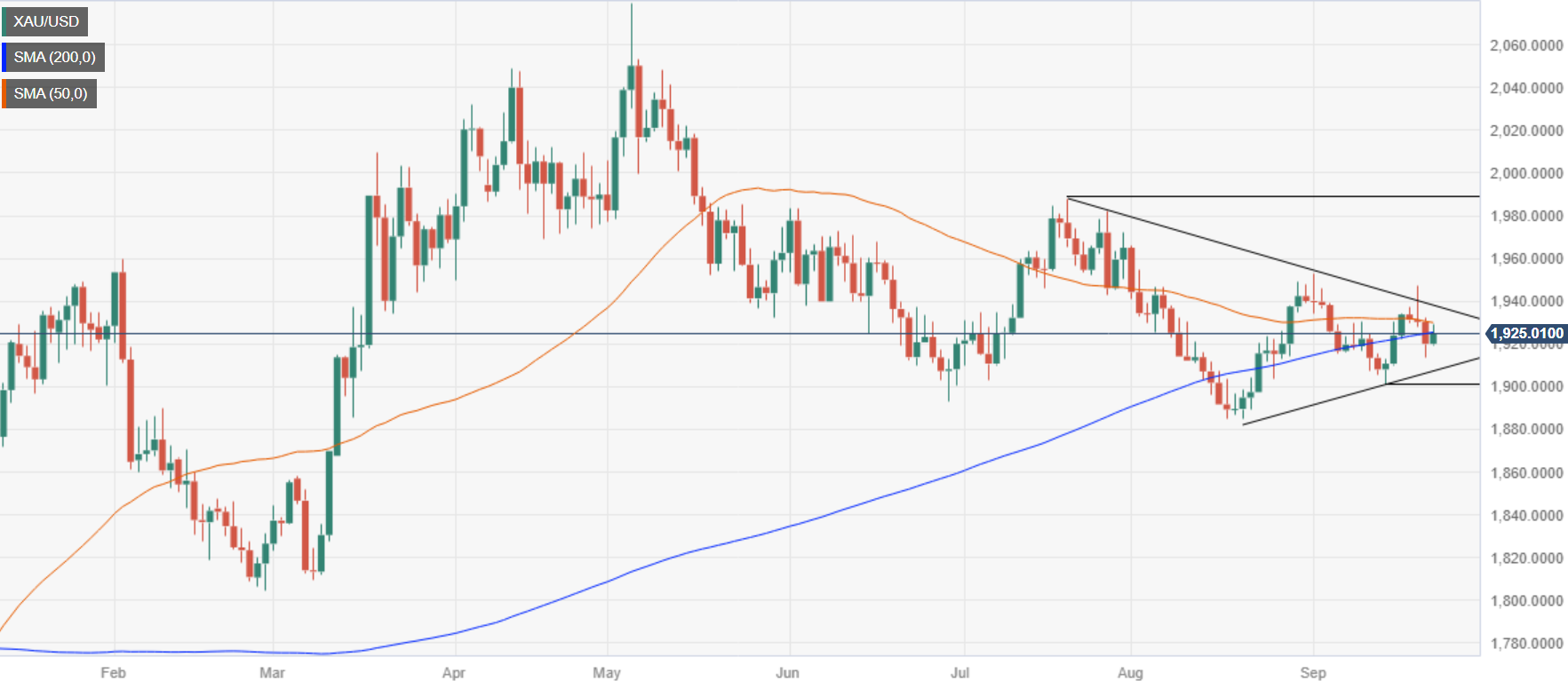
From a technical standpoint, the XAU/USD is set to continue to trade sideways, within the $1913-$1948 range, with most daily moving averages (DMAs) hovering around the current exchange rate. However, as the yellow metal remains below the 200-DMA, which sits at $1926.24, the path of least resistance is tilted to the downside. First support would be the September 21 low of $1913.99, followed by the September 14 $1901.11 swing low. Conversely if the non-yielding metal surpass the 100-DMA at $1941.86, a challenge of the $1950 mark is expected.
XAU/USD

Overview
Today last price1925.07
Today Daily Change4.99
Today Daily Change %0.26
Today daily open1920.08
 
Trends
Daily SMA201925.47
Daily SMA501930.63
Daily SMA1001943.18
Daily SMA2001924.83
 
Levels
Previous Daily High1932.04
Previous Daily Low1913.95
Previous Weekly High1930.77
Previous Weekly Low1901.07
Previous Monthly High1966.08
Previous Monthly Low1884.85
Daily Fibonacci 38.2%1920.86
Daily Fibonacci 61.8%1925.13
Daily Pivot Point S11912.01
Daily Pivot Point S21903.93
Daily Pivot Point S31893.92
Daily Pivot Point R11930.1
Daily Pivot Point R21940.11
Daily Pivot Point R31948.19

Author

Christian Borjon Valencia

Markets analyst, news editor, and trading instructor with over 14 years of experience across FX, commodities, US equity indices, and global macro markets.


More from Christian Borjon Valencia
Share:

Editor's Picks

AUD/USD hits nine-week lows below 0.7000 on RBA Bullock's remarks

AUD/USD reverses a brief uptick and turns lower to hit nine-week lows below 0.7000 in the European morning on Tuesday, as traders digest cautious remarks from Reserve Bank of Australia (RBA) Governor Michele Bullock during the press conference. Earlier on, the RBA raised the cash rate to 4.60%, as widely expected, leaving the door open to further rate hikes if needed.

USD/JPY consolidates near 157.50 as a bullish USD counters intervention risks

USD/JPY struggles to capitalize on the overnight bounce from a one-week low, consolidating around 157.50 in the Asian session on Tuesday. Trump's concerns about the Japanese Yen's weakness fueled speculation about another US-Japan joint intervention. This, along with the hawkish BoJ, underpins the JPY and caps the currency pair. Meanwhile, rising Fed rate-hike bets and oil-driven inflation fears continue to push US bond yields to multi-year highs, keeping the US Dollar pinned near a two-month high and supporting the pair.

Gold trims gains; back toward $4,150

Gold now surrenders some of its initial advance and retests the $4,150 zone per troy ounce on Tuesday. Meanwhile, the move higher in the yellow metal comes despite the firmer US Dollar and rising US Treasury yields across the board, while escalating geopolitical tensions appear to limit the downside potential.

Crypto Today: Bitcoin, Ethereum, XRP correct upward amid declining ETF inflows

The cryptocurrency market upholds a neutral-to-bullish bias on Tuesday, with Bitcoin edging closer to a breakout above $84,000. Altcoins mirror BTC’s outlook, with Ethereum holding above $2,700 and Ripple pushing past the reclaimed $1.50 level.

RBA recap: Rate hikes are on the table as demand stays too strong

The Reserve Bank of Australia unanimously tightened monetary policy, warning that inflation remained too high and that several upside risks had begun to materialise. Governor Michele Bullock said the Board would raise rates again if necessary.

Silver is more volatile than Gold ahead of PCE and NFP. This chart shows the positioning gap
The market’s attention is focused on American data this week, but there’s something only those with a trained eye may be looking at: Gold and Silver positioning gap. Financial markets are moving on fears, mostly related to persistently high energy prices driven by the Middle East war. Sure, the US Dollar (USD) is strong, but at what cost?