Gold Price Forecast: XAU/USD recovers above $3,300 with pressure building within a bull flag
- Gold prices bounce off moving average support, reclaiming the $3,300 level.
- XAU/USD technical levels remain firm within a bull flag pattern.
- Momentum remains neutral with a narrow range hinting at the potential for a breakout.

Gold prices are threatening key technical layers of support on Wednesday, with Bullion searching for a fresh catalyst to drive prices out of the confines of the bull flag pattern.
After erasing 1.25% on Tuesday, the momentum of the downtrend has temporarily paused. At the time of writing, Gold prices are trading above the $3,300 psychological level with the 20-day Simple Moving Average (SMA) providing additional support at $3,289.
The current zone of price action remains technically significant, as it aligns with the upper bound of the bull flag and the 23.60% Fibonacci Retracement level of the January-April move at $3,290.
Gold prices bounce off support as pressure builds within the confines of a bull flag
With the descending trendline from the bull flag providing an additional barrier of resistance for bulls near $3,320, bears have struggled to gain momentum below the Fibonacci support.
With the Relative Strength Index (RSI) flattening around 52, the next big move for the yellow metal hinges on whether bulls or bears can break free from their relative zones of restriction.
Gold daily chart
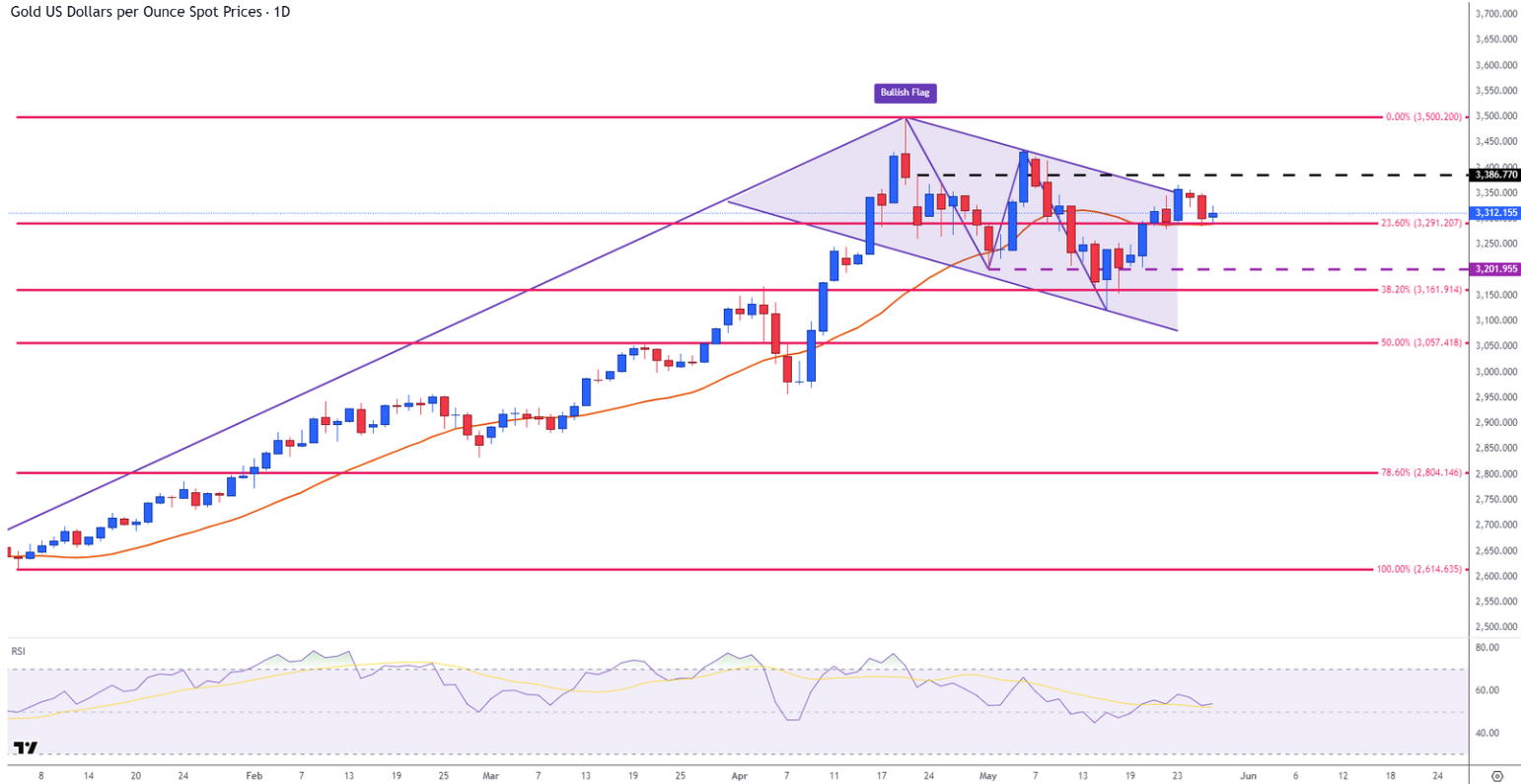
A breakdown below $3,200 could open the door toward the 38.2% retracement level at $3,161, followed by deeper support near the 50% and 61.8% Fibonacci levels at $3,057 and $2,952, respectively.
On the upside, a decisive breakout above the descending wedge, particularly a close above $3,350-$3,360, would likely attract bullish momentum. Such a breakout would target a retest of April’s all-time high just below $3,500.
Gold FAQs
Gold has played a key role in human’s history as it has been widely used as a store of value and medium of exchange. Currently, apart from its shine and usage for jewelry, the precious metal is widely seen as a safe-haven asset, meaning that it is considered a good investment during turbulent times. Gold is also widely seen as a hedge against inflation and against depreciating currencies as it doesn’t rely on any specific issuer or government.
Central banks are the biggest Gold holders. In their aim to support their currencies in turbulent times, central banks tend to diversify their reserves and buy Gold to improve the perceived strength of the economy and the currency. High Gold reserves can be a source of trust for a country’s solvency. Central banks added 1,136 tonnes of Gold worth around $70 billion to their reserves in 2022, according to data from the World Gold Council. This is the highest yearly purchase since records began. Central banks from emerging economies such as China, India and Turkey are quickly increasing their Gold reserves.
Gold has an inverse correlation with the US Dollar and US Treasuries, which are both major reserve and safe-haven assets. When the Dollar depreciates, Gold tends to rise, enabling investors and central banks to diversify their assets in turbulent times. Gold is also inversely correlated with risk assets. A rally in the stock market tends to weaken Gold price, while sell-offs in riskier markets tend to favor the precious metal.
The price can move due to a wide range of factors. Geopolitical instability or fears of a deep recession can quickly make Gold price escalate due to its safe-haven status. As a yield-less asset, Gold tends to rise with lower interest rates, while higher cost of money usually weighs down on the yellow metal. Still, most moves depend on how the US Dollar (USD) behaves as the asset is priced in dollars (XAU/USD). A strong Dollar tends to keep the price of Gold controlled, whereas a weaker Dollar is likely to push Gold prices up.
Author

Tammy Da Costa, CFTe®
FXStreet
Tammy is an economist and market analyst with a deep passion for financial markets, particularly commodities and geopolitics.

















