Gold Price Forecast: XAU/USD holds above $1,900 as Fed Minutes loom – Confluence Detector
- Gold Price rebounds from seven-week low but lacks upside momentum while making rounds to key support.
- XAU/USD consolidates losses ahead of Fed Minutes amid cautious optimism.
- Mixed US data flag policy pivot concerns, putting a floor under the Gold Price.
- China news, mid-tier US data also eyed for clear XAU/USD directions.

Gold Price (XAU/USD) recovers from the lowest level since late June as the market prepares for the US Federal Reserve (Fed) monetary policy meeting minutes. Adding strength to the corrective bounce could be the latest cautious optimism in the market amid hopes of more stimulus from China, as well as an end to Fed’s tightening cycle due to the recently mixed US data. It’s worth noting that the inaction of major central banks in the last few days also suggests an end of the rate-hike cycle and puts a floor under the XAU/USD price, especially when China shows readiness for more stimulus and Indian statistics remain firmer.
That said, upbeat US Retail Sales and disappointing China data joined strong US Treasury bond yields to drag the Gold Price toward the multi-day low the previous day. Also likely to have weighed on the XAU/USD is the recently downbeat performances of riskier assets like equities, Antipodeans and commodities.
Moving on, US Industrial Production for July and the Federal Open Market Committee’s (FOMC) latest Monetary Policy Meeting Minutes will be important to watch for clear directions. That said, any signals for the US central bank’s further rate hike may drag the quote back below the $1,900 support confluence.
Also read: Gold Price Forecast: XAU/USD downside opens up toward $1,885, eyes on Fed Minutes
Gold Price: Key levels to watch
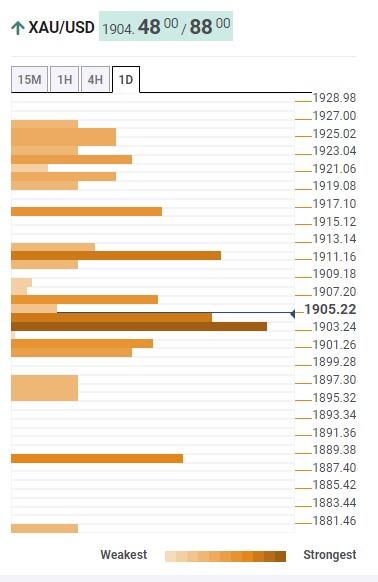
Our Technical Confluence indicator suggests that the Gold Price flirts with the $1,900 support confluence, recently bouncing off the threshold comprising the 200-DMA, previous monthly low and Fibonacci 38.2% on one-day.
With the market’s consolidation ahead of the Fed Minutes in play, the XAU/USD’s corrective bounce may aim for the $1,912 immediate hurdle encompassing the Pivot Point one-day R1, the middle band of the Bollinger on the four-hour (4H) play and the previous weekly low.
However, a clear upside break of $1,912 will allow the Gold buyers to aim for $1,930 with a likely stop around the $1,918 hurdle comprising the Pivot Point one-month S1.
Meanwhile, Pivot Point one-week S1 adds strength to the $1,900 support confluence as the level seesaws near $1,899.
Following that, the Pivot Point one-week S2 and one-day S2 together highlight the $1,888 as the last defense of XAU/USD buyers.
Here is how it looks on the tool
About Technical Confluences Detector
The TCD (Technical Confluences Detector) is a tool to locate and point out those price levels where there is a congestion of indicators, moving averages, Fibonacci levels, Pivot Points, etc. If you are a short-term trader, you will find entry points for counter-trend strategies and hunt a few points at a time. If you are a medium-to-long-term trader, this tool will allow you to know in advance the price levels where a medium-to-long-term trend may stop and rest, where to unwind positions, or where to increase your position size.
Author

Anil Panchal
FXStreet
Anil Panchal has nearly 15 years of experience in tracking financial markets. With a keen interest in macroeconomics, Anil aptly tracks global news/updates and stays well-informed about the global financial moves and their implications.

















