|

Gold Price Forecast: XAU/USD falls on upbeat US NFP data, yields spike

  • Gold price dips despite week’s strong showing; US job growth exceeds expectations.
  • Rising US Treasury bond yields and a robust USD exert downward pressure on gold.
  • US debt-ceiling resolution eases bond yields, potential respite for gold.

Gold price slumps after hitting a daily high of $1977.87, as the release of a solid US jobs data report underpinned US Treasury bond yields, a headwind for the yellow metal. That, alongside a strong US Dollar (USD), keeps XAU/USD downward pressured but still set to end the week with decent gains. At the time of writing, the XAU/USD is trading below the $1950 area.

XAU/USD falters amidst robust US data, Treasury yields surge and heightened Fed rate hike expectations

A risk on impulse keeps safe-haven assets under pressure, as Wall Street shrugged off a solid employment report from the United States (US). On Friday, the US Department of Labor revealed May’s Nonfarm Payrolls report, which crushed estimates of 190K, as the economy created 339K jobs. Regardings to the Unemployment Rate grew by 3.7% YoY from 3.4%.

US Treasury bond yields reacted to the upside, with 2s jumping 16 bps to 4.501%, while 10s stand at 3.689%, gaining nine bps. The greenback edged up 0.43% as shown by the US Dollar Index at 104.026, ready to post its first weekly loss, snapping three weeks of gains.

Bets that the US Federal Reserve will keep rates unchanged at the June meeting increased, although, in July, it is almost sure that the US central bank will raise rates by 25 bps.

Should be said that once the US House and Senate approved the US debt-ceiling bill, US bond yields dropped. The bill would be signed by US President Joe Biden during the weekend, ending the soap opera.

XAU/USD Price Analysis: Technical outlook
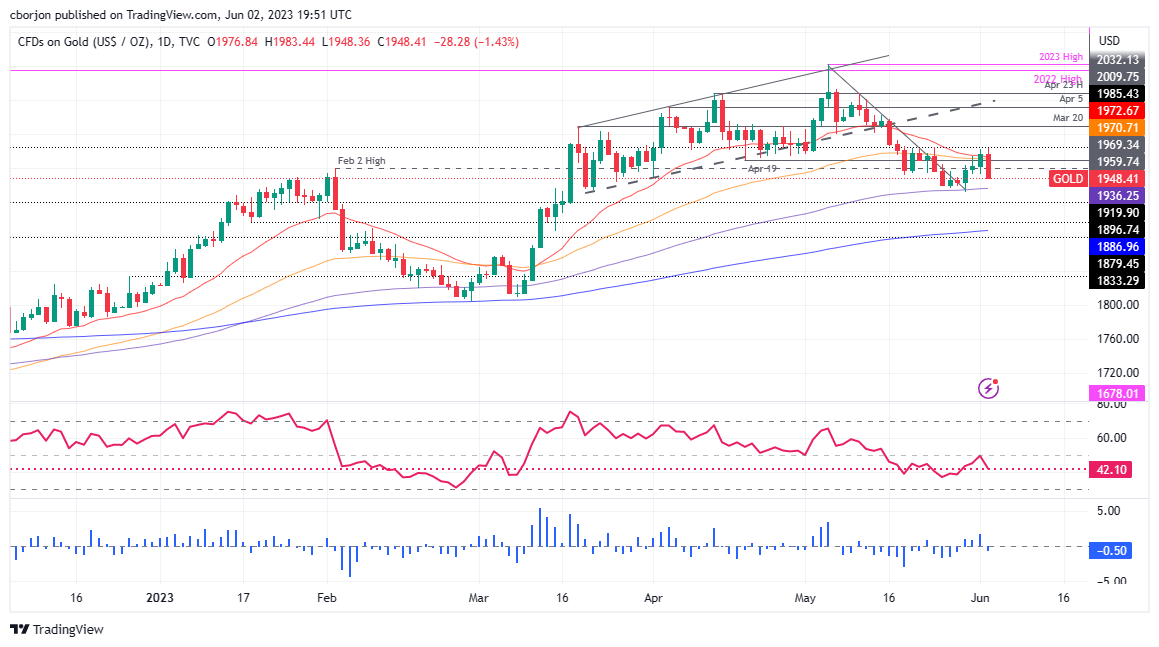
XAU/USD Daily chart

XAU/USD is neutral to downward biased, even though the Gold spot remains trading above the 200-day Exponential Moving Average (EMA) at $1886.98. As the yellow metal registered successive series of lower highs, despite pending confirmation for a second lower-low, it turned the bias slightly downwards.

Oscillators like the Relative Strength Index (RSI) and the 3-day Rate of Change (RoC) suggests sellers are in charge though a decisive break below $1950 would put them in the driver’s seat to challenge the 200-day EMA.

XAU/USD first support would be $1950, followed by the 100-day EMA at $1936.30. Once cleared, $1900 is up next. On the other hand, the XAU/USD first resistance would be the 50-day EMA at $1970.78, closely followed by the 20-day EMA at $1972.86. Upside risks lie at $2000.

XAU/USD

Overview
Today last price1950.31
Today Daily Change-27.45
Today Daily Change %-1.39
Today daily open1977.76
 
Trends
Daily SMA201984.35
Daily SMA501992.3
Daily SMA1001938.6
Daily SMA2001834.73
 
Levels
Previous Daily High1983.17
Previous Daily Low1953.41
Previous Weekly High1985.3
Previous Weekly Low1936.77
Previous Monthly High2079.76
Previous Monthly Low1932.12
Daily Fibonacci 38.2%1971.8
Daily Fibonacci 61.8%1964.78
Daily Pivot Point S11959.72
Daily Pivot Point S21941.69
Daily Pivot Point S31929.96
Daily Pivot Point R11989.48
Daily Pivot Point R22001.21
Daily Pivot Point R32019.24

Author

Christian Borjon Valencia

Markets analyst, news editor, and trading instructor with over 14 years of experience across FX, commodities, US equity indices, and global macro markets.


More from Christian Borjon Valencia
Share:

Editor's Picks

AUD/USD slides below mid-0.6800s, lowest level since January amid bullish USD

AUD/USD weakens below mid-0.6800s, hitting a 10-month low during the Asian session on Thursday as the possibility of a jumbo Fed rate hike in December helps the US Dollar hold near its highest level since April 2025. Geopolitical uncertainty also supports the safe-haven buck, while the RBA’s cautious, on-hold stance weighs on the Aussie.

USD/JPY faces rejection near 160.00 amid looming intervention risks, BoJ rate hike bets

USD/JPY retreats slightly from an over two-month high as the recent surge back to the 160.00 psychological mark prompted verbal warnings from Japanese authorities and sparked fears of direct FX intervention. Moreover, data showed that Japan’s wholesale inflation picked up again in October, strengthening the case for a BoJ hike in December and lifting the Japanese Yen. However, a bullish US Dollar, bolstered by odds of a jumbo Fed rate hike in December, could support the currency pair.


Gold rebounds to $4,000; upside seems limited as hawkish Fed bets support USD

Gold bounces off a one-week low, touched during the Asian session on Thursday, though the upside remains capped. The US Dollar pauses for a breather following the latest leg up to its highest level since April 2025, supporting the commodity. However, Fed rate hike expectations and the possibility of a jumbo 50 bps rate increase favor USD bulls, keeping the non-yielding bullion capped near $4,000.

Bitcoin Bull Score falls to 20 as USDT supply shrinks – CryptoQuant
Bitcoin's (BTC) market indicators have turned bearish at the same time, raising concerns that the top crypto could face a deeper correction despite historical similarities to previous market bottoms. In a report published Wednesday, CryptoQuant noted that its Bull Score Index dropped from 90 on October 13 to 20 in less than four weeks, reflecting a sharp deterioration in market conditions.
The Japanese Yen is doing something it hasn't done in ten weeks

USD/JPY climbs above the 159.00 resistance level, extending its advance on Wednesday, and bringing the Japanese Yen back toward its weakest levels in ten weeks amid renewed strength in the US Dollar. The move reflects a sharp repricing of Federal Reserve interest rate expectations following hawkish comments from Fed Governor Christopher Waller and stronger-than-expected US consumer inflation data.

What the US CPI headline doesn’t tell you about inflation

Brent crude has fallen about a third since mid-October on hopes the Iran war is ending, but diesel, freight and fertiliser costs haven't followed. Those costs reach US consumer prices in stages through 2027 and could keep inflation high after gasoline gets cheaper.