Gold Price Forecast: China, recession concerns probe XAU/USD rebound above $1,751
- Gold price portrays corrective pullback amid sluggish Asian session.
- Fears of economic slowdown in China, firmer yields exert downside pressure on XAU/USD.
- Fed Minutes failed to impress DXY bulls amid mixed US data.
- Second-tier US data, risk catalysts could entertain gold traders.

Gold price (XAU/USD) prints mild gains during the sluggish trading session amid early Thursday morning in Europe. In doing so, the bright metal snaps a four-day downtrend while bouncing off the weekly low, up 0.15% intraday near $1,764 by the press time.
The bullion’s latest rebound pays a little heed to the market’s risk-off mood, as well as the US Dollar Index (DXY) strength. The reason could be linked to the recession woes in the US and the firmer Treasury yields, which in turn drive the rush towards a traditional haven.
Also weighing on the market sentiment are the concerns surrounding China, as well as the chatters that the dragon nation braces for more stimulus. Goldman Sachs and Nomura both cut Beijing’s growth forecasts after witnessing the latest jump in the covid numbers. Also negatively impacting the Chinese economy are the doubts over the People’s Bank of China’s (PBOC) capacity to tame recession woes, as conveyed by Reuters. Additionally, comments from the US Trade Representative’s office stating, “Early this autumn, the US and Taiwan will begin formal negotiations on a trade initiative,” seem to renew the fears of the US-China tussle and also roil the mood.
On Wednesday, the Minutes of the latest Federal Open Market Committee (FOMC) showed, per Reuters, that officials were ready to slow the pace of interest rate hikes in tandem with signals of a slowdown in inflation. The news also added, “In their July meeting minutes released on Wednesday, Fed officials said the pace of future rate hikes would depend on incoming economic data, as well as assessments of how the economy was adapting to the higher rates already approved.”
After the Fed Minutes’ release, the US 10-year Treasury yields retreated from the weekly top surrounding 2.90%, down two basis points (bp) to 2.89% by the press time. That said, Wall Street registered losses and weighed down the stocks in Asia-Pacific, as well as the stock futures of late.
Given the doubts over the XAU/USD pair’s rebound, the second-tier US data, like, the weekly prints of the US Initial Jobless Claims and Philadelphia Fed Manufacturing Survey for August, will be closely watched. Above all, recession fears and Fed concerns will be crucial to watch for fresh impulse.
Technical analysis
Despite the latest corrective pullback from the weekly low, mainly backed by the oversold RSI (14), the gold price is likely to remain weak until the quote crosses the one-week-old resistance line, at $1,775 by the press time.
Even if the XAU/USD rises past $1,775, the 50-SMA on the four-hour chart and the weekly peak, respectively around $1,785 and $1,804, appear the last defense of the XAU/USD sellers.
On the contrary, a convergence of the 200-SMA and the previous resistance line from June 17, close to $1,751, appears a tough nut to crack for gold sellers.
Should the gold bears manage to conquer the $1,751 support convergence, the metal could fall to late July swing high near $1,740 before directing the sellers towards the yearly low of near $1,680.
Gold: Four-hour chart
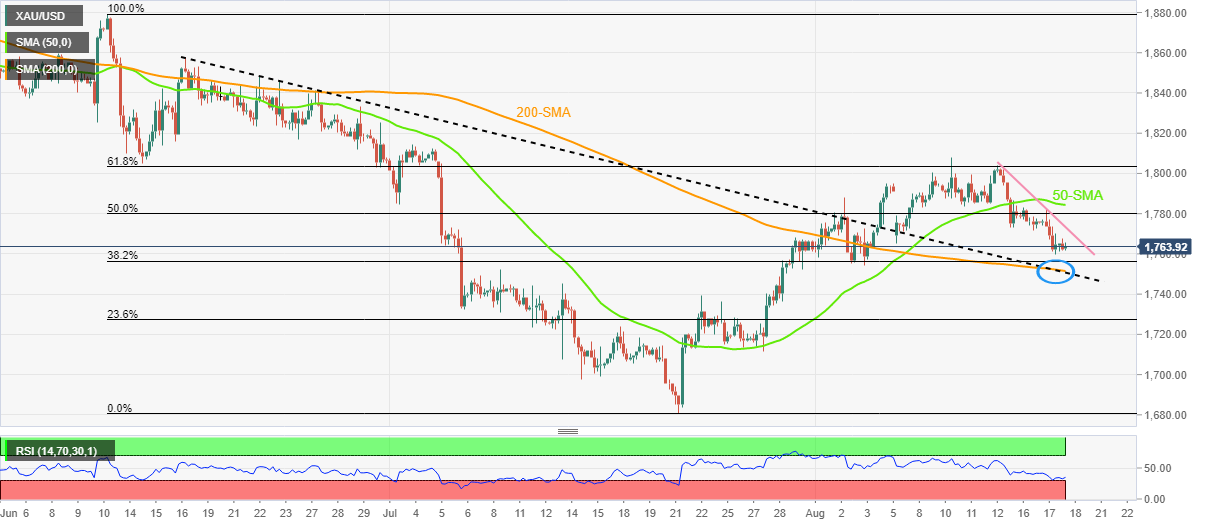
Trend: Further weakness expected
Author

Anil Panchal
FXStreet
Anil Panchal has nearly 15 years of experience in tracking financial markets. With a keen interest in macroeconomics, Anil aptly tracks global news/updates and stays well-informed about the global financial moves and their implications.

















