Gold price drops over 2% after Fed hold, US-China tariff talks boost US Dollar
- Fed holds rates at 4.25%–4.50%, citing economic uncertainty and balanced risks to mandates.
- Powell adopts neutral tone, says Fed can act “quickly” if needed but warns tariffs hinder policy goals.
- Despite pullback, Gold remains underpinned by global geopolitical risks and central bank buying.

Gold prices retreated by more than 2% on Wednesday, after the Federal Reserve (Fed) kept rates unchanged, and despite an improvement in risk appetite following the commencement of tariff talks between the United States (US) and China. At the time of writing, the XAU/USD trades at $3,371 after hitting a daily peak of $3,438.
On Wednesday, the Federal Reserve held interest rates steady at 4.25%–4.50% for a third consecutive meeting in 2025, citing growing uncertainty around the economic outlook and elevated risks to both maximum employment and price stability.
Fed Chair Jerome Powell maintained a neutral tone, stating that the current policy stance is appropriate and that the Fed is not in a hurry to adjust rates. He emphasized the central bank’s readiness to act “quickly as appropriate” if conditions change but warned that the Fed’s goals cannot be fully achieved if tariffs remain in place.
Powell added that if either side of the dual mandate veers too far off course, the Fed would evaluate which policy tools to use to rebalance. When asked which mandate—inflation or employment—requires more focus, he responded that it is too early to say.
On Tuesday, news that US Treasury Secretary Scott Bessent and China’s Vice Premier He Lifeng will meet in Switzerland calmed investors' fears about the “trade war.” Hence, the Greenback recovered some ground as traders booked profits and bought the US Dollar against its peers.
Despite this, Bullion prices are set to continue rallying amid the ongoing geopolitical conflicts between Russia/Ukraine, Israel/Hamas and India/Pakistan.
Central banks continued to add Gold to their reserves
The World Gold Council revealed that central banks from China, Poland and the Czech Republic increased their Bullion reserves in April.
Daily digest market movers: Gold rally halts as central banks continue to add Bullion to their reserves
- The Greenback’s recovery is a headwind for Bullion prices. The US Dollar Index (DXY), which tracks the buck’s value against a basket of six currencies, is up 0.13% at 99.52.
- Steady US Treasury yields have capped the Gold price rally. The US 10-year Treasury note yield is firm at 4.291%. Meanwhile, US real yields remain flat at 2.029%, as indicated by the US 10-year Treasury Inflation-Protected Securities yields.
- Data from the World Gold Council (WGC) revealed the People’s Bank of China (PBoC) added 2 tonnes to its Gold reserves in April – for the sixth consecutive month. Krishan Gopaul, Senior Analyst, EMEA, at the WGC, added, “Year-to-date net purchases now total 15 tonnes, helping to lift gold reserves to 2,294 tonnes.”
- The National Bank of Poland (NBP) increased 12 tonnes in April to 509 tonnes, while the Czech National Bank increased its reserves by 2.5 tonnes in April.
- Swap markets have so far priced in the Fed’s first 25 basis points (bps) rate cut for the July meeting, and they expect two additional reductions towards the end of the year.
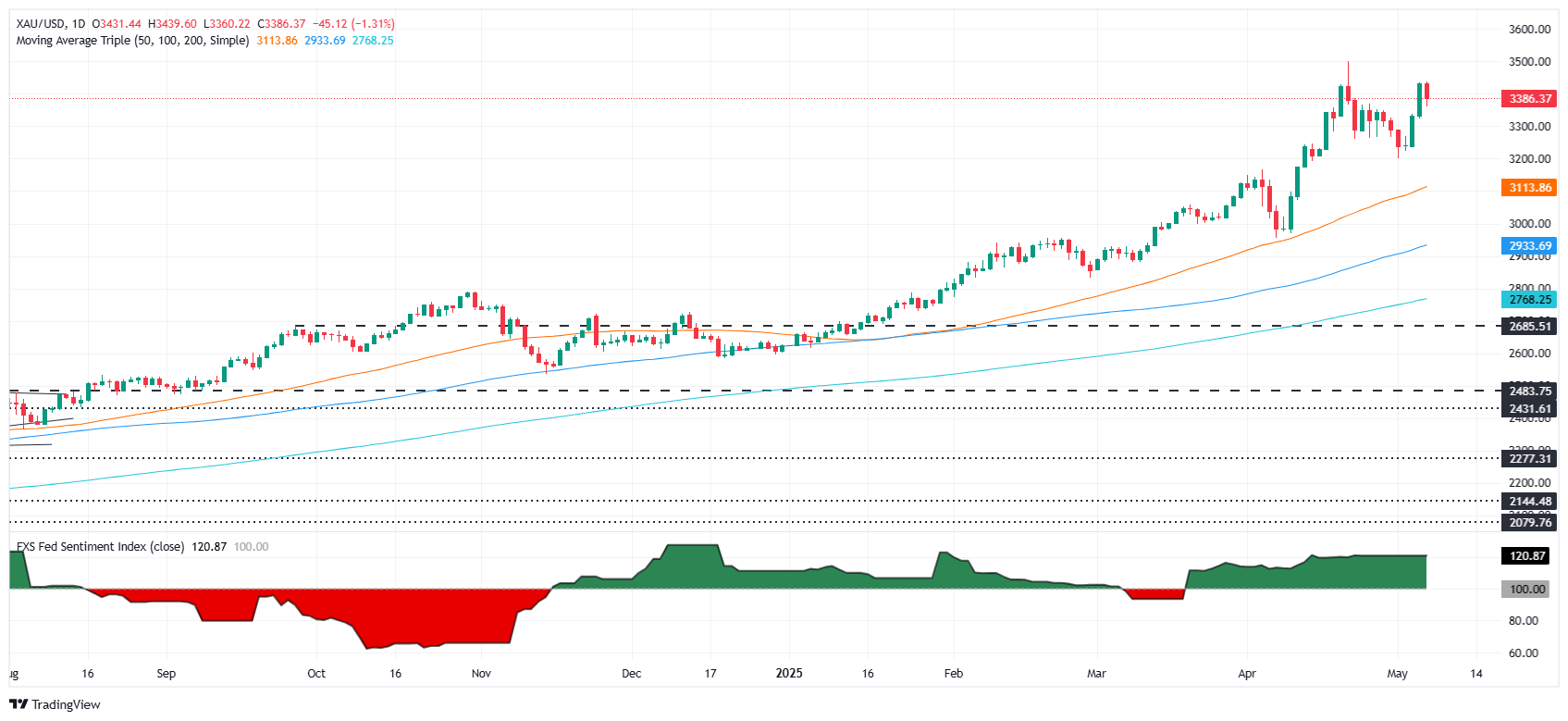
XAU/USD technical outlook: Gold price trapped within the $3,350-$3,400 range
Gold price retreats below $3,400, but it remains bullish. Nevertheless, buyers must reclaim the latter so they can remain hopeful of reaching the $3,450 mark. If these levels are taken out, bulls could test $3,500 Bullion’s all-time high (ATH)
On the other hand, Gold prices falling below $3,350 could pave the path to test the May 1 cycle low of $3,202. A decline beneath and sellers could challenge the 50-day Simple Moving Average (SMA) at $3,113.
Gold FAQs
Gold has played a key role in human’s history as it has been widely used as a store of value and medium of exchange. Currently, apart from its shine and usage for jewelry, the precious metal is widely seen as a safe-haven asset, meaning that it is considered a good investment during turbulent times. Gold is also widely seen as a hedge against inflation and against depreciating currencies as it doesn’t rely on any specific issuer or government.
Central banks are the biggest Gold holders. In their aim to support their currencies in turbulent times, central banks tend to diversify their reserves and buy Gold to improve the perceived strength of the economy and the currency. High Gold reserves can be a source of trust for a country’s solvency. Central banks added 1,136 tonnes of Gold worth around $70 billion to their reserves in 2022, according to data from the World Gold Council. This is the highest yearly purchase since records began. Central banks from emerging economies such as China, India and Turkey are quickly increasing their Gold reserves.
Gold has an inverse correlation with the US Dollar and US Treasuries, which are both major reserve and safe-haven assets. When the Dollar depreciates, Gold tends to rise, enabling investors and central banks to diversify their assets in turbulent times. Gold is also inversely correlated with risk assets. A rally in the stock market tends to weaken Gold price, while sell-offs in riskier markets tend to favor the precious metal.
The price can move due to a wide range of factors. Geopolitical instability or fears of a deep recession can quickly make Gold price escalate due to its safe-haven status. As a yield-less asset, Gold tends to rise with lower interest rates, while higher cost of money usually weighs down on the yellow metal. Still, most moves depend on how the US Dollar (USD) behaves as the asset is priced in dollars (XAU/USD). A strong Dollar tends to keep the price of Gold controlled, whereas a weaker Dollar is likely to push Gold prices up.
Author

Christian Borjon Valencia
FXStreet
Markets analyst, news editor, and trading instructor with over 14 years of experience across FX, commodities, US equity indices, and global macro markets.
















