Gold price attracts some sellers ahead of US Retail Sales
- The gold price trades with a negative bias in Friday’s early European session.
- The firmer USD, expectation of a slower pace of Fed rate cuts, exert selling pressure on the Gold price.
- The US Retail Sales report for October will take center stage later on Friday.

The Gold price (XAU/USD) struggles to gain ground around $2,570 on Friday after bouncing off a two-month low in the previous session. The precious metal remains under selling pressure amid the strong US Dollar (USD) and the rising uncertainty surrounding the Federal Reserve's (Fed) pace of interest rate reductions. The expectations of higher inflation next year due to Donald Trump’s policies have led to fewer expected rate cuts, weighing on the yellow metal as higher interest rates make holding non-yielding assets like gold less appealing.
However, the escalating tensions in the Middle East and the ongoing conflict between Ukraine and Russia could boost the Gold price, a traditional safe-haven asset. Looking ahead, investors will monitor the US Retail Sales for October, which are due later on Friday. Also, the NY Empire State Manufacturing Index and Industrial Production data will be published. The Fed’s Susan Collins and John Williams are set to speak later in the same day.
Gold price edges lower, US Dollar rally might cap its upside
- Fed Chair Jerome Powell said on Thursday that the recent performance of the US economy has been “remarkably good,” giving the Fed room to lower interest rates at a careful pace, per Bloomberg.
- Richmond Fed President Thomas Barkin stated on Thursday that while the Fed has made strong progress so far, there’s still more work to be done to keep the momentum going.
- The US Producer Price Index (PPI) rose 2.4% YoY in October, compared to a 1.9% rise recorded in September (revised from 1.8%), according to the US Bureau of Labor Statistics onThursday. This figure came in above the market expectation of 2.3%.
- The US weekly Initial Jobless Claims for the week ending November 9 increased to 217K from the previous week of 221K, below estimates of 223K.
- According to the CME FedWatch Tool, the markets have priced in nearly 59.1% of the 25 basis points (bps) rate cut by the Fed at the December meeting, down from 75% last week.
Gold price looks to resume the bearish trend
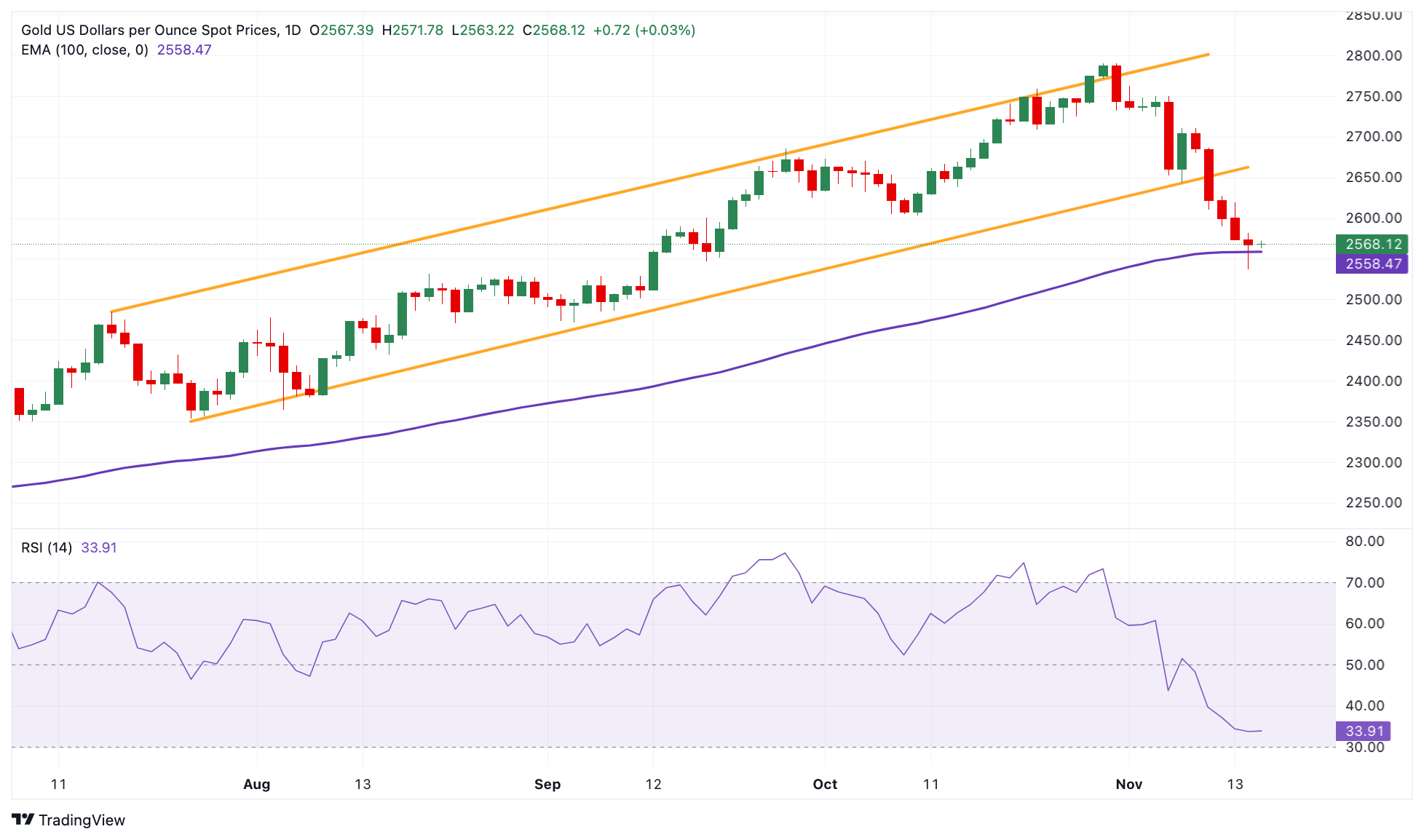
The Gold price edges higher on the day. The positive outlook of the precious metal seems vulnerable on the daily timeframe as the price hovers around the key 100-day Exponential Moving Average (EMA). The yellow metal could resume the downside if it can break below the 100-day EMA. The downward momentum cannot be ruled out as the 14-day Relative Strength Index (RSI) stands below the 50-midline near 33.60.
Consistent trading below the 100-day EMA could pave the way to $2,485, the low of September 8. The additional downside filter to watch is $2,353, the low of July 25. Extended losses could see a drop to the $2,300 psychological mark.
On the upside, the immediate resistance level for XAU/USD emerges near the support-turned-resistance level at $2,665. A decisive break above this level could result in a rally to $2,750, the high of November 6.
Gold FAQs
Gold has played a key role in human’s history as it has been widely used as a store of value and medium of exchange. Currently, apart from its shine and usage for jewelry, the precious metal is widely seen as a safe-haven asset, meaning that it is considered a good investment during turbulent times. Gold is also widely seen as a hedge against inflation and against depreciating currencies as it doesn’t rely on any specific issuer or government.
Central banks are the biggest Gold holders. In their aim to support their currencies in turbulent times, central banks tend to diversify their reserves and buy Gold to improve the perceived strength of the economy and the currency. High Gold reserves can be a source of trust for a country’s solvency. Central banks added 1,136 tonnes of Gold worth around $70 billion to their reserves in 2022, according to data from the World Gold Council. This is the highest yearly purchase since records began. Central banks from emerging economies such as China, India and Turkey are quickly increasing their Gold reserves.
Gold has an inverse correlation with the US Dollar and US Treasuries, which are both major reserve and safe-haven assets. When the Dollar depreciates, Gold tends to rise, enabling investors and central banks to diversify their assets in turbulent times. Gold is also inversely correlated with risk assets. A rally in the stock market tends to weaken Gold price, while sell-offs in riskier markets tend to favor the precious metal.
The price can move due to a wide range of factors. Geopolitical instability or fears of a deep recession can quickly make Gold price escalate due to its safe-haven status. As a yield-less asset, Gold tends to rise with lower interest rates, while higher cost of money usually weighs down on the yellow metal. Still, most moves depend on how the US Dollar (USD) behaves as the asset is priced in dollars (XAU/USD). A strong Dollar tends to keep the price of Gold controlled, whereas a weaker Dollar is likely to push Gold prices up.
Author

Lallalit Srijandorn
FXStreet
Lallalit Srijandorn is a Parisian at heart. She has lived in France since 2019 and now becomes a digital entrepreneur based in Paris and Bangkok.

















