Gold price drops to over three-week low, closer to $2,850 ahead of US PCE data
- Gold price attracts sellers for the second straight day amid a broadly stronger USD.
- The risk-off mood and sliding US bond yields do little to support the precious metal.
- Traders now look forward to the US PCE Price Index for some meaningful impetus.

Gold price (XAU/USD) prolongs this week's retracement slide from the all-time peak and continues losing ground for the second straight day on Friday. This also marks the third day of a negative move in the previous four and drags the commodity to over a three-week low, close to the $2,850 region during the first half of the European session. Expectations that the Federal Reserve (Fed) will stick to its hawkish stance amid still-elevated inflation assist the US Dollar (USD) to recover further from over a two-month low touched on Wednesday. This, in turn, is seen as a key factor weighing heavily on the non-yielding yellow metal.
Apart from this, the downfall could further be attributed to some repositioning trade ahead of the US Personal Consumption Expenditure (PCE) Price Index. The crucial US inflation data might influence the Fed's interest rate outlook and determine the near-term trajectory for the Gold price. Meanwhile, the intraday slide seems unaffected by the risk-off impulse, which tends to benefit the safe-haven bullion. Even worries about US President Donald Trump's tariff plans and declining US Treasury bond yields fail to lend any support, which supports prospects for a further near-term depreciating move for the XAU/USD pair.
Daily Digest Market Movers: Gold price bulls remain on the sidelines amid broadly stronger USD
- Data released on Thursday revealed that inflation in the US continues to rise and backs the case for the Federal Reserve to hold interest rates steady. This assists the US Dollar in building on its recovery from over a two-month low and drags the non-yielding Gold price to over a two-week low on Friday.
- The US Bureau of Economic Analysis published the second reading of the US Gross Domestic Product, which showed that the economy expanded as estimated previously, by a 2.3% annualized pace during the final quarter of 2024. Moreover, the GDP Price Index rose 2.4% compared to the initial estimate of 2.2%.
- This comes on top of worries that US President Donald Trump's policies would reignite inflation. Furthermore, Fed officials remain wary of future interest rate cuts amid sticky inflation, which continues to underpin the USD and contributes to driving flows away from the non-yielding yellow metal.
- Kansas City Fed President Jeff Schmid said on Thursday that recent surveys indicated a rise in consumer inflation expectations and that the central bank must stay focused on fully containing price pressures.
- Adding to this, Cleveland Fed President Beth Hammack noted that interest rates are likely on hold for the time being as inflation data starts to pose a growing problem for central policymakers.
- Separately, Philadelphia Fed President Patrick Harker noted that progress toward the 2% inflation target has slowed and that the policy rate remains restrictive to continue putting downward pressure on inflation.
- Hence, the market focus will remain glued to the release of the US Personal Consumption Expenditure (PCE) Price Index, due later during the North American session. The crucial inflation data will influence the Fed's interest rate outlook, which will drive the USD and provide some meaningful impetus to the XAU/USD pair.
- Meanwhile, investors remain worried about the potential economic fallout from Trump's tariff plans. In fact, Trump said that his proposed tariffs on Canada and Mexico would come into effect on March 4 as scheduled and has also threatened to announce a 25% tariff on imports from the European Union.
Gold price builds on the breakdown momentum below the 23.6% Fibo. level, remains vulnerable
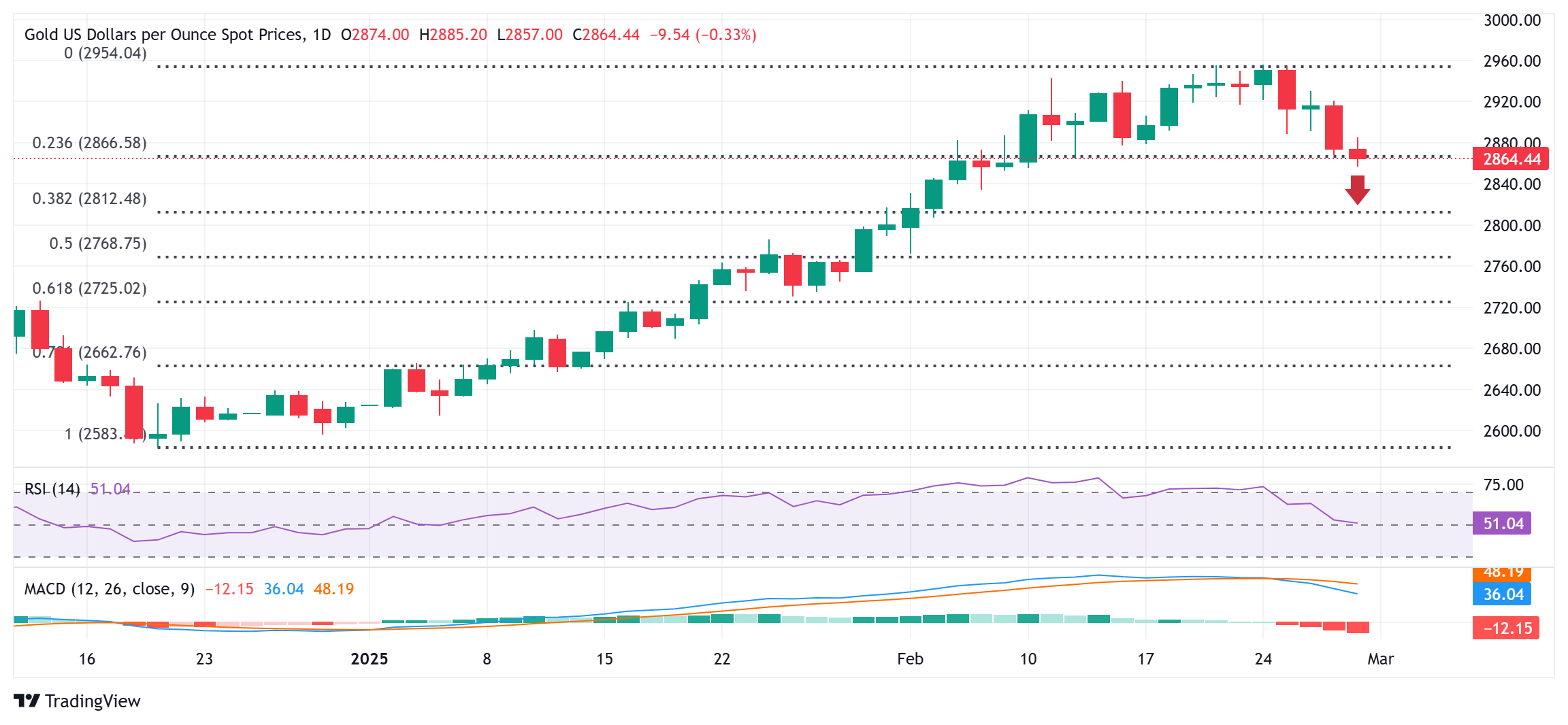
From a technical perspective, the latest leg down has now dragged the Gold price below the 23.6% Fibonacci retracement level of the December-February rally. Moreover, oscillators on the daily chart have just started gaining negative traction, and support prospects for an extension of this week's corrective pullback from the all-time peak. Some follow-through selling below the $2,856-2,855 horizontal zone will reaffirm the negative bias and drag the XAU/USD pair to the next relevant support near the $2,834 region en route to the 38.2% Fibo. level, around the $2,815-2,810 region. This is closely followed by the $2,800 mark, which if broken decisively will suggest that the commodity has topped out and also pave the way for deeper losses.
On the flip side, momentum back above the $2,867 area (23.6% Fibo. level) might now confront stiff resistance near the Asian session peak, around the $2,885 region, ahead of the $2,900 mark. A sustained strength beyond the latter could lift the Gold price further towards the $2,915 horizontal support breakpoint, which should now act as a key pivotal point. Some follow-through buying will shift the bias back in favor of bullish traders and expose the all-time peak, around the $2,956 region, with some intermediate hurdle near the $2,934 zone.
Interest rates FAQs
Interest rates are charged by financial institutions on loans to borrowers and are paid as interest to savers and depositors. They are influenced by base lending rates, which are set by central banks in response to changes in the economy. Central banks normally have a mandate to ensure price stability, which in most cases means targeting a core inflation rate of around 2%. If inflation falls below target the central bank may cut base lending rates, with a view to stimulating lending and boosting the economy. If inflation rises substantially above 2% it normally results in the central bank raising base lending rates in an attempt to lower inflation.
Higher interest rates generally help strengthen a country’s currency as they make it a more attractive place for global investors to park their money.
Higher interest rates overall weigh on the price of Gold because they increase the opportunity cost of holding Gold instead of investing in an interest-bearing asset or placing cash in the bank. If interest rates are high that usually pushes up the price of the US Dollar (USD), and since Gold is priced in Dollars, this has the effect of lowering the price of Gold.
The Fed funds rate is the overnight rate at which US banks lend to each other. It is the oft-quoted headline rate set by the Federal Reserve at its FOMC meetings. It is set as a range, for example 4.75%-5.00%, though the upper limit (in that case 5.00%) is the quoted figure. Market expectations for future Fed funds rate are tracked by the CME FedWatch tool, which shapes how many financial markets behave in anticipation of future Federal Reserve monetary policy decisions.
Author

Haresh Menghani
FXStreet
Haresh Menghani is a detail-oriented professional with 10+ years of extensive experience in analysing the global financial markets.