Gold price crumbles below $3,300 as trade hopes fade, US Dollar stays firm
- Gold fails to hold gains despite falling US Treasury yields and softer DXY.
- Trump’s refusal to lift China tariffs without concessions sours market mood.
- Traders brace for heavy US data week including GDP, ISM and Nonfarm Payrolls.

Gold price made a U-turn and erased Thursday’s gains, falling below the $3,300 mark as the Greenback remained bid and Bullion failed to capitalize on falling US Treasury yields. A de-escalation of the trade war between the US and China sponsored a leg-down in the precious metal, which exchanged hands at $3,294, losing over 1.60%.
Markets remain volatile as sentiment swings between risk-on and risk-off due to comments made by US President Donald Trump. Earlier, Bloomberg revealed that China wants to exempt some US products from tariffs. Traders reacted positively to the news, but later Trump said he “won’t remove China tariffs unless they give us something.”
Sentiment went sour, and even though the Greenback paired some of its gains with the US Dollar Index (DXY) edging down, it remains up 0.23% at 99.51. This prevents Gold from recovering some ground, and it seems traders were caught off guard after booking profits ahead of the weekend.
US Consumer Sentiment worsened in April, according to the University of Michigan (UoM), which reported the fourth lowest reading since the late 1970s.
Next week, traders are eyeing the release of the US JOLTS report for March, the first reading of Q1 2025 Gross Domestic Product (GDP), the ISM Manufacturing PMI, and April’s Nonfarm Payrolls figures.
Regarding the chances of the Fed reducing interest rates at the upcoming meeting, traders see a 92% chance of keeping them unchanged, according to Prime Market Terminal. Nevertheless, traders expect the fed funds rate to end the year at 3.45%, equal to 86 basis points of easing (bps).
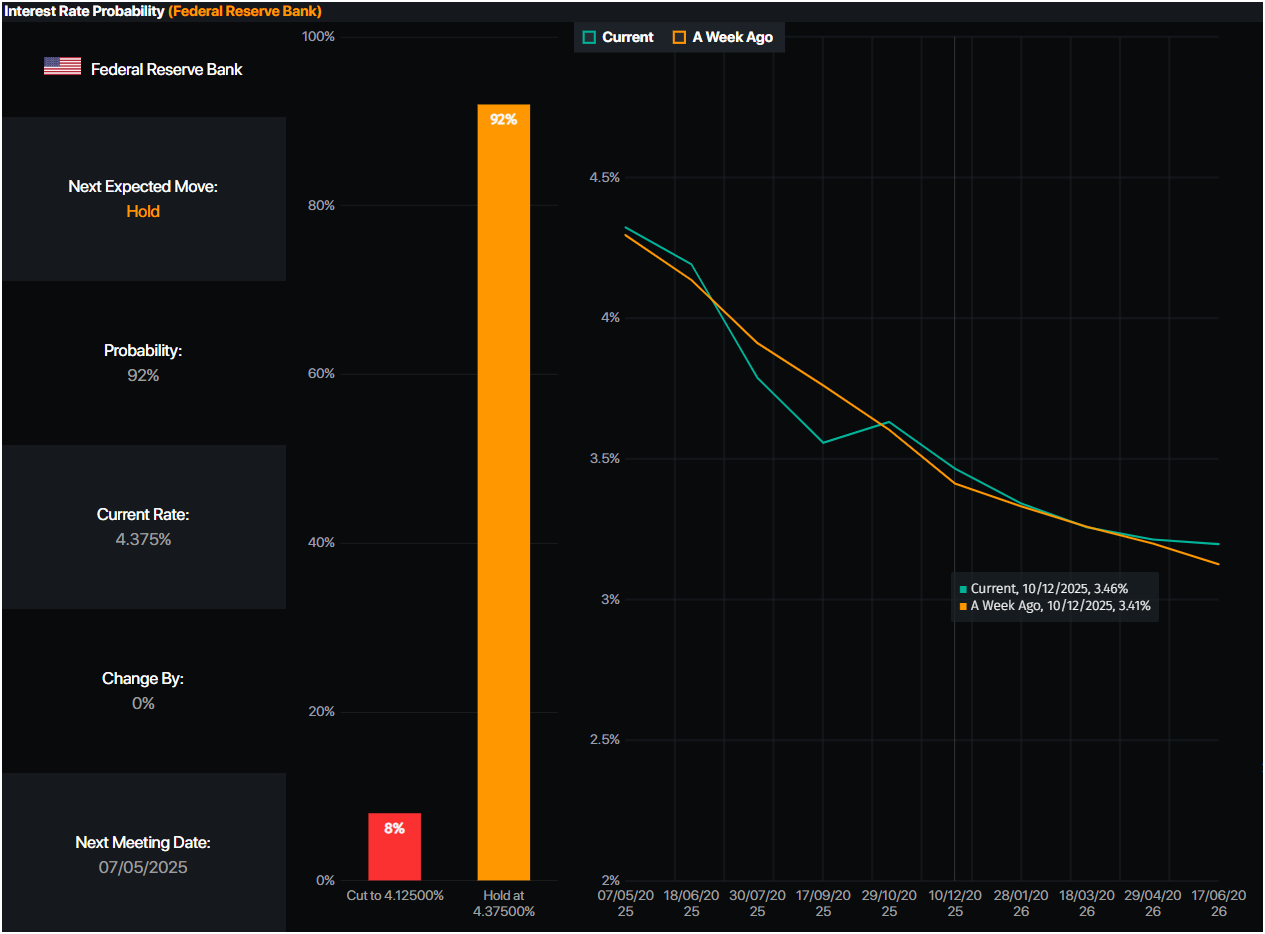
Source: Prime Market Terminal
Daily digest market movers: Gold price falls as the Greenback stages a comeback
- The yield on the US 10-year Treasury note has dropped five basis points, reaching 4.266%.
- US real yields collapsed four and a half bps to 1.968%, as shown by the US 10-year Treasury Inflation-Protected Securities yields.
- The University of Michigan (UoM) Consumer Sentiment in April dipped from 57 to 52. Consumers’ inflation expectations for one year rose from 5% to 6.5% and a five-year increase of 4.4% from 4.1%.
- On Thursday, Cleveland Fed President Beth Hammack stated the Fed could act as soon as June if the data supports it but emphasized that uncertainty is weighing on business planning.
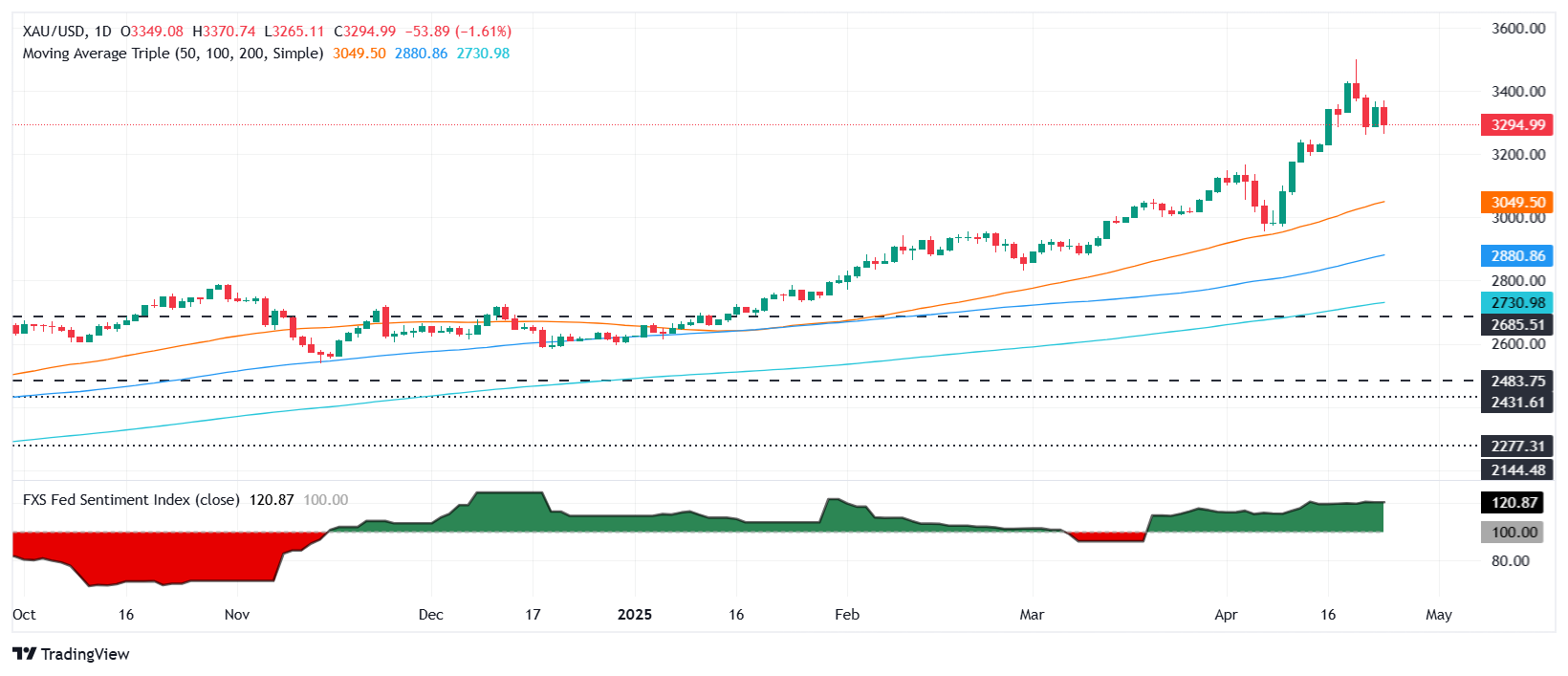
XAU/USD technical outlook: Remains bullish but poised to test $3,200
Gold’s uptrend remains intact, though the precious metal drifts below $3,300 due to buyers' lack of commitment to pushing prices above $3,400. Also, the Relative Strength Index (RSI) shows buyers’ momentum is fading. This clears the path for sellers to push XAU/USD lower.
The first support would be $3,250. A breach of the latter will expose the April 3 peak of $3,167 and the 50-day Simple Moving Average (SMA) at $3,041.
Conversely, if buyers reclaim $3,300, the next key resistance would be the April 22 high of $3,386 to prevent sellers from dragging down prices. The next key resistance level would be $3,400, followed by the $3,450 and the $3,500 figures.
Gold FAQs
Gold has played a key role in human’s history as it has been widely used as a store of value and medium of exchange. Currently, apart from its shine and usage for jewelry, the precious metal is widely seen as a safe-haven asset, meaning that it is considered a good investment during turbulent times. Gold is also widely seen as a hedge against inflation and against depreciating currencies as it doesn’t rely on any specific issuer or government.
Central banks are the biggest Gold holders. In their aim to support their currencies in turbulent times, central banks tend to diversify their reserves and buy Gold to improve the perceived strength of the economy and the currency. High Gold reserves can be a source of trust for a country’s solvency. Central banks added 1,136 tonnes of Gold worth around $70 billion to their reserves in 2022, according to data from the World Gold Council. This is the highest yearly purchase since records began. Central banks from emerging economies such as China, India and Turkey are quickly increasing their Gold reserves.
Gold has an inverse correlation with the US Dollar and US Treasuries, which are both major reserve and safe-haven assets. When the Dollar depreciates, Gold tends to rise, enabling investors and central banks to diversify their assets in turbulent times. Gold is also inversely correlated with risk assets. A rally in the stock market tends to weaken Gold price, while sell-offs in riskier markets tend to favor the precious metal.
The price can move due to a wide range of factors. Geopolitical instability or fears of a deep recession can quickly make Gold price escalate due to its safe-haven status. As a yield-less asset, Gold tends to rise with lower interest rates, while higher cost of money usually weighs down on the yellow metal. Still, most moves depend on how the US Dollar (USD) behaves as the asset is priced in dollars (XAU/USD). A strong Dollar tends to keep the price of Gold controlled, whereas a weaker Dollar is likely to push Gold prices up.
Author

Christian Borjon Valencia
FXStreet
Markets analyst, news editor, and trading instructor with over 14 years of experience across FX, commodities, US equity indices, and global macro markets.