Gold slumps as US yields jump, markets shrug off tariff threats
- Gold drops over 1% as US Dollar and Treasury yields strengthen.
- Trump delays tariff deadline to August 1, calming trade nerves.
- Traders scale back 2025 Fed cut expectations to just 48 basis points.

Gold price is plunging over 1% on Tuesday during the North American session as appetite for its safe-haven demand diminished, although US President Donald Trump announced that the first tariff letters had been sent to some of the US's trade partners. Additionally, the US Dollar's recovery and heightened US Treasury yields exert downward pressure on the precious metal, which trades at $3,297 after reaching a high of $3,345.
Sentiment has improved, as depicted by the major US equity indices. On Monday, Trump imposed tariffs within the 25% to 40% range on 14 countries, although he decided to push back the July 9 deadline to August 1, stating that no further extensions would be warranted. Policymakers from Japan and South Korea said they would try to negotiate with the US, seeking a reduction of levies.
The jump in US Treasury yields also pressures the bullion price, as investors priced out rate cuts by the Federal Reserve (Fed). Data from the Chicago Board of Trade revealed that market players are eyeing 48 basis points (bps) of easing in 2025.
Traders are awaiting the release of the latest Federal Reserve meeting minutes on Wednesday. After that, the docket will feature the release of Initial Jobless Claims for the week ending July 5.
Daily digest market movers: Gold pressured despite witnessing the largest inflow to Gold ETFs
- Gold’s uptrend is questionable as it approaches strong support near $3,250. High US Treasury yields and a strong US Dollar are weighing on the yellow metal. The US 10-year Treasury note yield rose four basis points to 4.423%. US real yields are also up four bps at 2.073%. The US Dollar Index (DXY), which tracks the Greenback’s performance against a basket of currencies, advances 0.20% to 97.70.
- US President Donald Trump commented that the Federal Reserve Chair Jerome Powell should resign immediately and that the August 1 deadline is fixed. He stated that some tariff letters are at a rate of 60% or 70%. Regarding the European Union (EU), he said the EU is treating the US very nicely, that’s why he refrained from sending the letter.
- Trump added that he could have been harsher on trade and announced that he would impose duties on pharmaceuticals, semiconductors, and copper, which he said would result in tariffs of around 50%.
- The NFIB Small Business Optimism Index edged down to 98.6 in June, slightly below expectations of 98.7 and a decline from May’s reading of 98.8. The decrease was primarily driven by an increase in the number of respondents citing excessive inventories.
- Even though XAU/USD remains pressured, the World Gold Council (WGC) announced that Gold ETFs drew the largest inflow in five years during the first half of 2025. “Gold ETFs recorded an inflow of $38 billion in the first half of 2025 with their collective holdings rising by 397.1 metric tons of Gold.” The total holdings by the end of June rose to 3,615.9 tons, the largest since August 2022.
- The People's Bank of China (PBoC) revealed that it added 70,000 tons, meaning that the central bank’s Gold reserves increased by 1.1 million since purchases resumed last November.
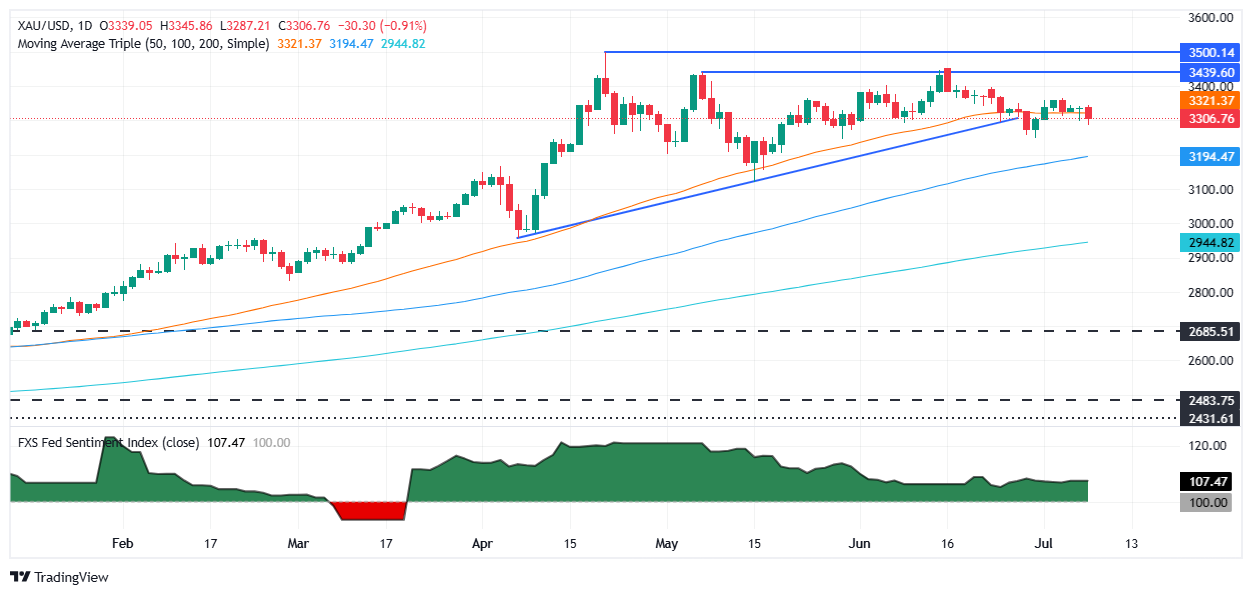
XAU/USD technical outlook: Gold price collapses towards $3,300
Gold’s uptrend remains in play, but it seems that buyers are losing steam. It is worth noting that the Relative Strength Index (RSI) triggered a ‘sell signal’ as the index crossed below 50, an indication that sellers are outweighing buyers.
From a price action perspective, XAU/USD needs to clear the June 30 low of $3,246 to pave the way for further downside, with the 100-day Simple Moving Average (SMA) at $3,181 eyed, followed by the May 15 low of $3,120.
Conversely, if XAU/USD climbs back above the 50-day SMA $3,320, expect a test of $3,350.
US-China Trade War FAQs
Generally speaking, a trade war is an economic conflict between two or more countries due to extreme protectionism on one end. It implies the creation of trade barriers, such as tariffs, which result in counter-barriers, escalating import costs, and hence the cost of living.
An economic conflict between the United States (US) and China began early in 2018, when President Donald Trump set trade barriers on China, claiming unfair commercial practices and intellectual property theft from the Asian giant. China took retaliatory action, imposing tariffs on multiple US goods, such as automobiles and soybeans. Tensions escalated until the two countries signed the US-China Phase One trade deal in January 2020. The agreement required structural reforms and other changes to China’s economic and trade regime and pretended to restore stability and trust between the two nations. However, the Coronavirus pandemic took the focus out of the conflict. Yet, it is worth mentioning that President Joe Biden, who took office after Trump, kept tariffs in place and even added some additional levies.
The return of Donald Trump to the White House as the 47th US President has sparked a fresh wave of tensions between the two countries. During the 2024 election campaign, Trump pledged to impose 60% tariffs on China once he returned to office, which he did on January 20, 2025. With Trump back, the US-China trade war is meant to resume where it was left, with tit-for-tat policies affecting the global economic landscape amid disruptions in global supply chains, resulting in a reduction in spending, particularly investment, and directly feeding into the Consumer Price Index inflation.
Author

Christian Borjon Valencia
FXStreet
Markets analyst, news editor, and trading instructor with over 14 years of experience across FX, commodities, US equity indices, and global macro markets.

















