Gold price retreats from one-week high amid receding safe-haven demand
- Gold price retreats from a one-week high amid the prevalent risk-on environment.
- Trade war fears, Fed rate cut bets, and a bearish USD could support the commodity.
- Traders might also opt to wait for the release of the crucial US NFP report on Friday.

Gold price (XAU/USD) attracts some sellers during the first half of the European session on Thursday, though it manages to hold above the $2,900 round figure. The US offered some concessions in recent trade tariffs against Canada and Mexico, which boosts investors' appetite for riskier assets and turns out to be a key factor driving flows away from the safe-haven precious metal. Apart from this, the intraday downtick lacks any fundamental catalyst and is more likely to remain limited.
Investors remain worried about US President Donald Trump's tariff measures and the rising risk of a global trade war, which continues to act as a tailwind for the safe-haven Gold price. Furthermore, expectations that Trump's policies could slow the US economic growth and force the Federal Reserve (Fed) to cut interest rates multiple times in 2025 should contribute to limiting the downside for the bullion. This, in turn, warrants some caution for bearish traders.
Daily Digest Market Movers: Gold price drifts lower as upbeat market mood undermines safe-haven demand
- US President Donald Trump's new 25% tariffs on most imports from Mexico and Canada took effect on Tuesday, along with the doubling of duties on Chinese goods to 20%.
- Canada announced retaliatory tariffs against more than $100 billion worth of US products, while China slapped tariffs of up to 15% on various US agricultural exports.
- In his first address to the US Congress, Trump said that further tariffs, including "reciprocal tariffs" would follow on April 2, raising the risk of an all-out trade war.
- Investors remain worried that Trump's tariffs could slow the US economic growth and force the Federal Reserve to cut interest rates multiple times by the end of this year.
- The bets were lifted by the Automatic Data Processing (ADP) report, which showed that US private sector employment grew by just 77K in February, vs 140K expected.
- Meanwhile, the economic activity in the US service sector continued to expand at an accelerating pace in February, though it did little to inspire the US Dollar bulls.
- The USD Index (DXY) drops to its lowest level since December 2024 and further acts as a tailwind for the Gold price during the Asian session on Thursday.
- The White House announced a one-month delay for US automakers to comply with the US–Mexico–Canada Agreement regarding the tariffs imposed on Mexico and Canada.
- This, in turn, boosts investors' appetite for riskier assets, which is holding back traders from placing aggressive bullish bets around the safe-haven XAU/USD pair.
- Investors now look to the usual Weekly Initial Jobless Claims data from the US for some impetus, though the focus remains on the US Nonfarm Payrolls on Friday.
Gold price any further slide could be seen as buying opportunity and remain limited near the $2,884-2,883 region
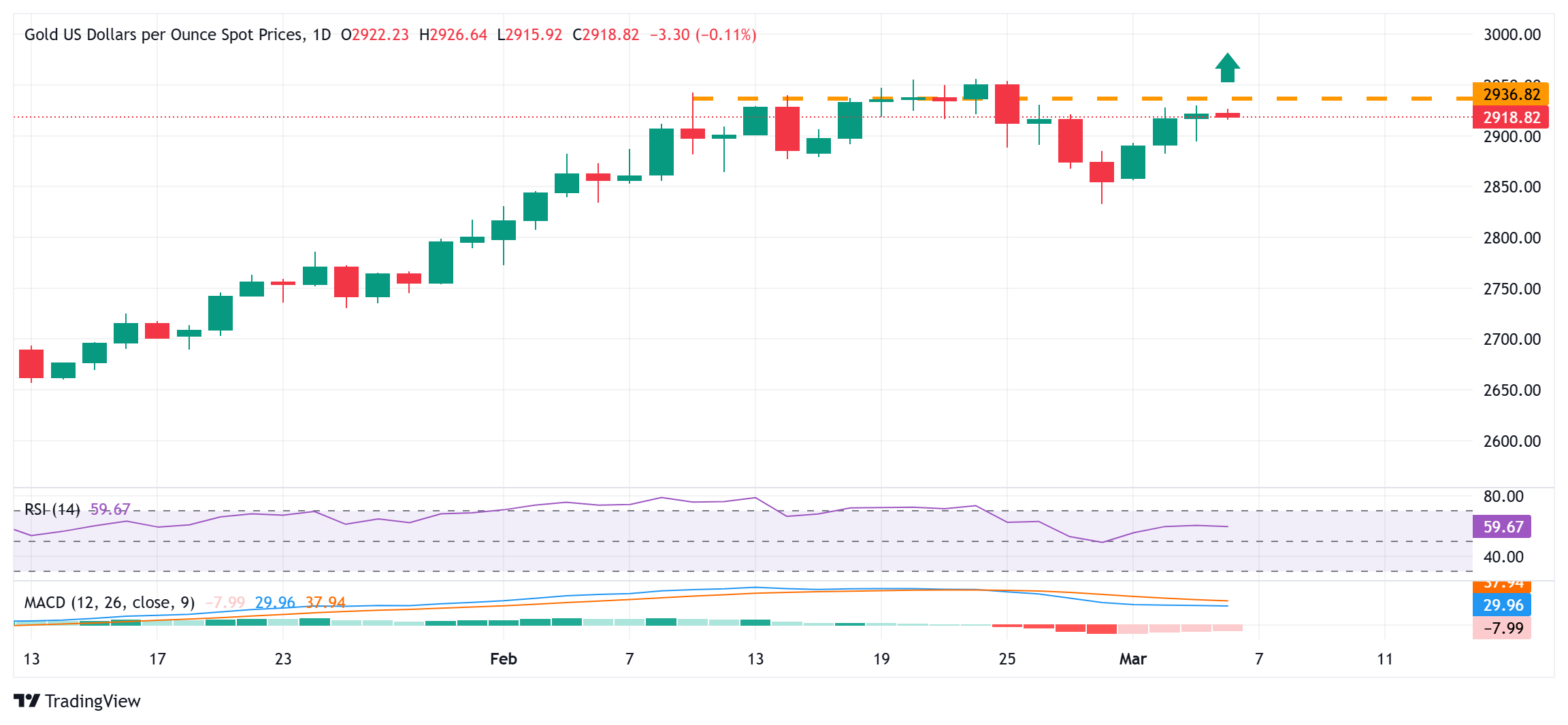
From a technical perspective, momentum beyond the $2,934 immediate hurdle has the potential to lift the Gold price back towards the all-time peak, around the $2,956 area touched in February. Some follow-through buying would be seen as a fresh trigger for bullish traders and pave the way for an extension of a multi-month-old uptrend witnessed amid positive oscillators on the daily chart.
Meanwhile, the lack of follow-through buying warrants some caution before positioning for any further gains. That said, any corrective slide might still be seen as a buying opportunity near the $2,900 mark and remain limited. Some follow-through selling, however, could pave the way for deeper losses towards the $2,884-2,883 intermediate support en route to the $2,860-2,858 horizontal support.
Interest rates FAQs
Interest rates are charged by financial institutions on loans to borrowers and are paid as interest to savers and depositors. They are influenced by base lending rates, which are set by central banks in response to changes in the economy. Central banks normally have a mandate to ensure price stability, which in most cases means targeting a core inflation rate of around 2%. If inflation falls below target the central bank may cut base lending rates, with a view to stimulating lending and boosting the economy. If inflation rises substantially above 2% it normally results in the central bank raising base lending rates in an attempt to lower inflation.
Higher interest rates generally help strengthen a country’s currency as they make it a more attractive place for global investors to park their money.
Higher interest rates overall weigh on the price of Gold because they increase the opportunity cost of holding Gold instead of investing in an interest-bearing asset or placing cash in the bank. If interest rates are high that usually pushes up the price of the US Dollar (USD), and since Gold is priced in Dollars, this has the effect of lowering the price of Gold.
The Fed funds rate is the overnight rate at which US banks lend to each other. It is the oft-quoted headline rate set by the Federal Reserve at its FOMC meetings. It is set as a range, for example 4.75%-5.00%, though the upper limit (in that case 5.00%) is the quoted figure. Market expectations for future Fed funds rate are tracked by the CME FedWatch tool, which shapes how many financial markets behave in anticipation of future Federal Reserve monetary policy decisions.
Author

Haresh Menghani
FXStreet
Haresh Menghani is a detail-oriented professional with 10+ years of extensive experience in analysing the global financial markets.