Gold slips on Powell remarks of no rush to lower rates
- XAU/USD remains subdued under the weight of a strengthening Dollar and recent US inflation data.
- Producer Price Index exceeds expectations, suggesting Fed easing cycle might be reconsidered.
- Investors recalibrate expectations for December Fed rate cut amid ongoing inflation concerns.

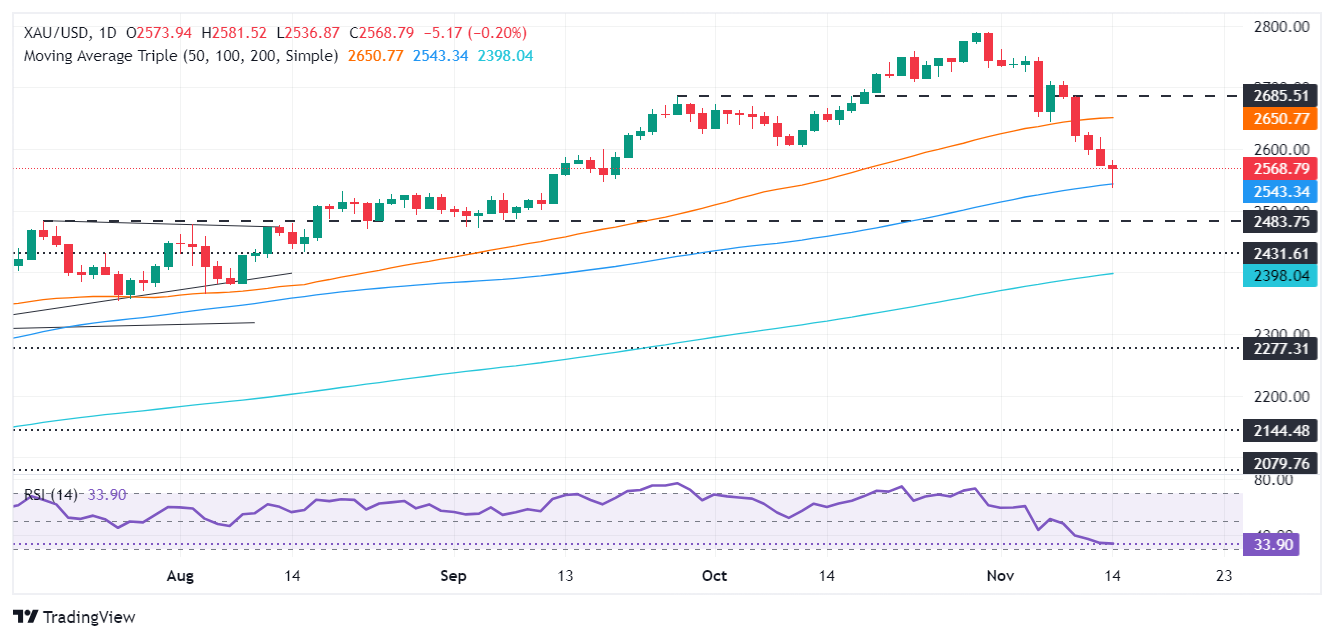
Gold recovers some ground on Thursday yet remains trading below its opening price for the fifth consecutive day, undermined by the Greenback’s advance for its own fifth consecutive day. A slightly hot inflation report in the US and solid jobs data sponsored XAU/USD’s leg down toward the 100-day Simple Moving Average (SMA). At the time of writing, Bullion trades at $2,568.
The market mood shifted negatively yet failed to boost Gold’s prices and underpin the US Dollar. The US Bureau of Labor Statistics revealed that the Producer Price Index (PPI) rose in October, exceeding estimates and September’s figures.
This indicates that the Federal Reserve's (Fed) job is far from done, even though the central bank embarked on an easing cycle that has seen the Fed lower its primary interest rate instrument by 75 basis points since September 2024.
At the same time, the US Department of Labor revealed that unemployment claims filled by Americans diminished compared to the previous reading
Fed officials have recently underscored the delicate act of balancing inflation control with employment goals. Governor Adriana Kugler stressed the importance of addressing both mandates, pointing out that while strides have been made toward reducing inflation, hitting the 2% target remains challenging.
Likewise, Richmond Fed President Thomas Barkin acknowledged the progress in curbing inflation but warned against premature optimism. He sees risks like substantial union wage settlements and potential tariff hikes, which could spark inflationary pressure.
Gold has been undermined by investor fears that US President-elect Donald Trump’s proposed tariffs and tax reductions are likely to increase inflation, which could prompt the Fed to pause its easing cycle.
Market participants see a 72% chance of a quarter percentage rate cut by the Fed in the upcoming December meeting, down from 82% a day ago.
Investors are awaiting remarks from Fed Chair Jerome Powell later on Thursday along with Friday's US Retail Sales data.
Daily digest market movers: Gold steadies alongside strong US Dollar
- Gold prices recover as US real yields, which inversely correlate against Bullion, fall three basis points to 2.068%. The DXY registers gains of 0.18% to 106.67.
- Fed Chair Jerome Powell, commented the US economy is not sending signals that US central bank needs to be in a hurry to lower interest rates, and he expect inflation to “come down toward the 2% goal.” Powell reassured the Fed’s commitment on inflation.
- The US PPI surpassed expectations with the headline increasing by 2.4% YoY, beating the 2.3% forecast and up from 1.9% in September. The Core PPI, often influencing the core Personal Consumption Expenditures (PCE) Price Index, rose by 3.1% YoY, higher than the prior 2.9% and above the expected 3%.
- Initial Jobless Claims for the week ending November 9 came in at 217K, a decrease from the previous week's 221K and below the forecast of 223K.
- According to the December fed funds futures contract data from the Chicago Board of Trade, investors are projecting a 25 bps Fed rate cut in December.
XAU/USD Technical Outlook: Gold price holds firm, but downside risks remain
Gold (XAU/USD) has recently declined below the October 10 swing low of $2,603, exacerbating further losses below $2,600 and opening the door to a new two-month low of $2,536, briefly below the 100-day Simple Moving Average (SMA) at $2,547. Nevertheless, sellers’ failure to push Bullion prices toward $2,500 paved the way for a leg-up.
XAU/USD’s first resistance is seen at $2,600. If buyers reclaim that level, they could test the 50-day SMA at $2,650, with subsequent resistance around $2,700. Surpassing this could open the path to the November 7 high of $2,710.
The Relative Strength Index (RSI) has moved away from its neutral line, suggesting a bearish momentum that could lead to further declines in XAU/USD.
Risk sentiment FAQs
In the world of financial jargon the two widely used terms “risk-on” and “risk off'' refer to the level of risk that investors are willing to stomach during the period referenced. In a “risk-on” market, investors are optimistic about the future and more willing to buy risky assets. In a “risk-off” market investors start to ‘play it safe’ because they are worried about the future, and therefore buy less risky assets that are more certain of bringing a return, even if it is relatively modest.
Typically, during periods of “risk-on”, stock markets will rise, most commodities – except Gold – will also gain in value, since they benefit from a positive growth outlook. The currencies of nations that are heavy commodity exporters strengthen because of increased demand, and Cryptocurrencies rise. In a “risk-off” market, Bonds go up – especially major government Bonds – Gold shines, and safe-haven currencies such as the Japanese Yen, Swiss Franc and US Dollar all benefit.
The Australian Dollar (AUD), the Canadian Dollar (CAD), the New Zealand Dollar (NZD) and minor FX like the Ruble (RUB) and the South African Rand (ZAR), all tend to rise in markets that are “risk-on”. This is because the economies of these currencies are heavily reliant on commodity exports for growth, and commodities tend to rise in price during risk-on periods. This is because investors foresee greater demand for raw materials in the future due to heightened economic activity.
The major currencies that tend to rise during periods of “risk-off” are the US Dollar (USD), the Japanese Yen (JPY) and the Swiss Franc (CHF). The US Dollar, because it is the world’s reserve currency, and because in times of crisis investors buy US government debt, which is seen as safe because the largest economy in the world is unlikely to default. The Yen, from increased demand for Japanese government bonds, because a high proportion are held by domestic investors who are unlikely to dump them – even in a crisis. The Swiss Franc, because strict Swiss banking laws offer investors enhanced capital protection.
Author

Christian Borjon Valencia
FXStreet
Markets analyst, news editor, and trading instructor with over 14 years of experience across FX, commodities, US equity indices, and global macro markets.