Gold price keeps the red as easing trade tensions undermine safe-haven demand; lacks bearish conviction
- Gold price drifts lower as the US-China trade truce optimism undermines safe-haven demand.
- Tuesday’s US CPI print reaffirms Fed rate cut bets and keeps the USD bulls on the defensive.
- Geopolitical risks could limit deeper losses for the XAU/USD pair, warranting caution for bears.

Gold price (XAU/USD) remains depressed through the first half of the European session on Wednesday, though it manages to hold above the #3,200 round-figure mark or the weekly through. The latest optimism over the de-escalation of a potentially damaging US-China trade war remains supportive of a generally positive tone around the equity markets and turns out to be a key factor undermining the safe-haven bullion.
The downside, however, remains cushioned in the wake of a modest US Dollar (USD) downtick. The softer-than-expected inflation data from the US released on Tuesday reaffirmed bets for at least two interest rate cuts by the Federal Reserve (Fed) in 2025. This keeps the USD depressed below its highest level since April 10, touched earlier this week, and acts as a tailwind for the non-yielding Gold rice, warranting caution for bears.
Daily Digest Market Movers: Gold price bulls remain on the sidelines amid US-China trade truce optimism
- US President Donald Trump said on Monday that he does not see tariffs on Chinese imports returning to 145% after the 90-day pause. In a Fox News interview earlier this Wednesday, Trump said that the relationship with China is excellent, adding to the trade optimism and undermining the safe-haven Gold price during the Asian session.
- On the geopolitical front, Russia and Ukraine are set for their first high-level face-to-face talks since 2022 in Istanbul this week amid increasing demand for Russia to agree to a 30-day ceasefire. On the US side, Secretary of State Marco Rubio and special envoys Steve Witkoff and Keith Kellogg are expected to attend the negotiations.
- The Israeli military said it intercepted a hypersonic ballistic missile fired by the Iran-aligned Houthis militia group towards Ben Gurion Airport near Tel Aviv from Yemen on Tuesday evening. This keeps geopolitical risks in play and might hold back traders from placing aggressive bearish bets around the XAU/USD pair.
- The US Bureau of Labor Statistics (BLS) reported that the headline Consumer Price Index (CPI) edged lower to the 2.3% YoY rate in April from 2.4% in the previous month. Meanwhile, the core CPI, which excludes volatile food and energy prices, matched consensus estimates and rose 2.8% on a yearly basis in April.
- Traders are still pricing in the possibility that the Federal Reserve will lower borrowing costs by 56 basis points in 2025. This fails to assist the US Dollar to attract any meaningful buyers following Tuesday's pullback from a one-month high and should contribute to limiting deeper losses for the non-yielding yellow metal.
- There isn't any relevant market-moving economic data due for release from the US on Wednesday, leaving the USD at the mercy of scheduled speeches from Fed officials. Apart from this, the broader risk sentiment will play a key role in producing short-term trading opportunities around the commodity.
Gold price continues to show some resilience near 200-period SMA pivotal support on H4; bearish bias remains
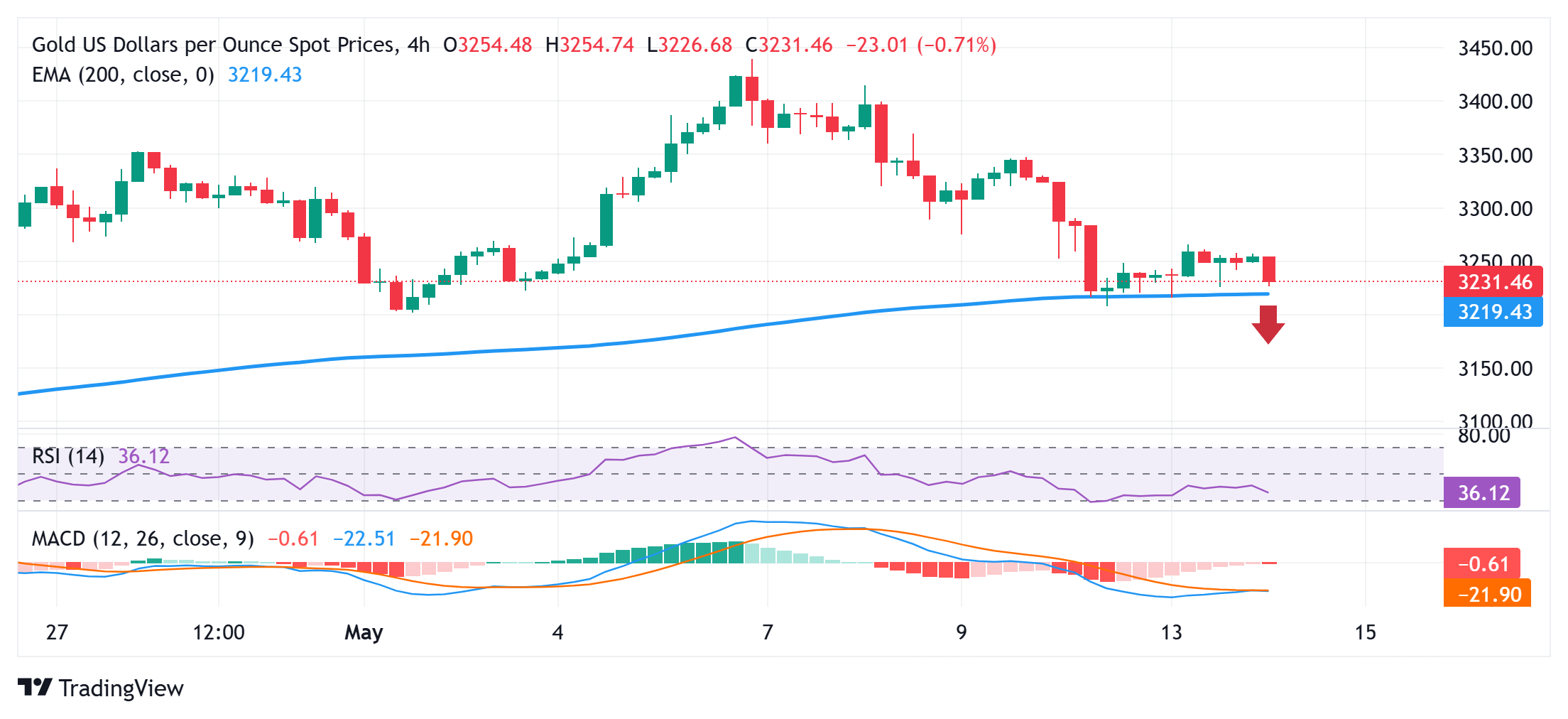
From a technical perspective, the XAU/USD pair has been showing some resilience near the 200-period Exponential Moving Average (EMA), currently pegged near the $3,225 region, on the 4-hour chart since the beginning of this week. Given that oscillators on the daily chart have just started drifting in negative territory, a convincing break below the said support will be seen as a fresh trigger for bearish traders. A subsequent fall below the $3,200 round figure will confirm a fresh breakdown and make the Gold price vulnerable to resume its recent corrective slide from the $3,500 psychological mark, or the all-time peak touched in April. The commodity might then accelerate the fall towards testing the next relevant support near the $3,135 area.
On the flip side, the overnight swing high, around the $3,265-3,266 region, now seems to act as an immediate hurdle, above which the Gold price could aim to reclaim the $3,300 mark. Some follow-through buying and a move beyond the weekly high, around the $3,317-3,318 zone, might shift the bias in favor of bullish traders and lift the Gold price to the $3,345-3,347 hurdle en route to the $3,360-3,365 static barrier. A sustained strength beyond the latter will set the stage for a move towards the $3,400 round figure.
Fed FAQs
Monetary policy in the US is shaped by the Federal Reserve (Fed). The Fed has two mandates: to achieve price stability and foster full employment. Its primary tool to achieve these goals is by adjusting interest rates. When prices are rising too quickly and inflation is above the Fed’s 2% target, it raises interest rates, increasing borrowing costs throughout the economy. This results in a stronger US Dollar (USD) as it makes the US a more attractive place for international investors to park their money. When inflation falls below 2% or the Unemployment Rate is too high, the Fed may lower interest rates to encourage borrowing, which weighs on the Greenback.
The Federal Reserve (Fed) holds eight policy meetings a year, where the Federal Open Market Committee (FOMC) assesses economic conditions and makes monetary policy decisions. The FOMC is attended by twelve Fed officials – the seven members of the Board of Governors, the president of the Federal Reserve Bank of New York, and four of the remaining eleven regional Reserve Bank presidents, who serve one-year terms on a rotating basis.
In extreme situations, the Federal Reserve may resort to a policy named Quantitative Easing (QE). QE is the process by which the Fed substantially increases the flow of credit in a stuck financial system. It is a non-standard policy measure used during crises or when inflation is extremely low. It was the Fed’s weapon of choice during the Great Financial Crisis in 2008. It involves the Fed printing more Dollars and using them to buy high grade bonds from financial institutions. QE usually weakens the US Dollar.
Quantitative tightening (QT) is the reverse process of QE, whereby the Federal Reserve stops buying bonds from financial institutions and does not reinvest the principal from the bonds it holds maturing, to purchase new bonds. It is usually positive for the value of the US Dollar.
Author

Haresh Menghani
FXStreet
Haresh Menghani is a detail-oriented professional with 10+ years of extensive experience in analysing the global financial markets.

















