Gold Price Analysis: XAU/USD sticks close to 200DMA ahead of key Fed announcement
- The 200DMA just above $1790 has been acting like a magnet for spot gold prices on a quiet trading day.
- The main focus for gold traders is Wednesday’s Fed meeting, which carries hawkish risks.

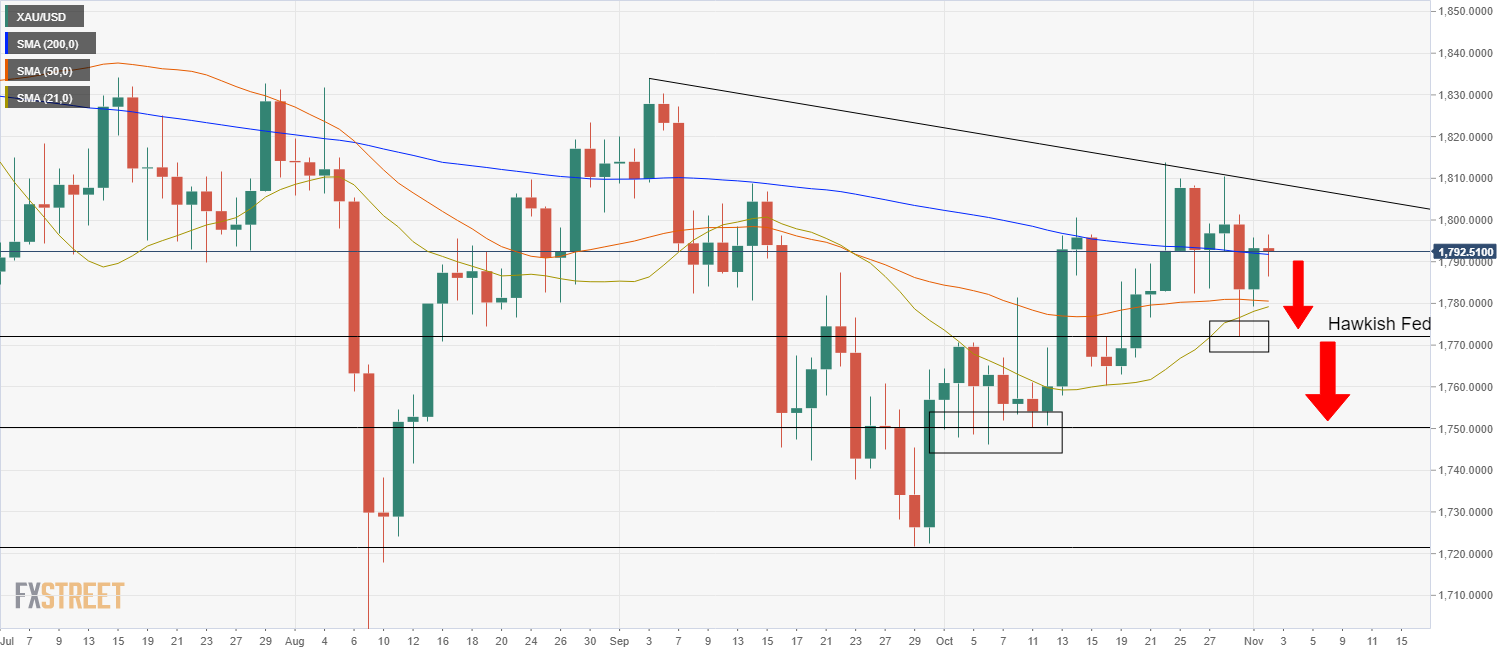
Spot gold (XAU/USD) prices trade marginally lower on Tuesday, having gradually ebbed in recent hours from Asia Pacific session highs in the mid-$1790s to current levels around $1790. That means spot prices have been undulating either side of the 200-day moving average (currently at $1792.40). A lack of notable economic data points or scheduled events for the remainder of the European and US trading sessions suggests that lackluster trading conditions may persist and that the 200DMA may continue to act as a magnet for XAU/USD.
Fed meeting looms
Currency, bond and (by virtue) precious metal markets are in wait and see mode ahead of tomorrow’s Fed policy meeting and Friday’s US labour market report; at present, the DXY is around the 94.00 level and well within recent ranges and the same can be said for US bond yields, with the nominal 10-year close to 1.55% and the 10-year TIPS close to -1.0%. With regards to the Fed meeting, there are a few key focal points of interest to market participants; 1) the timing/pace of the bank’s QE taper plans (Fed officials have said they plan to announce taper plans at this meeting) – markets currently expect the Fed to reduce the monthly pace of purchases at a rate of $15B per month, taking eight months to taper net monthly purchases to zero from the current $120B, 2) any new guidance on when the bank might potentially start lifting interest rates, given that markets are now pricing a strong likelihood of lift-off in early H2 2022 and 3) any further recognition that upside inflation risks have grown.
Some analysts have suggested that there are upside risks to market expectations for a monthly QE taper pace of $15B. Danske Bank said in a recent note that they see a strong risk that the Fed opts to taper at a rate of $20B per month, meaning that (assuming the taper begun in November) QE purchases would be reduced to zero by April. This might be taken as a hawkish signal by markets; the Fed has previously said it does not want to lift interest rates before its QE taper has concluded, so a move to end the QE taper more quickly might be seen as the Fed giving itself more optionality to lift rates earlier if required. This may reflect a growing fear within the FOMC that their (up until only very recently) strongly held conviction that the current spike in inflation is “transitory” is under threat. Indeed, the recent spike in gas prices, combined with continued pro-inflationary supply bottlenecks are hitting consumer pockets, and rising inflation expectations and an already very tight US labour market risk embedding expectations for a more prolonged period of high inflation, all risks that recent rhetoric from Fed members has suggested they are growing increasingly worried about.
A hawkish Fed meeting could send real yields higher and would likely give the DXY the impetus that it needs to break above recent highs in the mid-94.00s, which would not be a good combo for gold. In this case, XAU/USD could well slip back below its 21 and 50DMAs around $1780 and to a retest of recent lows in the $1770s, ahead of a more protracted move back towards support in the $1750 area.
Author

Joel Frank
Independent Analyst
Joel Frank is an economics graduate from the University of Birmingham and has worked as a full-time financial market analyst since 2018, specialising in the coverage of how developments in the global economy impact financial asset