Australian Dollar leans on a China prop that's quietly buckling
- Friday's blowout US jobs report dragged the Aussie to its weakest level since mid-April.
- A thin Monday bounce faded fast as iron ore and Chinese steel demand keep softening.
- China trade figures and US inflation later this week will decide whether the rebound has any legs.

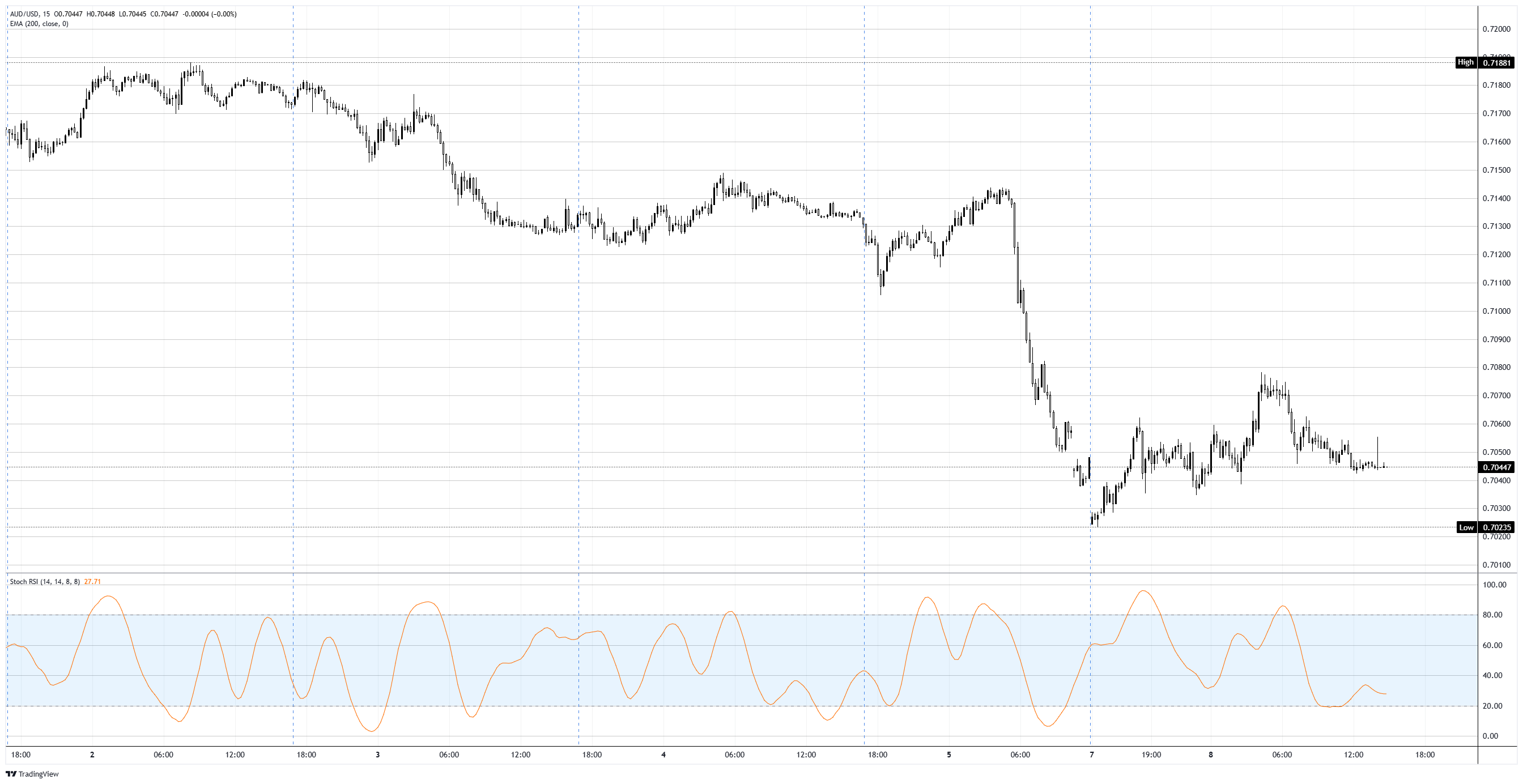
The Australian Dollar spent Monday trying to talk itself into a recovery, and the tape was not buying it. AUD/USD has ridden a China-and-commodities narrative for months, one that conveniently glossed over how shaky both legs of that trade have become, and Friday's Nonfarm Payrolls (NFP) print finally forced a reckoning. US employers added 172K jobs against a consensus near 85K, with roughly 93K of upward revisions to prior months and the unemployment rate steady at 4.3%. The Dollar tore to a two-month high and the Aussie slid to its lowest since mid-April, around 0.7050 by the time Asian desks took over. Monday's attempt to claw back ground stalled near the same level, a rally that looked more like short covering than conviction.
The commodity prop is cracking
The comfortable story has been that firm iron ore and a steadying China would keep a floor under the Aussie regardless of what the Dollar did. That floor is looking thinner by the week. Iron ore has been pinned near $105 a tonne for the better part of a year, but the demand picture underneath it is deteriorating: Chinese steel output in April was the weakest for the month since 2018, down close to 3% YoY, with the property sector still structurally impaired. Mills have leaned on inventory rather than fresh imports, the kind of quiet demand erosion that does not show up in a single price print until it suddenly does. For a currency that effectively trades as a liquid proxy for Chinese growth, that is not a reassuring backdrop.
Tuesday's Chinese trade data, exports and imports for May, will be the first read on whether that import pullback is accelerating. Wednesday brings Chinese inflation: Consumer Price Index (CPI) is still flirting with deflation, while Producer Price Index (PPI) is forecast to swing up to 3.8% YoY. Before reading that as a demand revival, note that factory-gate reflation built on higher commodity and energy costs is cost-push, not the end-demand pull the Aussie actually needs, especially with steel output and property still soft. Neither print is likely to rescue the currency on its own.
The real catalyst is American, not Australian
The home calendar is quiet enough to ignore. Westpac consumer confidence and National Australia Bank (NAB) business surveys land Tuesday, with consumer inflation expectations following Thursday, none of it the sort of data that moves a major pair. The genuine swing factor sits in Washington. US CPI on Wednesday is forecast at 4.2% YoY on the headline, a jump driven largely by the energy shock rippling out of the Middle East, even as the core rate sits closer to 2.9%. A hot headline plays straight into the hawkish repricing already underway: CME FedWatch now puts the odds of higher rates by December near 72%, an extraordinary shift toward at least one Federal Reserve (Fed) hike rather than a cut, and one that leaves high-beta currencies like the Aussie badly exposed.
The Crude Oil angle cuts both ways here. Brent spiked more than 5% early Monday after Iran and Israel traded strikes, then pared the move as both sides paused, with WTI settling back near $91. Higher energy prices are Dollar-supportive through the inflation channel, and they do the Aussie no favours.
Upside, downside, bias
The daily Stochastic Relative Strength Index (Stoch RSI) is turning up from oversold, which argues for the kind of shallow bounce Monday delivered, but the 200-period Exponential Moving Average (EMA) on the daily chart sits far below near 0.6900, leaving plenty of air underneath. Resistance comes in around 0.7100, with the more meaningful supply near 0.7150. On the downside, the 0.7000 handle is the line that matters, and a clean break opens 0.6950.
Bias leans lower. The setup favours selling rallies toward 0.7100 rather than chasing the bounce, with Wednesday's US CPI the binary that either confirms the Dollar's run or hands the Aussie a reprieve. Until then, the China props look more decorative than load-bearing.
AUD/USD 15-minute chart
Australian Dollar FAQs
One of the most significant factors for the Australian Dollar (AUD) is the level of interest rates set by the Reserve Bank of Australia (RBA). Because Australia is a resource-rich country another key driver is the price of its biggest export, Iron Ore. The health of the Chinese economy, its largest trading partner, is a factor, as well as inflation in Australia, its growth rate and Trade Balance. Market sentiment – whether investors are taking on more risky assets (risk-on) or seeking safe-havens (risk-off) – is also a factor, with risk-on positive for AUD.
The Reserve Bank of Australia (RBA) influences the Australian Dollar (AUD) by setting the level of interest rates that Australian banks can lend to each other. This influences the level of interest rates in the economy as a whole. The main goal of the RBA is to maintain a stable inflation rate of 2-3% by adjusting interest rates up or down. Relatively high interest rates compared to other major central banks support the AUD, and the opposite for relatively low. The RBA can also use quantitative easing and tightening to influence credit conditions, with the former AUD-negative and the latter AUD-positive.
China is Australia’s largest trading partner so the health of the Chinese economy is a major influence on the value of the Australian Dollar (AUD). When the Chinese economy is doing well it purchases more raw materials, goods and services from Australia, lifting demand for the AUD, and pushing up its value. The opposite is the case when the Chinese economy is not growing as fast as expected. Positive or negative surprises in Chinese growth data, therefore, often have a direct impact on the Australian Dollar and its pairs.
Iron Ore is Australia’s largest export, accounting for $118 billion a year according to data from 2021, with China as its primary destination. The price of Iron Ore, therefore, can be a driver of the Australian Dollar. Generally, if the price of Iron Ore rises, AUD also goes up, as aggregate demand for the currency increases. The opposite is the case if the price of Iron Ore falls. Higher Iron Ore prices also tend to result in a greater likelihood of a positive Trade Balance for Australia, which is also positive of the AUD.
The Trade Balance, which is the difference between what a country earns from its exports versus what it pays for its imports, is another factor that can influence the value of the Australian Dollar. If Australia produces highly sought after exports, then its currency will gain in value purely from the surplus demand created from foreign buyers seeking to purchase its exports versus what it spends to purchase imports. Therefore, a positive net Trade Balance strengthens the AUD, with the opposite effect if the Trade Balance is negative.
Author

Joshua Gibson
FXStreet
Joshua joins the FXStreet team as an Economics and Finance double major from Vancouver Island University with twelve years' experience as an independent trader focusing on technical analysis.

















