|

Gold Price Analysis: XAU/USD corrective pullback eyes $1,845, $1,858 resistances – Confluence Detector

Gold prices keep bounce off the fresh low since December 01, marked earlier in Asia, while picking up the bids around $1,837, up 0.74% intraday, during the pre-European session trading on Monday. The yellow metal initially had to respect the US dollar’s run-up before bouncing off the key support.

Off in the US and a light calendar in Asia, except for China’s mixed activity numbers, restrict the bullion’s moves while challenges for the US President-elect Joe Biden and company join the coronavirus (COVID-19) worries to heavy the risks.

Gold: Key levels to watch

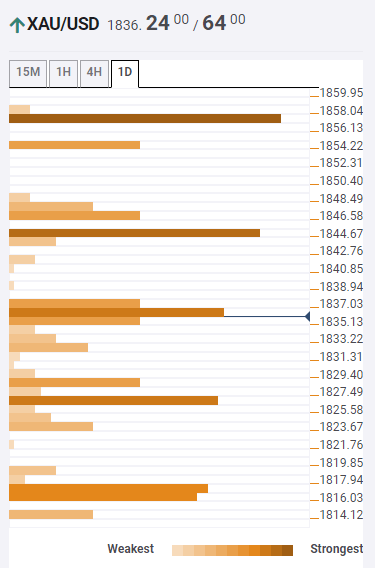
Gold battles $1,836/37 resistance area comprising 38.2% Fibonacci retracement of one day move (1D) and SMA 10 on the four-hour move.

In doing so, gold buyers eye SMA 200, 61.8% Fibonacci retracement SMA 5 on one day chart, currently around $1,845. However, bulls will remain cautious unless breaking the previous high on the 1D and upper band of the Bollinger near $1,858.

Meanwhile, previous high on hourly chart (1H), SMA 50 on 15-minute (15M) and middle Bollinger on the 15M can offer immediate support around $1,826.

Should gold sellers dominate past-$1,826, the previous week’s low and lower band of the Bollinger on 1D and first support of Pivot Point on monthly chart will be the key to follow around $1,817/16.

Here is how it looks on the tool
fxsoriginal

About Confluence Detector

The TCI (Technical Confluences Indicator) is a tool to locate and point out those price levels where there is a congestion of indicators, moving averages, Fibonacci levels, Pivot Points, etc. Knowing where these congestion points are located is very useful for the trader, and can be used as a basis for different strategies.

Learn more about Technical   Confluence

Author

Anil Panchal

Anil Panchal

FXStreet

Anil Panchal has nearly 15 years of experience in tracking financial markets. With a keen interest in macroeconomics, Anil aptly tracks global news/updates and stays well-informed about the global financial moves and their implications.


More from Anil Panchal
Share:

Editor's Picks

AUD/USD struggles to recover as hawkish Fed bets escalate

The Australian Dollar is under pressure against the US Dollar as traders have raised bets supporting interest rate hikes by the Federal Reserve this year, with the AUD/USD pair posting a fresh almost eight-week low at around 0.7025. Hawkish Fed bets have accelerated following the release of the surprisingly strong United States Nonfarm Payroll (NFP) data for May.

USD/JPY holds higher ground toward 160.50 despite 'Yentervention' fears

USD/JPY holds higher ground toward 160.50 in Monday's Asian trading, despite intervention fears. Japan’s revised GDP print, which confirmed that the economy lost momentum in the first quarter, weighs on the Japanese Yen. Meanwhile, Friday's upbeat US NFP report and fresh Israel-Iran attacks favor the US Dollar bulls, underpinning the currency pair.

Gold sticks to the positive bias, still below  $4,350

Gold manages to reclaim the $4,300 mark per troy ounce and above on Monday. The yellow metal’s small uptick comes on the back of modest losses in the US Dollar, while traders continue to follow geopolitical events in the Middle East and the likelihood of a tighter-for-longer Fed.

Solana: ETF outflows and bearish sentiment reinforce downside risks

Solana (SOL) remains under pressure, trading below $66 on Monday after losing nearly 20% in the previous week. Institutional demand weakened with spot Exchange Traded Funds recording a net outflow of over $6.5 million last week, snapping a four-week streak of inflows.

$1.75 trillion: Is SpaceX the most popular IPO in history, or the most engineered?

On June 12, the largest initial public offering (IPO) in history is set to hit the tape, and almost nobody is asking whether the price is right, because almost everybody already wants in.

The US economy defies the rules: 100 days into the Oil shock and the recession signal is still missing

More than three months after the start of the Iran war and the resulting disruption to global energy markets, the US economy continues to display remarkable resilience. The conflict has triggered a sharp rise in Oil prices, reignited inflationary pressures and fueled widespread concerns about a potential economic slowdown.