|

Gold Price Analysis: Eyeing two higher levels after completing its correction – Confluence Detector

Gold has been hovering around $1,800 after hitting a high of $1,817 and correcting to the downside. IS it ready to rise? XAU/USD has solid support and two technical levels in its sights. 

The Technical Confluences Indicator is showing that gold is battling $1,805, which is the convergence of the Simple Moving Average 20-4h and the Pivot Point one-week Resistance 2. 

Support awaits at $1,803, which is a dense cluster of lines including the Bollinger Band 1h-Middle, the Fibonacci 38.2%, the SMA 5-4h, the SMA 10-1h, and more. 

Even lower, the next confluence is at $1,786, which is where the previous monthly high, the SMA 200-1h, and the SMA 50-4h converge. 

The upside target for gold bulls is $1,814, where the BB one-day upper and the Pivot Point R1 meet up. 

Further above, $1,821 is a juncture including the PP one-month R1 and the PP one-week R3. 

Here is how it looks on the tool:
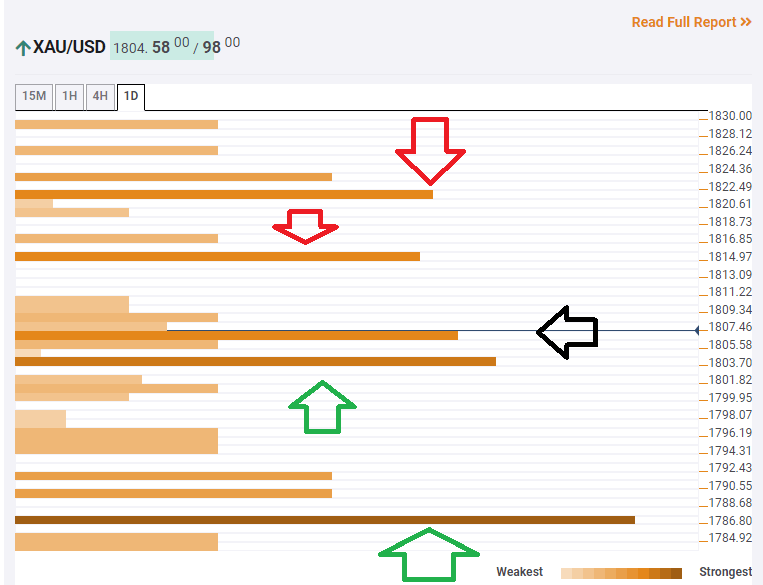
Confluence Detector

The Confluence Detector finds exciting opportunities using Technical Confluences. The TC is a tool to locate and point out those price levels where there is a congestion of indicators, moving averages, Fibonacci levels, Pivot Points, etc. Knowing where these congestion points are located is very useful for the trader, and can be used as a basis for different strategies.

This tool assigns a certain amount of “weight” to each indicator, and this “weight” can influence adjacents price levels. These weightings mean that one price level without any indicator or moving average but under the influence of two “strongly weighted” levels accumulate more resistance than their neighbors. In these cases, the tool signals resistance in apparently empty areas.

Learn more about Technical Confluence

Author

Yohay Elam

Yohay Elam

FXStreet

Yohay is in Forex since 2008 when he founded Forex Crunch, a blog crafted in his free time that turned into a fully-fledged currency website later sold to Finixio.


More from Yohay Elam
Share:

Editor's Picks

GBP/USD: Daily gains remain capped by 1.3650

GBP/USD leaves behind Monday’s pessimism and advances marginally on Tuesday. Cable’s humble gains, however, appear to have met quite a decent resistance in the 1.3650 zone for now, in a context of a slight selling pressure hovering around the Greenback.

EUR/USD struggles to regain pace; gyrates around 1.1670

EUR/USD clinches humble gains around 1.1670 following Tuesday’s close on Wall Street. Indeed, marginal losses in the US Dollar encourages spot to set aside two dauly pullbacks in a row and maintain the 1.1700 barrier on the cross-hairs for now. Moving forward, US inflation tracked by the PCE and another revision of Q2 GDP data should keep investors entertained on Wednesday.

$4700 back on Gold buyers’ radar as US core PCE inflation data looms

Gold is heading back toward the fresh 15-week highs of $4,697 in Wednesday’s Asian trades, reversing a brief dip below the $4,650 level. Gold buyers find renewed strength from a broadly subdued US Dollar (USD), as they look to reposition ahead of the US core Personal Consumption Expenditures (PCE) Price Index data for July.

Bitcoin pauses near $80,000, Ethereum at $2,500, XRP below $1.50
Bitcoin (BTC), Ethereum (ETH), and Ripple (XRP) are facing downside pressure near key psychological thresholds as last week's double-digit rally loses momentum. The pullback reflects near-term corrective measures as traders book profits. Bitcoin trades near $78,760 at press time on Wednesday, maintaining its bullish bias after last week's 23% rally.
America’s self‑inflicted trade wound
I’m conflicted about the trade war that the U.S. has started with Canada. Let’s be clear: any representation that Canada has been taking unfair advantage of the U.S. or that they have been treating us badly for years is a bogus characterization. In reality, the shoe is on the other foot. It’s the U.S. that has been behaving badly.
Canada hits US goods with tariffs; The rate market sees a problem
On September 8, Canada begins charging its own importers 15%, 25% and 50% on roughly 700 lines of American goods. The measure is billed as dollar for dollar, and on the arithmetic of covered trade it is. What it is not is a tax on the United States.














