Gold fades as Trump win fuels a US Dollar rally
- Gold price tanks as US yields rise and underpin the Greenback.
- Trump’s decisive win lifts US yields and US Dollar to four-month high, pressuring Gold.
- Fed’s expected rate cut on Thursday, which could halt Bullion's losses.
Gold plunged to a three-week low below $2700 a troy ounce on Wednesday after the 2024 US Presidential election. The Republican candidate, former President Donald Trump, won the contest, bolstering the Greenback and US Treasury bond yields. Therefore, the XAU/USD posted losses of over 2.50% and traded at $2,667 at the time of writing.
Traders’ uncertainty has finally subsided, as Trump’s victory was not as close as expected. Besides this, the Republican party completed the red sweep, achieving the majority in the Senate and controlling the House of Representatives.
Therefore, the Trump trade extended as market participants lifted US equities to record highs, the Greenback soared to a four-month peak, and the US Treasury yield skyrocketed.
Investors continued to digest the US economic outlook. Trump’s economic policy suggests imposing tariffs, a wider fiscal deficit, and fewer taxes. His economic proposals are at odds with the Fed's fight against inflation. Therefore, the US central bank would be forced to adopt a gradual approach when easing monetary policy.
In the meantime, the US Dollar Index (DXY), which tracks the buck’s performance against six peers, is up at 105.04 and gains 1.54%. Yields, particularly the 10-year benchmark note coupon, surged 16 basis points to 4.437%.
Bullion prices are also down as traders clarify who will occupy the White House for the next four years, beginning in January 2025. Rhona 0' Connell, Stone X analyst, said, “A clear presidential victory when the market has been pricing in a contested result, removal of an element of risk, Trump trades include the dollar's strengthening this morning, and the combination of the two has brought gold lower.”
The US economic schedule will feature Thursday's Federal Reserve (Fed) monetary policy decision. The central bank is expected to lower borrowing costs by 25 basis points to the 4.50%-4.75% range.
Daily Digest Market Movers: Gold price slumps also on heightened US Real yields
- Gold prices retreated sharply in addition to elevated US real yields, which inversely correlate against Bullion. Real yields are up 15 basis points to 2.156%, hit its highest level since July 2024.
- On Tuesday, the US economic schedule revealed that the Balance of Trade deficit widened while business activity cooled slightly.
- S&P Global revealed that October’s service activity dipped, while the Institute for Supply Management’s (ISM) Services PMI improved for the same period.
- Data from the Chicago Board of Trade, based on the December fed funds rate futures contract, indicates that investors estimate 49 basis points (bps) of Fed easing by the end of the year.
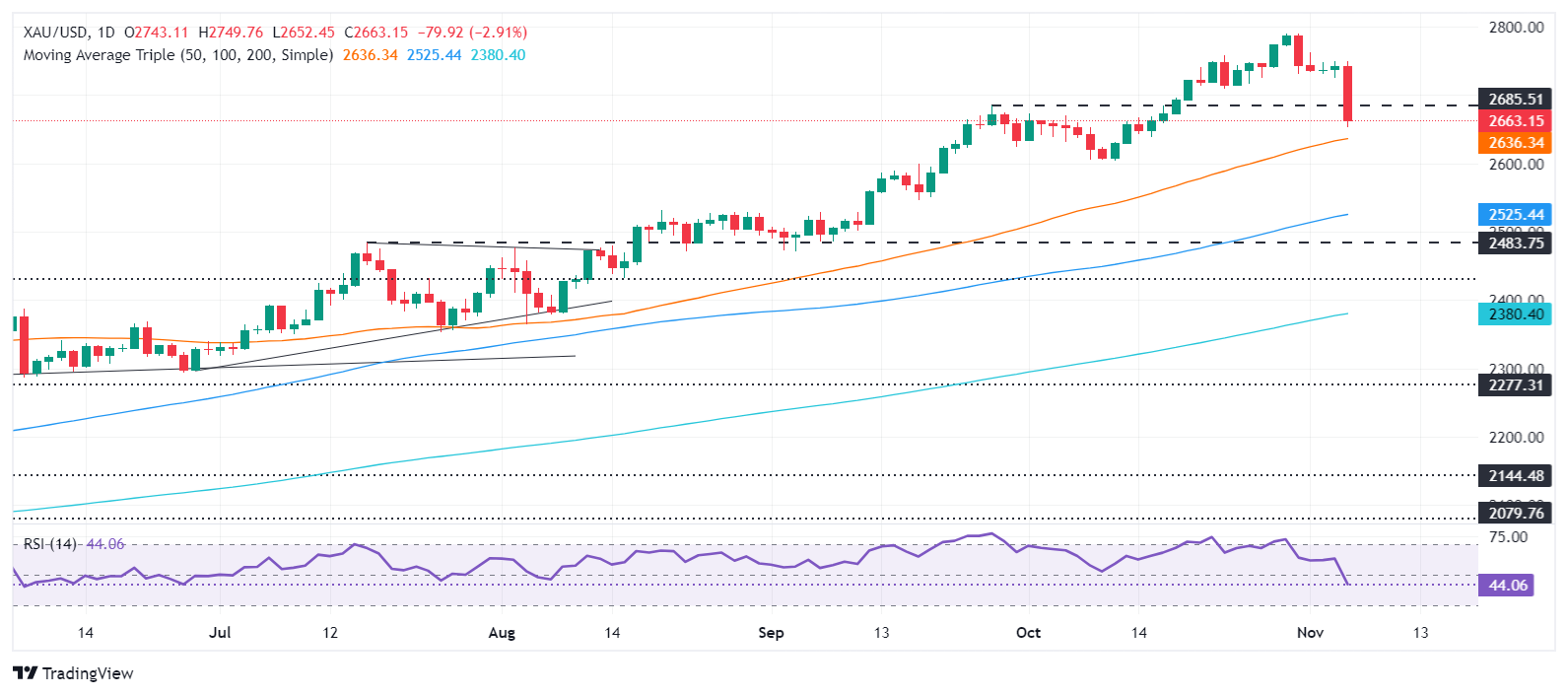
XAU/USD Technical Outlook: Gold price tumbles with sellers eyeing $2,650
Gold price retreated below $2,700 and cleared the September 26 daily high, turning support at $2,685. This triggered a move toward the $2,650 region, which, if broken, would expose the 50-day Simple Moving Average (SMA) at $2,635. A break to the downside might expose $2,600.
On the other hand, if buyers lift XAU/USD past $2,700, the golden metal might consolidate around that area. But if they clear the October 23 high at $2,758, Gold could test the record high of $2,790 in the near term.
Momentum favors sellers, although the uptrend remains intact. The Relative Strength Index (RSI) turned bearish after falling steeper below its neutral line.
Gold FAQs
Gold has played a key role in human’s history as it has been widely used as a store of value and medium of exchange. Currently, apart from its shine and usage for jewelry, the precious metal is widely seen as a safe-haven asset, meaning that it is considered a good investment during turbulent times. Gold is also widely seen as a hedge against inflation and against depreciating currencies as it doesn’t rely on any specific issuer or government.
Central banks are the biggest Gold holders. In their aim to support their currencies in turbulent times, central banks tend to diversify their reserves and buy Gold to improve the perceived strength of the economy and the currency. High Gold reserves can be a source of trust for a country’s solvency. Central banks added 1,136 tonnes of Gold worth around $70 billion to their reserves in 2022, according to data from the World Gold Council. This is the highest yearly purchase since records began. Central banks from emerging economies such as China, India and Turkey are quickly increasing their Gold reserves.
Gold has an inverse correlation with the US Dollar and US Treasuries, which are both major reserve and safe-haven assets. When the Dollar depreciates, Gold tends to rise, enabling investors and central banks to diversify their assets in turbulent times. Gold is also inversely correlated with risk assets. A rally in the stock market tends to weaken Gold price, while sell-offs in riskier markets tend to favor the precious metal.
The price can move due to a wide range of factors. Geopolitical instability or fears of a deep recession can quickly make Gold price escalate due to its safe-haven status. As a yield-less asset, Gold tends to rise with lower interest rates, while higher cost of money usually weighs down on the yellow metal. Still, most moves depend on how the US Dollar (USD) behaves as the asset is priced in dollars (XAU/USD). A strong Dollar tends to keep the price of Gold controlled, whereas a weaker Dollar is likely to push Gold prices up.
Author

Christian Borjon Valencia
FXStreet
Markets analyst, news editor, and trading instructor with over 14 years of experience across FX, commodities, US equity indices, and global macro markets.

















