Gold appreciates within previous ranges with investros awaiting central banks' decisions
- Gold has appreciated moderately with risk appetite returning as geopolitical fears ease..
- Hopes that the Fed might hint towards monetary easing on Wednesday keep US Treasury yields near mid-term lows.
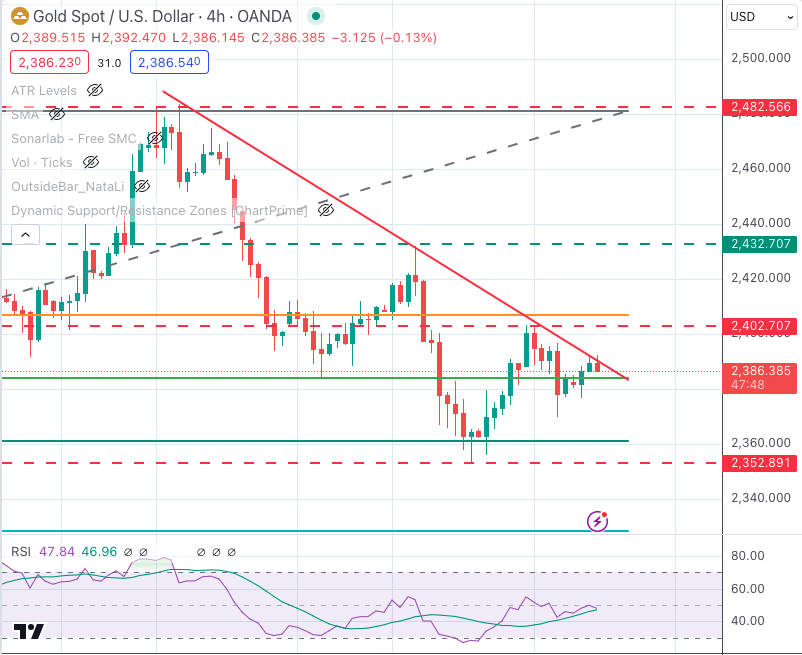
- XAU/USD needs to break the $2,400 resistance to cancel the broader bearish structure.

Gold price (XAU/USD) found buyers after a moderate pullback on Monday. The precious metal has been going through a mild recovery during Tuesday’s Asian session and European sessions, before meeting some resistance at $2,390.
News reporting that Israel is willing to avoid an all-out war in the Middle East has eased geopolitical concerns, allowing the safe-haven US Dollar (USD) to trim some gains.
Investors’ focus is now on the Federal Reserve’s (Fed) monetary policy decision, due on Wednesday. The bank will highly likely leave interest rates unchanged, but the attention will be on the ensuing press release by Fed Chair Jerome Powell. With price pressures on a disinflationary trend and the labour market finally showing signs of exhaustion, Powell might suggest that the easing cycle might start before December. That would harm the US Dollar and support precious metals.
Daily digest market movers: Gold remains moving in range with all eyes on the Fed
- Gold is regaining some of the ground lost on Monday, favoured by a somewhat brighter market mood as concerns of a full-blown war in the Middle East have eased.
- Israeli authorities assured that they want to retaliate Hizbullah, for the rocket attack that killed 12 people on the weekend, but that they want to avoid a regional war in the Middle East. This has calmed market fears.
- Later today, the Conference Board is expected to show that the Consumer Sentiment Index deteriorated marginally in July, to a reading of 99.5 from the 100.4 posted in the previous month.
- In the same line, US JOLTS Job Openings are seen to have declined to 8.03 million in June from the 8.14 million openings reported in May.
- The Fed is releasing its monetary policy decision on Wednesday, and the recent inflation readings have boosted market expectations that the bank might signal the exit of the restrictive cycle.
- US 10-year yields are marginally above four-month highs, while the 2-year yield, the most closely related to interest rate expectations, remains depressed at their lowest levels since February.
- The CME Group’s Fed Watch tool is pricing a 95% chance that the Fed will keep rates on hold on Wednesday and a 100% chance that rate cuts will start in September.
Technical analysis: XAU/USD remains capped below the $2,400 resistance level
XAU/USD is on a corrective decline after having been capped right below the $2,500 level in mid-July. The pair has found significant support at the 61.8% Fibonacci retracement of the June-July bullish run, near $2,360, and the higher low printed last week suggests that the correction might have been completed.
The 4-hour Relative Strength Index (RSI) indicator is flattening near the 50 level, indicating a lack of clear bias. The precious metal needs an additional impulse to breach the $2,400 resistance area. Soft data today and a dovish Fed would probably do it. The next target, in this case, would be $2,430.
On the downside, supports are at the mentioned 61.8% Fibonacci retracement, at $2,350, ahead of $2,320.
XAU/USD 4-hour chart
Fed FAQs
Monetary policy in the US is shaped by the Federal Reserve (Fed). The Fed has two mandates: to achieve price stability and foster full employment. Its primary tool to achieve these goals is by adjusting interest rates. When prices are rising too quickly and inflation is above the Fed’s 2% target, it raises interest rates, increasing borrowing costs throughout the economy. This results in a stronger US Dollar (USD) as it makes the US a more attractive place for international investors to park their money. When inflation falls below 2% or the Unemployment Rate is too high, the Fed may lower interest rates to encourage borrowing, which weighs on the Greenback.
The Federal Reserve (Fed) holds eight policy meetings a year, where the Federal Open Market Committee (FOMC) assesses economic conditions and makes monetary policy decisions. The FOMC is attended by twelve Fed officials – the seven members of the Board of Governors, the president of the Federal Reserve Bank of New York, and four of the remaining eleven regional Reserve Bank presidents, who serve one-year terms on a rotating basis.
In extreme situations, the Federal Reserve may resort to a policy named Quantitative Easing (QE). QE is the process by which the Fed substantially increases the flow of credit in a stuck financial system. It is a non-standard policy measure used during crises or when inflation is extremely low. It was the Fed’s weapon of choice during the Great Financial Crisis in 2008. It involves the Fed printing more Dollars and using them to buy high grade bonds from financial institutions. QE usually weakens the US Dollar.
Quantitative tightening (QT) is the reverse process of QE, whereby the Federal Reserve stops buying bonds from financial institutions and does not reinvest the principal from the bonds it holds maturing, to purchase new bonds. It is usually positive for the value of the US Dollar.
Author

Guillermo Alcala
FXStreet
Graduated in Communication Sciences at the Universidad del Pais Vasco and Universiteit van Amsterdam, Guillermo has been working as financial news editor and copywriter in diverse Forex-related firms, like FXStreet and Kantox.















