Gold pares gains as Dollar strength, Ukraine peace rumors offset safe-haven demand
- Gold trims a 1% advance, trading near $4,071 as the US Dollar strength outweighs lower Treasury yields across the curve.
- Traders await delayed NFP report, with December rate-cut odds slipping to 42% after Powell’s warnings.
- Rumored US–Russia peace plan pressures Bullion, while AI-bubble fears keep market sentiment fragile but supportive.

Gold (XAU/USD) remains firm during the North American session on Wednesday, but trims earlier gains of over 1% as the US Dollar (USD) rallies sharply as traders wait for a key US job report due on Thursday and assess the developments on the Russia-Ukraine war. At the time of writing, XAU/USD trades at $4,081, up 0.31%.
XAU/USD pares gains as stronger Greenback and Ukraine peace-talk rumors offset safe-haven demand before key US data
Market mood improved modestly as US equities recovered some ground, following back-to-back bearish sessions as traders questioned a possible AI bubble, a tailwind for Bullion prices.
The non-yielding metal recovered, but it has retreated as the Greenback posts solid gains even though US Treasury bond yields tumbled across the whole curve. Traders brace for the Federal Reserve's (Fed) last meeting minutes and for Thursday’s Nonfarm Payrolls report.
Regarding October and November’s NFP reports, the US Bureau of Labor Statistics (BLS) revealed that they will be published on December 16, after the Fed’s last meeting. The BLS added that the Unemployment Rate could not be collected.
Money markets had priced in a 42% chance that the Fed will cut rates at the December 9-10 meeting. In the last meeting, the Fed Chair Jerome Powell warned that a rate cut in December is far from being a sure thing, adding that there are “strongly different views” within the Federal Open Market Committee (FOMC).
Rumors that US and Russian officials drafted a new peace plan for Ukraine, according to the Financial Times, pushed Gold prices lower.
Daily market movers: Gold’s direction determined by Fed minutes, US NFP
- The Dollar surges to a two-week high as depicted by the US Dollar Index (DXY). The DXY, which tracks the buck’s performance versus six currencies, is up 0.54% to 100.13. Contrarily, US Treasury yields are steady, with the 10-year US Treasury note yield standing at 4.11%. US real yields — which correlate inversely to Gold prices, are also unchanged at 1.85%.
- US Nonfarm Payrolls figures for September will be revealed on Thursday. Economists expect that the economy added 50K people to the workforce, exceeding August’s 22K print.
- On Tuesday, the US Department of Labor revealed the Initial Jobless Claims for the week ending October 18 showed that 232K people applied for unemployment benefits. Continuing claims rose to 1.957 million for the same week, the highest level since early August.
- The US Treasury Secretary Scott Bessent stated that US President Donald Trump will announce his pick to become the next Federal Reserve Chair in December.
- Goldman Sachs revealed that central banks continued to purchase Gold, particularly the People’s Bank of China (PBoC). The PBoC added an estimate of 15 tons of the yellow metal to its Forex reserves two months ago. They added that the PBoC could continue its purchases in November, which could push Bullion prices higher.
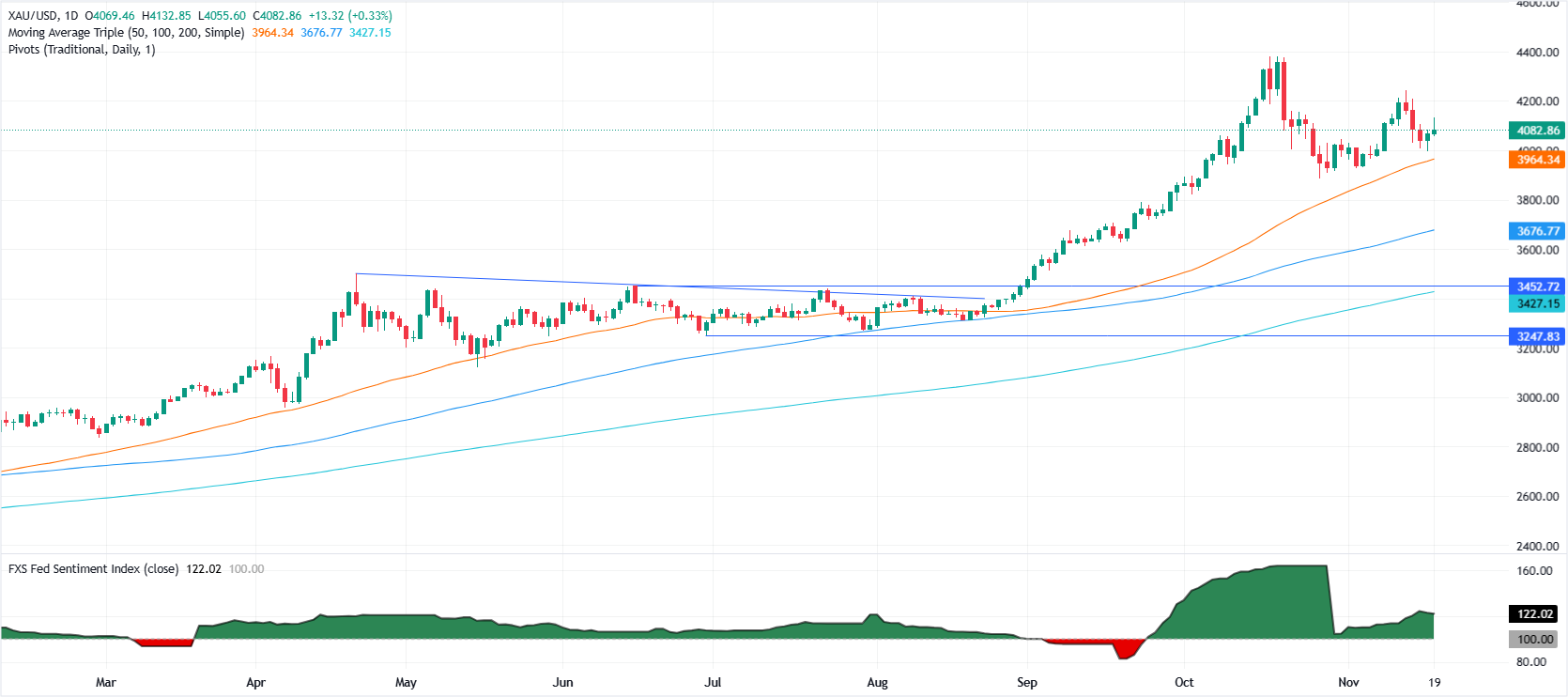
Technical outlook: Gold consolidates within $4,070-$4,100, subdued
Gold’s uptrend remains intact, but price action so far indicates that buyers are cautious, waiting for the Fed minutes. So far, XAU/USD sits above the 20-day Simple Moving Average (SMA) at $4,044, seen as a key support level. Momentum remains bullish as depicted by the Relative Strength Index (RSI).
If Gold clears $4,100, traders could challenge the $4,200 mark. However, a drop below the 20-day SMA would make it vulnerable for a retracement toward $4,000, followed by the October 28 low near $3,886.
Gold FAQs
Gold has played a key role in human’s history as it has been widely used as a store of value and medium of exchange. Currently, apart from its shine and usage for jewelry, the precious metal is widely seen as a safe-haven asset, meaning that it is considered a good investment during turbulent times. Gold is also widely seen as a hedge against inflation and against depreciating currencies as it doesn’t rely on any specific issuer or government.
Central banks are the biggest Gold holders. In their aim to support their currencies in turbulent times, central banks tend to diversify their reserves and buy Gold to improve the perceived strength of the economy and the currency. High Gold reserves can be a source of trust for a country’s solvency. Central banks added 1,136 tonnes of Gold worth around $70 billion to their reserves in 2022, according to data from the World Gold Council. This is the highest yearly purchase since records began. Central banks from emerging economies such as China, India and Turkey are quickly increasing their Gold reserves.
Gold has an inverse correlation with the US Dollar and US Treasuries, which are both major reserve and safe-haven assets. When the Dollar depreciates, Gold tends to rise, enabling investors and central banks to diversify their assets in turbulent times. Gold is also inversely correlated with risk assets. A rally in the stock market tends to weaken Gold price, while sell-offs in riskier markets tend to favor the precious metal.
The price can move due to a wide range of factors. Geopolitical instability or fears of a deep recession can quickly make Gold price escalate due to its safe-haven status. As a yield-less asset, Gold tends to rise with lower interest rates, while higher cost of money usually weighs down on the yellow metal. Still, most moves depend on how the US Dollar (USD) behaves as the asset is priced in dollars (XAU/USD). A strong Dollar tends to keep the price of Gold controlled, whereas a weaker Dollar is likely to push Gold prices up.
Author

Christian Borjon Valencia
FXStreet
Markets analyst, news editor, and trading instructor with over 14 years of experience across FX, commodities, US equity indices, and global macro markets.