Gold slips below $4,000, heads for second weekly loss
- Gold slips modestly on Friday, struggling to attract fresh buying interest.
- The US Dollar and Treasury yields stay firm after the Fed’s cautious guidance.
- Technically, the short-term bias is neutral to bearish, but the underlying uptrend remains constructive.

Gold (XAU/USD) drifts lower on Friday after holding above the $4,000 level for the better part of the day as investors reassess the Federal Reserve’s (Fed) monetary policy outlook following this week’s interest rate cut. At the time of writing, XAU/USD is trading around $3,985, down nearly 1.0% on the day and poised for a second straight weekly loss.
A firmer US Dollar (USD) and steady Treasury yields are capping upside attempts in Gold, as traders scale back expectations of another rate cut this year. In his post-meeting remarks, Fed Chair Jerome Powell downplayed the likelihood of a December rate cut, saying it was “not a foregone conclusion” and emphasizing that policy decisions will remain data-dependent.
Improved market sentiment is also weighing on Bullion’s safe-haven appeal after the much-anticipated meeting between US President Donald Trump and Chinese President Xi Jinping concluded with positive outcomes. The discussion offered some temporary relief following the recent escalation in trade tensions.
Against this backdrop, Gold’s near-term outlook appears neutral to slightly bearish. However, the broader uptrend remains constructive, with long-term drivers such as central bank demand and geopolitical uncertainty still intact despite the recent correction.
Market movers: Markets weigh Fed outlook, ongoing US shutdown
- The US Dollar Index (DXY), which measures the Greenback’s strength against six major peers, is trading around 99.70 after surging to a three-month high on Thursday. Meanwhile, Treasury yields continue to edge higher across the curve, with the benchmark 10-year yield climbing nearly 30 basis points since Wednesday to a three-week high near 4.11%.
- According to the CME FedWatch tool, market expectations for a December rate cut have dropped sharply over the past week. The probability of a 25-basis-point reduction has fallen from around 91.7% a week ago to roughly 66.8% at present, reflecting a shift toward a more cautious outlook following Chair Jerome Powell’s recent comments.
- On Thursday, US President Donald Trump and Chinese President Xi Jinping met on the sidelines of the APEC Summit in South Korea and agreed to a one-year trade truce until November 2026. Under the deal, the United States (US) will halve its fentanyl-related tariff to 10%, while China will remove its 10-15% retaliatory duties on various US agricultural products and delay the implementation of rare-earth export controls announced earlier this month.
- The US government shutdown has now entered its fifth week, with no breakthrough after the Senate adjourned on Thursday. Senators are scheduled to reconvene on Monday, but talks remain stalled despite President Donald Trump's urging Republicans to end the filibuster to push funding bills through. The shutdown is already delaying key US economic data releases and raising concerns over its broader economic impact.
- Looking ahead, next week’s set of US private-sector data, including the ISM Manufacturing Purchasing Managers Index (PMI), JOLTS Job Openings, ADP Employment Change, Challenger Job Cuts, University of Michigan sentiment survey, and the New York Fed’s inflation expectations survey, will provide key insights into the labor market and inflation outlook.
Technical analysis: XAU/USD capped below $4,050 as sellers defend key resistance
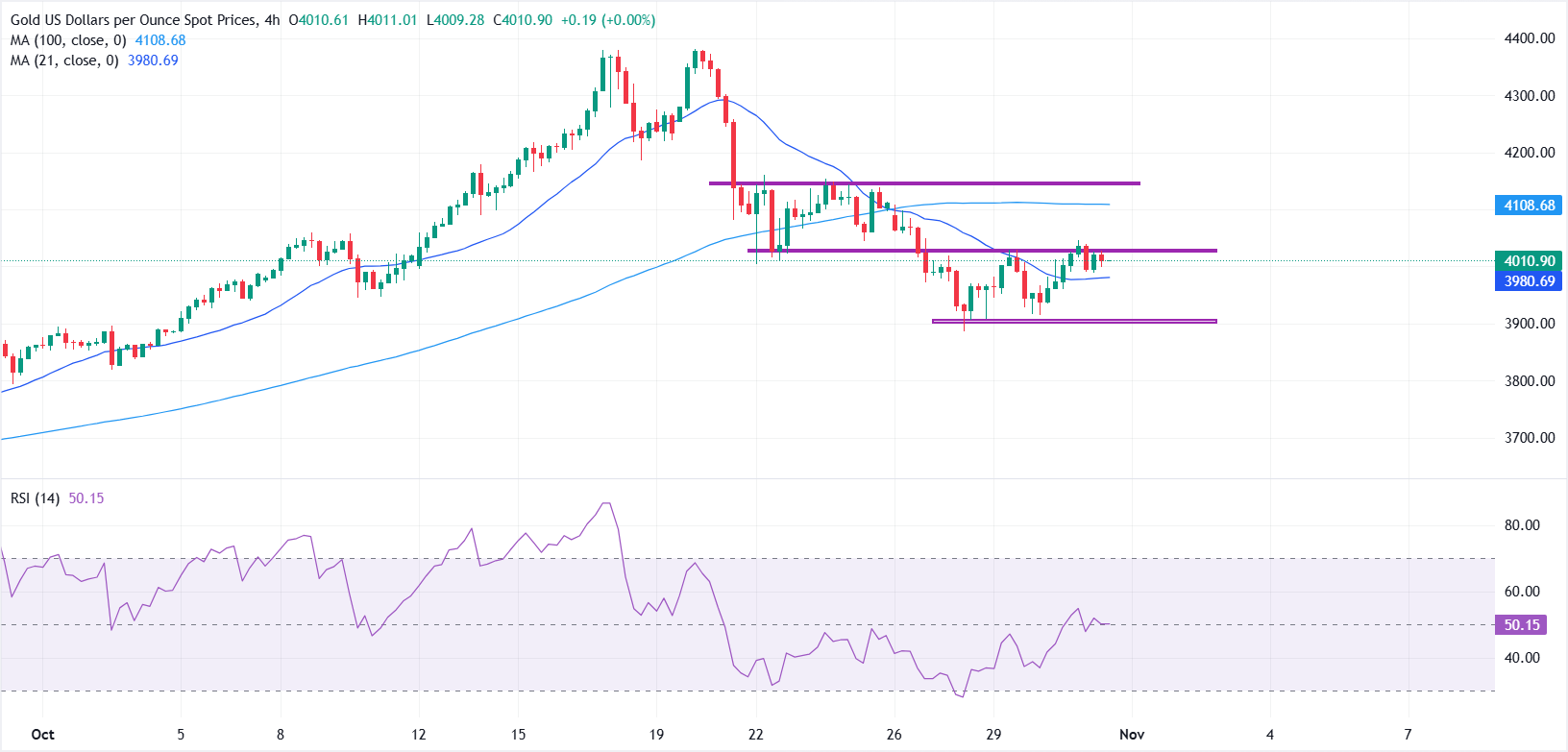
XAU/USD appears to be entering a consolidation phase following an extended rally and a healthy correction — a setup that resembles accumulation before the next directional leg.
On the 4-hour chart, the metal is facing immediate resistance at $4,020-$4,050, a former support-turned-resistance zone. A sustained move above this area could open the door toward the $4,100-$4,150 region, though fresh selling pressure is likely to emerge unless there is a clear breakout beyond this range.
On the downside, the 21-period Simple Moving Average (SMA) near $3,980 is acting as short-term support. A decisive break below this level could expose $3,900, which remains a key pivot and strong support. A clear drop below $3,900 would strengthen the case for a deeper corrective pullback. Meanwhile, the Relative Strength Index (RSI) hovers around 50, suggesting a neutral momentum bias consistent with range-bound trading in the near term.
Gold FAQs
Gold has played a key role in human’s history as it has been widely used as a store of value and medium of exchange. Currently, apart from its shine and usage for jewelry, the precious metal is widely seen as a safe-haven asset, meaning that it is considered a good investment during turbulent times. Gold is also widely seen as a hedge against inflation and against depreciating currencies as it doesn’t rely on any specific issuer or government.
Central banks are the biggest Gold holders. In their aim to support their currencies in turbulent times, central banks tend to diversify their reserves and buy Gold to improve the perceived strength of the economy and the currency. High Gold reserves can be a source of trust for a country’s solvency. Central banks added 1,136 tonnes of Gold worth around $70 billion to their reserves in 2022, according to data from the World Gold Council. This is the highest yearly purchase since records began. Central banks from emerging economies such as China, India and Turkey are quickly increasing their Gold reserves.
Gold has an inverse correlation with the US Dollar and US Treasuries, which are both major reserve and safe-haven assets. When the Dollar depreciates, Gold tends to rise, enabling investors and central banks to diversify their assets in turbulent times. Gold is also inversely correlated with risk assets. A rally in the stock market tends to weaken Gold price, while sell-offs in riskier markets tend to favor the precious metal.
The price can move due to a wide range of factors. Geopolitical instability or fears of a deep recession can quickly make Gold price escalate due to its safe-haven status. As a yield-less asset, Gold tends to rise with lower interest rates, while higher cost of money usually weighs down on the yellow metal. Still, most moves depend on how the US Dollar (USD) behaves as the asset is priced in dollars (XAU/USD). A strong Dollar tends to keep the price of Gold controlled, whereas a weaker Dollar is likely to push Gold prices up.
Author

Vishal Chaturvedi
FXStreet
I am a macro-focused research analyst with over four years of experience covering forex and commodities market. I enjoy breaking down complex economic trends and turning them into clear, actionable insights that help traders stay ahead of the curve.