Gold holds firm near record highs amid trade tensions and geopolitical risks
- Gold stabilizes after a modest pullback from record highs.
- Trade tensions, geopolitical risks and US shutdown fears keep safe-haven demand elevated.
- Traders refrain from aggressive bets ahead of the Federal Reserve’s interest rate decision.
Gold (XAU/USD)takes a breather on Tuesday after surging to a fresh all-time high near $5,111 on Monday. The metal remains underpinned by strong safe-haven demand as investors stay cautious amid lingering geopolitical tensions and broader economic uncertainty.
At the time of writing, XAU/USD trades around $5,088, holding firm after a modest pullback from record highs that briefly dragged prices below the $5,000 mark.
Trade tensions remain front and center, with US President Donald Trump’s tariff agenda once again unsettling markets. Trump’s aggressive trade rhetoric and repeated use of tariffs as an economic weapon are weighing on the US Dollar (USD).
While US equity markets have so far remained resilient, growing concerns over stretched valuations are keeping investor sentiment fragile. At the same time, fears of another US government shutdown are mounting, with lawmakers facing a January 30 funding deadline. Against this backdrop, Bullion continues to attract defensive flows.
However, the metal is struggling to attract strong follow-through buying, as traders remain reluctant to place fresh directional bets ahead of the Federal Reserve’s (Fed) interest rate decision due on Wednesday.
Market movers: Tariffs, Fed, geopolitics in focus
- On the data front, the ADP Employment Change four-week average came in at 7.75K, slightly below the previous 8K reading. Meanwhile, the Housing Price Index rose 0.6% MoM in November, up from 0.4% in October and above expectations of 0.3%. The Conference Board’s Consumer Confidence Index fell sharply to 84.5 in January, missing forecasts of 91 and down from a revised 94.2 in December. The reading marked the lowest level since 2014.
- The US Dollar Index (DXY), which tracks the Greenback's value against a basket of six major currencies, is trading near four-month lows around 96.43.
- On the monetary policy front, markets are fully pricing in the Fed to keep interest rates unchanged at the 3.50%-3.75% range on Wednesday. Attention will instead turn to the Chair Jerome Powell's post-meeting press conference for fresh guidance on the monetary policy path, with traders currently expecting around two rate cuts later this year
- US President Donald Trump said on Monday he plans to raise tariffs on South Korean imports to 25% from 15%. In a social media post, Trump blamed South Korea’s legislature for not approving a trade agreement reached last year, adding that higher tariffs would apply to autos, lumber and pharmaceuticals.
- The move followed a fresh escalation over the weekend, when Trump warned he could impose sweeping 100% tariffs on all Canadian goods if Ottawa proceeds with a trade agreement with China.
- Fed leadership is also in focus, with President Trump expected to announce his decision on the next Fed Chair in the coming days. Markets remain wary that Trump’s choice could steer the central bank toward a more dovish policy path, following his repeated criticism of current Chair Jerome Powell for not cutting interest rates more aggressively.
- US-Iran tensions resurfaced after reports that the US Navy’s aircraft carrier USS Abraham Lincoln and accompanying warships arrived in the Middle East, fueling concerns over a possible escalation with Iran. Iranian officials have warned of retaliation if the US takes military action.
Technical analysis: XAU/USD consolidates below $5,100, upside bias intact
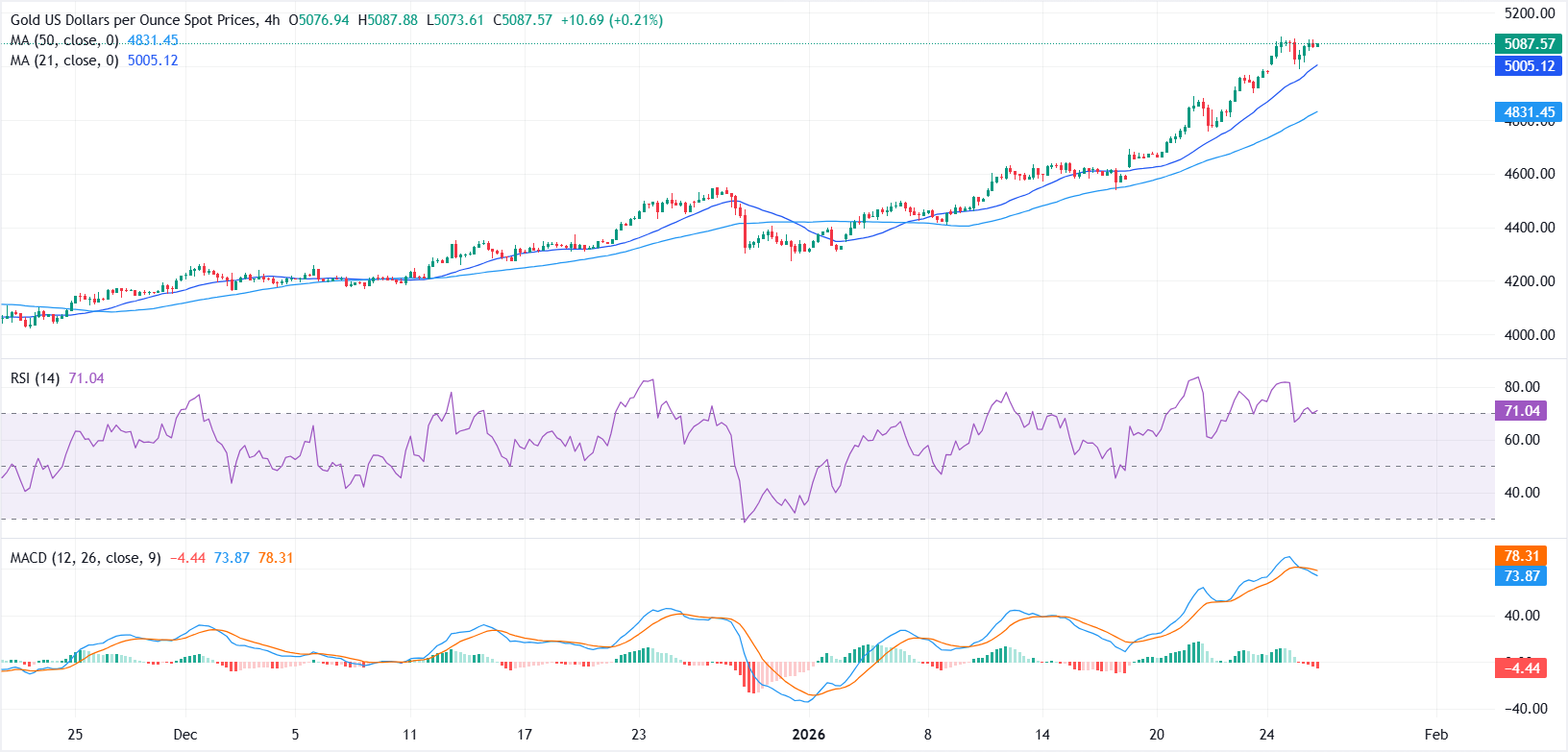
From a technical perspective, dip-buying continues to keep the broader outlook tilted to the upside, although bulls are struggling to secure a decisive break above the $5,100 psychological mark.
On the 4-hour chart, the 21-period Simple Moving Average (SMA), near $5,004, is acting as immediate dynamic support. A sustained break below the $5,000 handle could weaken the near-term structure, exposing the $4,900 region, followed by the 50-period SMA around $4,831 as the next downside targets.
The Moving Average Convergence Divergence (MACD) histogram has slipped below zero and is expanding in negative territory, indicating that the MACD line has moved beneath the Signal line and downside momentum is building.
Meanwhile, the Relative Strength Index (RSI) stands near 70, easing back after previously pushing deep into overbought territory, suggesting that bullish momentum is moderating.
Gold FAQs
Gold has played a key role in human’s history as it has been widely used as a store of value and medium of exchange. Currently, apart from its shine and usage for jewelry, the precious metal is widely seen as a safe-haven asset, meaning that it is considered a good investment during turbulent times. Gold is also widely seen as a hedge against inflation and against depreciating currencies as it doesn’t rely on any specific issuer or government.
Central banks are the biggest Gold holders. In their aim to support their currencies in turbulent times, central banks tend to diversify their reserves and buy Gold to improve the perceived strength of the economy and the currency. High Gold reserves can be a source of trust for a country’s solvency. Central banks added 1,136 tonnes of Gold worth around $70 billion to their reserves in 2022, according to data from the World Gold Council. This is the highest yearly purchase since records began. Central banks from emerging economies such as China, India and Turkey are quickly increasing their Gold reserves.
Gold has an inverse correlation with the US Dollar and US Treasuries, which are both major reserve and safe-haven assets. When the Dollar depreciates, Gold tends to rise, enabling investors and central banks to diversify their assets in turbulent times. Gold is also inversely correlated with risk assets. A rally in the stock market tends to weaken Gold price, while sell-offs in riskier markets tend to favor the precious metal.
The price can move due to a wide range of factors. Geopolitical instability or fears of a deep recession can quickly make Gold price escalate due to its safe-haven status. As a yield-less asset, Gold tends to rise with lower interest rates, while higher cost of money usually weighs down on the yellow metal. Still, most moves depend on how the US Dollar (USD) behaves as the asset is priced in dollars (XAU/USD). A strong Dollar tends to keep the price of Gold controlled, whereas a weaker Dollar is likely to push Gold prices up.
Author

Vishal Chaturvedi
FXStreet
I am a macro-focused research analyst with over four years of experience covering forex and commodities market. I enjoy breaking down complex economic trends and turning them into clear, actionable insights that help traders stay ahead of the curve.