Gold drops as US-China tariff reduction weighs on safe-haven demand
- Gold prices fall over 3% as safe-haven demand weakens following the agreement between the US and China to lower reciprocal tariffs.
- US Dollar strength and improved risk sentiment pressure XAU/USD.
- XAU/USD plunges toward key support at $3,200 ahead of US inflation data on Tuesday.
Gold prices are under significant pressure in Monday’s session, weighed down by improving global risk sentiment and a strengthening US Dollar (USD).
At the time of writing, XAU/USD is trading around $3,217 per ounce, marking a decline of over 3% from the previous session as safe-haven demand fades.
The drop comes after the announcement of a 90-day trade agreement between the United States and China to cut the level of tariffs they apply to each other’s goods, which has helped ease geopolitical tensions and spurred gains in equities and the US Dollar, reducing Gold’s appeal.
Gold Slides on US-China trade agreement, strong Dollar ahead of CPI release
Adding further downside pressure, the US Dollar Index (DXY) trades above 100.60, making Gold more expensive for non-dollar holders and further dampening demand.
Additionally, geopolitical developments, including a ceasefire between India and Pakistan and ongoing Russia-Ukraine negotiations, have reduced risk aversion, contributing to outflows from Gold.
Market participants are also awaiting this Tuesday’s US Consumer Price Index (CPI) release, a key data point that could influence future Federal Reserve (Fed) policy decisions, and by extension, the Gold price.
Technical Analysis: Gold breaches support as momentum turns bearish
On the technical front, Gold is trading below multiple key levels, indicating a breakdown in short-term momentum. The price has dropped below the mid-point of the April rally at $3,228, calculated from the April low of $2,957 to the all-time high of $3,500, turning this level into immediate resistance. Further resistance is located at the 20-day Simple Moving Average (SMA) near $3,314, which now acts as a dynamic ceiling following the recent decline.
Gold (XAU/USD) daily chart
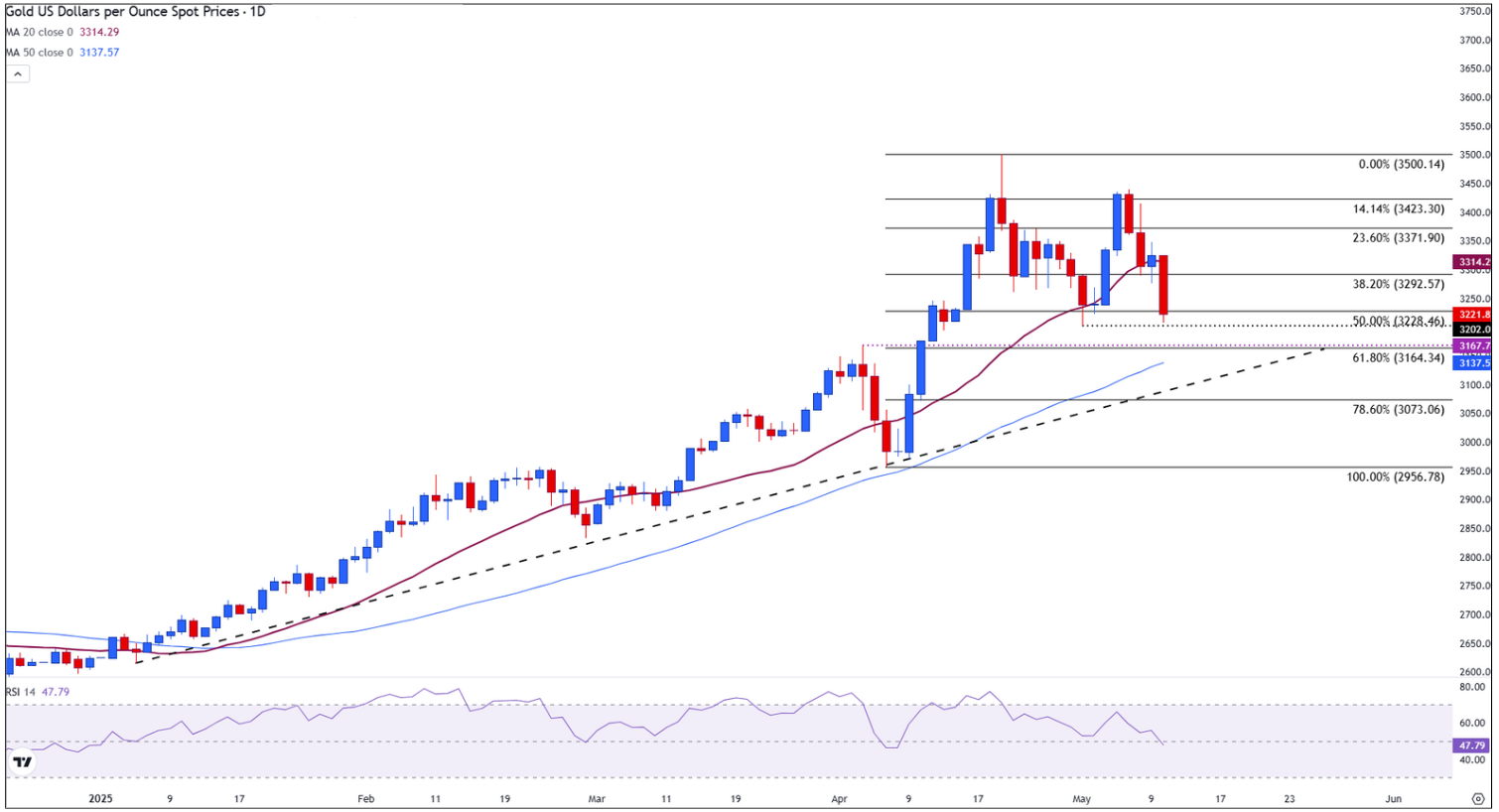
The next key support lies at the $3,200 psychological level, a zone that held during the May 1 pullback when Gold briefly tested $3,202.
A break below this level would expose the 61.8% Fibonacci retracement at $3,164, followed by the 50-day SMA support near $3,138.
If these supports fail, Gold could potentially extend its decline toward $3,150 and $3,000.
On the upside, any recovery would need to reclaim the mid-point at $3,228, which could bring the 38.2% Fibonacci retracement at $3,292 back into focus.
A move above $3,300, followed by a close above the 20-day SMA, may open the door to retest the 23.6% Fib at $3,372.
Momentum indicators reflect this bearish shift. The Relative Strength Index (RSI) on the daily chart stands at 47.80, slightly below the neutral 50 level and pointing down, signaling a loss of bullish momentum without yet reaching oversold conditions.
Gold FAQs
Gold has played a key role in human’s history as it has been widely used as a store of value and medium of exchange. Currently, apart from its shine and usage for jewelry, the precious metal is widely seen as a safe-haven asset, meaning that it is considered a good investment during turbulent times. Gold is also widely seen as a hedge against inflation and against depreciating currencies as it doesn’t rely on any specific issuer or government.
Central banks are the biggest Gold holders. In their aim to support their currencies in turbulent times, central banks tend to diversify their reserves and buy Gold to improve the perceived strength of the economy and the currency. High Gold reserves can be a source of trust for a country’s solvency. Central banks added 1,136 tonnes of Gold worth around $70 billion to their reserves in 2022, according to data from the World Gold Council. This is the highest yearly purchase since records began. Central banks from emerging economies such as China, India and Turkey are quickly increasing their Gold reserves.
Gold has an inverse correlation with the US Dollar and US Treasuries, which are both major reserve and safe-haven assets. When the Dollar depreciates, Gold tends to rise, enabling investors and central banks to diversify their assets in turbulent times. Gold is also inversely correlated with risk assets. A rally in the stock market tends to weaken Gold price, while sell-offs in riskier markets tend to favor the precious metal.
The price can move due to a wide range of factors. Geopolitical instability or fears of a deep recession can quickly make Gold price escalate due to its safe-haven status. As a yield-less asset, Gold tends to rise with lower interest rates, while higher cost of money usually weighs down on the yellow metal. Still, most moves depend on how the US Dollar (USD) behaves as the asset is priced in dollars (XAU/USD). A strong Dollar tends to keep the price of Gold controlled, whereas a weaker Dollar is likely to push Gold prices up.
Author

Tammy Da Costa, CFTe®
FXStreet
Tammy is an economist and market analyst with a deep passion for financial markets, particularly commodities and geopolitics.