Gold pulls back under $3,650 after BLS jobs revision sparks rebound in US Dollar
- Gold extends record-breaking rally to a fresh all-time high near $3,675, trading around $3,640 on Tuesday.
- Markets fully price in a September Fed rate cut after weaker-than-expected NFP, with a 25 bps move seen as certain.
- XAU/USD is consolidating just below record highs on the 1-hour chart, with RSI divergence signaling momentum fatigue.

Gold (XAU/USD) surged to a fresh all-time high near $3,675 on Tuesday before paring most of its intraday gains. The metal was last seen trading around $3,640, easing after its latest push into record territory.
The rally found fresh fuel after the US Bureau of Labor Statistics (BLS) released its preliminary benchmark revision, showing payrolls were overstated by 911,000 jobs through March 2025. The sharp downward adjustment underlined that the labor market has been cooling more significantly than initially reported, lending weight to dovish Fed bets. However, with much of the weakness already priced in, Gold pared gains as the Greenback rebounded on short-covering and Treasury yields ticked higher.
A broadly weaker US Dollar (USD) has amplified the rally, making Gold more attractive for overseas buyers. At the same time, a string of disappointing US labor market readings has strengthened bets that the Federal Reserve (Fed) will cut borrowing costs at its September 16-17 meeting. The prospect of easier monetary policy continues to underpin demand for bullion, keeping the downside cushioned.
Steady central bank purchases are adding another layer of support, as major reserve holders diversify away from the US Dollar. Also, concerns over global trade frictions linked to US tariffs, alongside broader geopolitical tensions, are bolstering safe-haven flows into Gold. Meanwhile, uncertainty over the Fed’s independence amid growing political pressure has heightened market anxiety. Altogether is helping to sustain demand for Gold amid broader risk aversion.
Market movers: Markets eye US CPI, PPI as Fed rate cut bets mount
- The US Dollar Index (DXY), which tracks the Greenback against a basket of six major currencies, fell to a seven-week low — its weakest level since July 24 — before stabilizing near 97.66 at the time of writing. However, the index remains under pressure from a dovish Fed outlook, with markets expecting the central bank to prioritize maximum employment over price stability within its dual mandate, given that monetary policy is still moderately restrictive.
- US Treasury yields stabilized across the curve after a four-day slump that dragged rates to multi-month lows. The benchmark 10-year yield is holding around 4.06%, while the 30-year is hovering near 4.72% and the rate-sensitive 2-year yield sits at 3.50%. The recent drop in yields underscores the view that the US economy is losing momentum, adding pressure on the Fed to ease monetary policy sooner rather than later.
- Markets remain fully priced for a 25-basis-point rate cut at the September 16-17 meeting, but odds of a larger 50 bps move have risen to around 11% following the weak Nonfarm Payrolls (NFP) report, up from near zero just a week earlier, according to the CME FedWatch tool. Futures are also pricing in nearly 75 bps of cuts by year-end and about 140 bps of easing over the next twelve months, as per a report from BHH Marketview.
- Multiple explosions were reported in Qatar’s capital, Doha, on Tuesday, with smoke seen rising over the Katara district. An Israeli official told Axios that the incident was an assassination operation targeting senior Hamas leaders. The Israeli Defense Forces (IDF) and Shin Bet security agency later acknowledged carrying out a strike against Hamas leadership abroad, though they did not immediately specify which officials were targeted.
- France's Prime Minister François Bayrou lost a confidence motion in parliament on Monday, as widely expected, paving the way for his resignation. French President Emmanuel Macron's office said he would accept Bayrou's resignation and appoint a new prime minister in the coming days – his fourth prime minister since the June 2024 snap parliamentary election.
- US President Donald Trump signaled on Sunday readiness to launch a “second phase” of sanctions against Russia over its war in Ukraine. EU foreign policy chief António Costa confirmed on Monday that the bloc is preparing its 19th sanctions package in close coordination with Washington.
- All eyes are on the US Producer Price Index (PPI) due Wednesday, followed by the US Consumer Price Index (CPI) on Thursday, which will be key for the Fed’s monetary policy path. Markets are looking for signs of disinflation, with forecasts pointing to only modest monthly gains. A softer set of readings would further cement expectations of rate cuts next week, while any upside surprise could temper dovish bets and weigh on Gold.
Technical analysis: XAU/USD consolidates near $3,650 as RSI divergence flashes caution
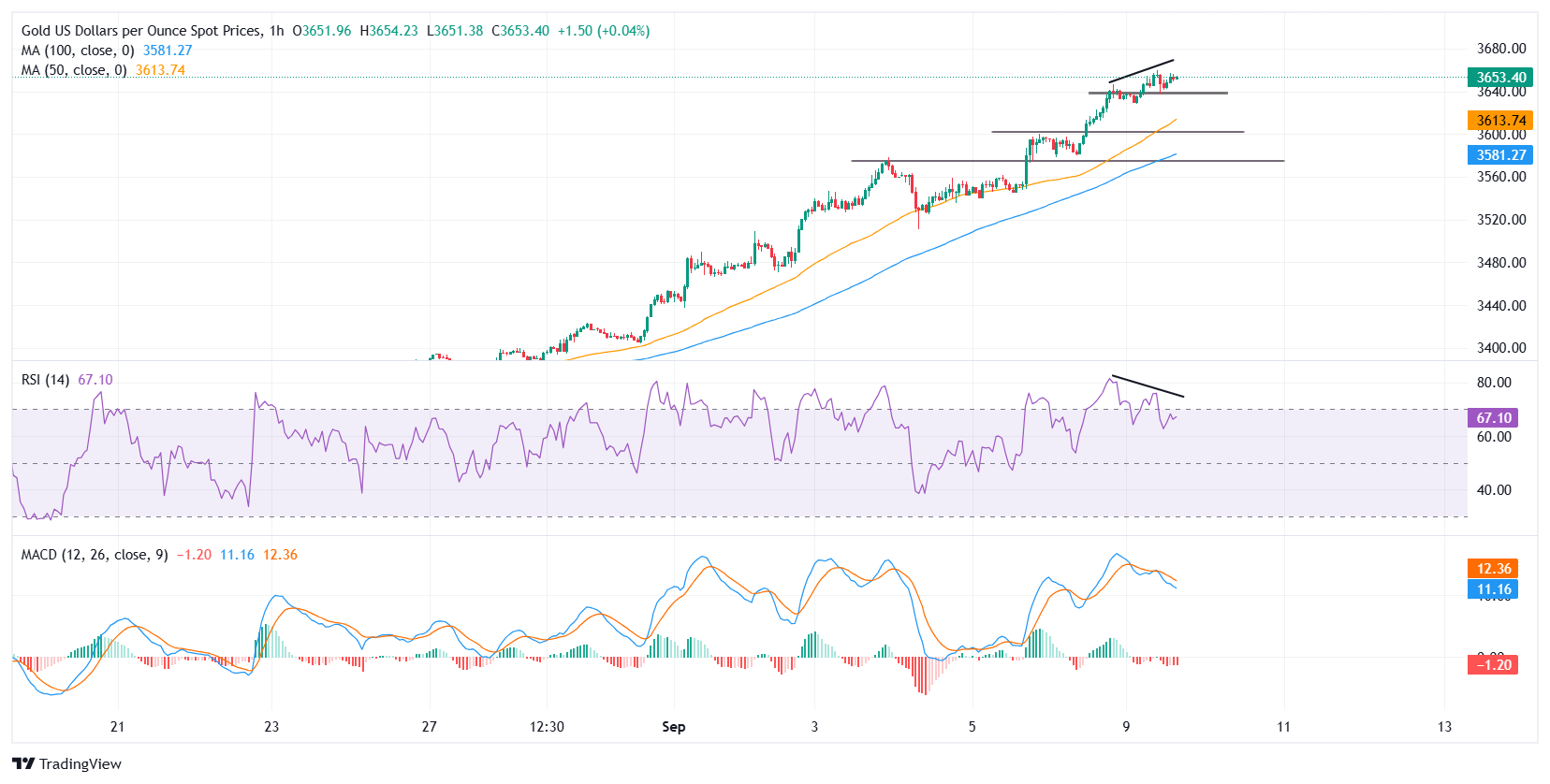
Gold (XAU/USD) is consolidating just below its record peak near $3,675 reached earlier on Tuesday, with intraday price action showing a tight range above $3,640 support. The 50-hour Simple Moving Average (SMA) at $3,613 and the 100-hour SMA at $3,581 are sloping higher, highlighting the underlying bullish bias.
Momentum indicators, however, are showing early signs of fatigue. The Relative Strength Index (RSI) at 67 on the 1-hour chart is flirting with overbought territory and has formed a bearish divergence, with price making higher highs while RSI records lower highs. The Moving Average Convergence Divergence (MACD) indicator on the same chart is still in positive territory, though its histogram shows waning strength, hinting at consolidation before the next leg higher.
A sustained break above $3,660 would pave the way for an advance toward $3,680–$3,700, while immediate support rests at $3,640. Below that, the 50-hour SMA at $3,613 and the $3,600 handle are key levels, followed by the 100-hour SMA at $3,581 and $3,575 as deeper downside cushions.
Gold FAQs
Gold has played a key role in human’s history as it has been widely used as a store of value and medium of exchange. Currently, apart from its shine and usage for jewelry, the precious metal is widely seen as a safe-haven asset, meaning that it is considered a good investment during turbulent times. Gold is also widely seen as a hedge against inflation and against depreciating currencies as it doesn’t rely on any specific issuer or government.
Central banks are the biggest Gold holders. In their aim to support their currencies in turbulent times, central banks tend to diversify their reserves and buy Gold to improve the perceived strength of the economy and the currency. High Gold reserves can be a source of trust for a country’s solvency. Central banks added 1,136 tonnes of Gold worth around $70 billion to their reserves in 2022, according to data from the World Gold Council. This is the highest yearly purchase since records began. Central banks from emerging economies such as China, India and Turkey are quickly increasing their Gold reserves.
Gold has an inverse correlation with the US Dollar and US Treasuries, which are both major reserve and safe-haven assets. When the Dollar depreciates, Gold tends to rise, enabling investors and central banks to diversify their assets in turbulent times. Gold is also inversely correlated with risk assets. A rally in the stock market tends to weaken Gold price, while sell-offs in riskier markets tend to favor the precious metal.
The price can move due to a wide range of factors. Geopolitical instability or fears of a deep recession can quickly make Gold price escalate due to its safe-haven status. As a yield-less asset, Gold tends to rise with lower interest rates, while higher cost of money usually weighs down on the yellow metal. Still, most moves depend on how the US Dollar (USD) behaves as the asset is priced in dollars (XAU/USD). A strong Dollar tends to keep the price of Gold controlled, whereas a weaker Dollar is likely to push Gold prices up.
Author

Vishal Chaturvedi
FXStreet
I am a macro-focused research analyst with over four years of experience covering forex and commodities market. I enjoy breaking down complex economic trends and turning them into clear, actionable insights that help traders stay ahead of the curve.

















