Gold eases from over one-week top amid positive risk tone; bullish potential seems intact
- Gold struggles to capitalize on a modest intraday uptick to an over one-week peak.
- A positive risk tone and a bullish USD cap XAU/USD ahead of the US macro data.
- Rising December Fed rate cut bets and geopolitical risks support the precious metal.

Gold (XAU/USD) retreats slightly from a one-and-a-half-week top touched this Tuesday, though any meaningful corrective decline seems elusive. A generally positive tone around the equity markets turns out to be a key factor acting as a headwind for the safe-haven commodity ahead of the key US macro data. Furthermore, the US Dollar (USD), so far, has managed to preserve its recent gains to the highest level since late May and contributes to capping the precious metal.
The USD bulls, however, seem reluctant to place fresh bets amid mixed signals from Federal Reserve (Fed) officials recently, which lifted bets for another interest rate cut in December. This might continue to benefit the non-yielding Gold. Apart from this, persistent geopolitical uncertainties stemming from the intensifying Russia-Ukraine war and fresh conflicts in the Middle East suggest that any corrective pullback is likely to be bought into, warranting caution for the XAU/USD bears.
Daily Digest Market Movers: Gold bulls turn cautious amid risk-on mood, ahead of US data
- New York Federal Reserve President John Williams said on Friday that interest rates could fall in the near term without putting the central bank's inflation goal at risk. Adding to this, Fed Governor Christopher Waller said on Monday that the job market is weak enough to warrant another quarter-point rate cut in December.
- According to CME Group's FedWatch tool, the futures-market-implied probability of a 25 basis points rate reduction to a range of 3.50% to 3.75% in December now stands at around 80%. This fails to assist the US Dollar to build on last week's strong move up to a multi-month high and lends support to the non-yielding Gold.
- Russia launched a wave of attacks on Ukraine’s capital, Kyiv, early Tuesday (November 25, 2025), striking residential buildings and energy infrastructure. The attack follows negotiations between the US and Ukraine representatives in Switzerland over the weekend about a US-brokered plan to end a nearly four-year-old war.
- The White House said US President Donald Trump remains hopeful and optimistic that a deal can be struck, though he cautioned that any progress remains uncertain. According to a Ukrainian official, the US-proposed Russia-Ukraine peace plan now has 19 points and does not include a strict limit on the size of the Ukrainian army.
- The changes, however, could very well be less acceptable to Russia. Furthermore, Israel, according to the Gaza Government Media Office, has violated the United States-brokered Gaza ceasefire at least 497 times in 44 days. This keeps geopolitical risks in play and turns out to be another factor supporting the safe-haven precious metal.
- Traders now look forward to Tuesday's US economic docket – featuring the delayed release of the US Producer Price Index and Retail Sales figures, along with Pending Home Sales and Richmond Manufacturing Index. This could influence the USD price dynamics and produce short-term trading opportunities around the XAU/USD pair.
Gold technical setup suggests that any corrective slide could be seen as buying opportunity
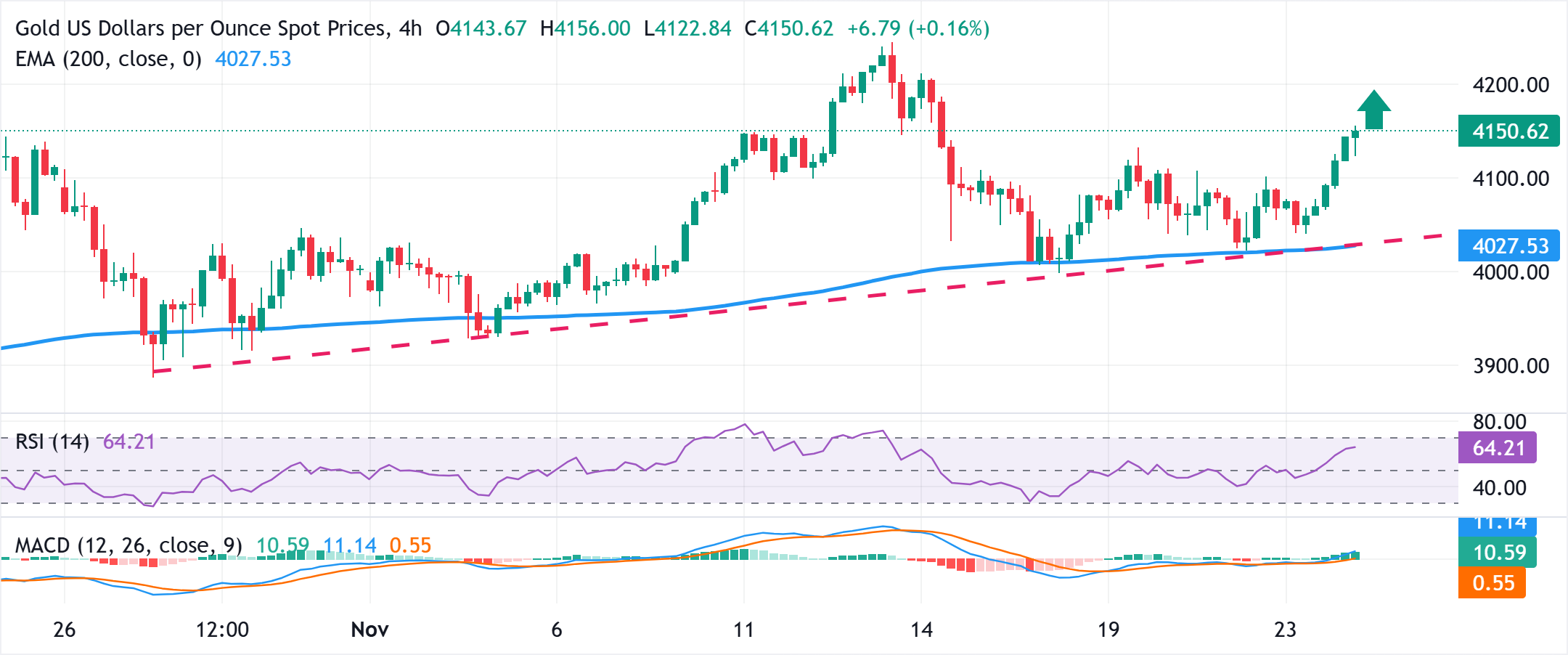
The overnight strong move up validated a confluence support – comprising an upward sloping trend-line extending from late October and the 200-period Exponential Moving Average (EMA) on the 4-hour chart. The subsequent move up and positive oscillators on 4-hour/daily charts back the case for a further near-term appreciating move for the XAU/USD pair. Hence, some follow-through strength towards the $4,177-4,178 region, en route to the $4,200 round figure, looks like a distinct possibility. The momentum could extend further towards testing the monthly swing high, around the $4,245 zone.
On the flip side, any pullback below the $4,132-4,130 area might now be seen as a buying opportunity and find decent support near the $4,110-4,100 region. A convincing break below the latter would expose the aforementioned confluence, currently pegged near the $4,032-4,030 zone, which, if broken, might shift the near-term bias in favor of bears and drag the Gold price to the $4,000 psychological mark. Some follow-through selling should pave the way for a fall towards last week's swing low, around the $3,968-3,967 area, en route to the $3,931 support, the $3,900 mark and late October swing low, around the $3,886 region.
Risk sentiment FAQs
In the world of financial jargon the two widely used terms “risk-on” and “risk off'' refer to the level of risk that investors are willing to stomach during the period referenced. In a “risk-on” market, investors are optimistic about the future and more willing to buy risky assets. In a “risk-off” market investors start to ‘play it safe’ because they are worried about the future, and therefore buy less risky assets that are more certain of bringing a return, even if it is relatively modest.
Typically, during periods of “risk-on”, stock markets will rise, most commodities – except Gold – will also gain in value, since they benefit from a positive growth outlook. The currencies of nations that are heavy commodity exporters strengthen because of increased demand, and Cryptocurrencies rise. In a “risk-off” market, Bonds go up – especially major government Bonds – Gold shines, and safe-haven currencies such as the Japanese Yen, Swiss Franc and US Dollar all benefit.
The Australian Dollar (AUD), the Canadian Dollar (CAD), the New Zealand Dollar (NZD) and minor FX like the Ruble (RUB) and the South African Rand (ZAR), all tend to rise in markets that are “risk-on”. This is because the economies of these currencies are heavily reliant on commodity exports for growth, and commodities tend to rise in price during risk-on periods. This is because investors foresee greater demand for raw materials in the future due to heightened economic activity.
The major currencies that tend to rise during periods of “risk-off” are the US Dollar (USD), the Japanese Yen (JPY) and the Swiss Franc (CHF). The US Dollar, because it is the world’s reserve currency, and because in times of crisis investors buy US government debt, which is seen as safe because the largest economy in the world is unlikely to default. The Yen, from increased demand for Japanese government bonds, because a high proportion are held by domestic investors who are unlikely to dump them – even in a crisis. The Swiss Franc, because strict Swiss banking laws offer investors enhanced capital protection.
Author

Haresh Menghani
FXStreet
Haresh Menghani is a detail-oriented professional with 10+ years of extensive experience in analysing the global financial markets.