Gold climbs as weaker USD and lower yields offset firm US data
- Gold rises after rebounding from $4,127, supported by lower yields and a softer US Dollar.
- US jobless claims hit their lowest since April, and strong durable goods keep Fed cut odds to 84%.
- China–Taiwan tensions and Russia–Ukraine peace signals create mixed geopolitical crosswinds for bullion momentum.

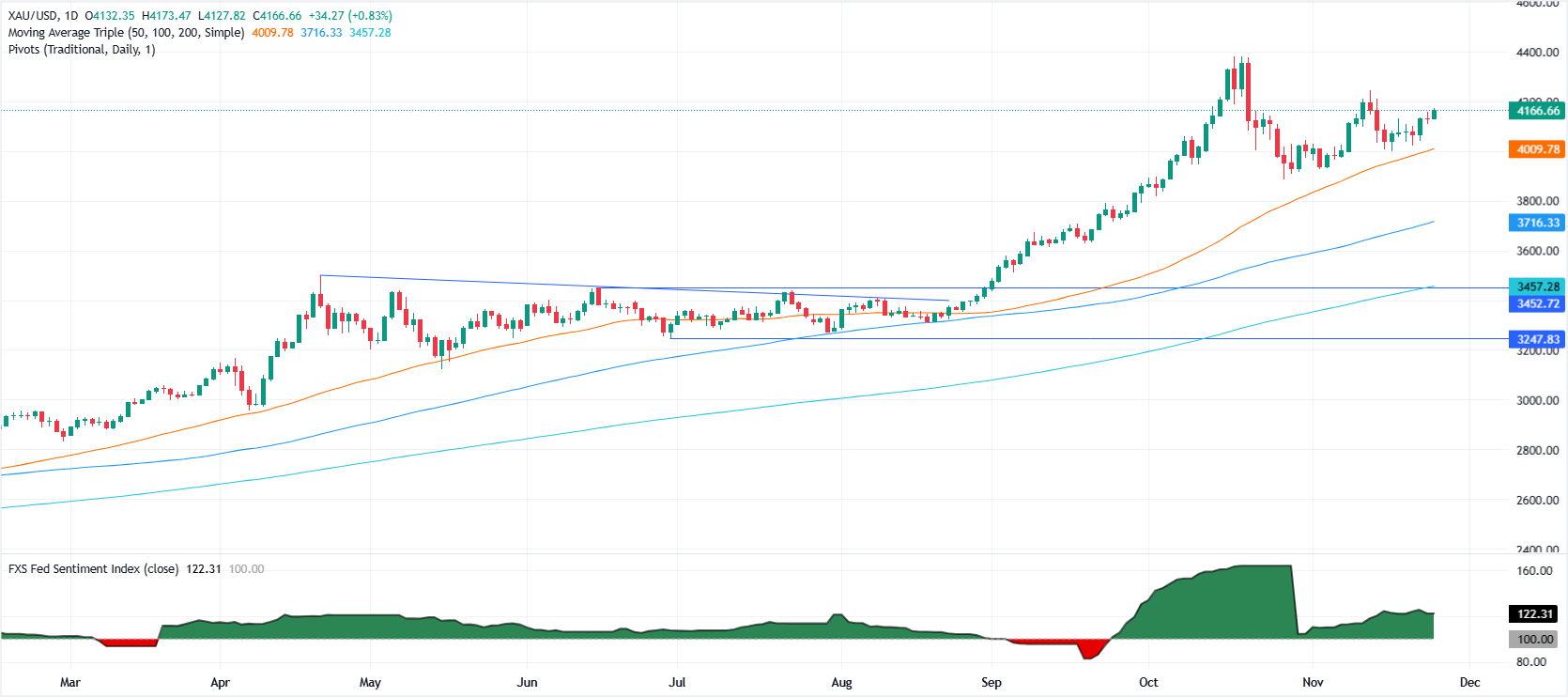
Gold (XAU/USD) rises sharply on Wednesday, edging up over 0.80% sponsored by falling US Treasury yields and a weaker US Dollar, as the odds for a rate cut by the Federal Reserve (Fed) remain elevated despite strong economic data in the US. At the time of writing, XAU/USD trades at $4,165 after bouncing off daily lows of $4,127.
XAU/USD jumps over 0.80% amid upbeat US jobless and durable goods figures
Data in the US revealed that the number of Americans filing for unemployment benefits dipped compared to the previous week, reaching its lowest level since mid-April, according to the US Department of Labor. Durable Goods Orders for September topped expectations yet dipped compared to the August print, revealed the US Census Bureau.
The data release barely moved the needle regarding rate cut expectations by the Federal Reserve for its December meeting, which remain close to 85%, according to the CME FedWatch Tool.
Regarding geopolitics, tensions between China and Taiwan resurfaced after Taiwan’s Defense Ministry commented that Beijing changed its patterns, squeezing Taiwan’s response time. Taiwan added that the special defense budget running from 2026 to 2030 will cover missiles and drones, to counter Chinese threats.
Aside from this, the progress of a possible end to the Russia-Ukraine war looms as a Russian aide said, “Some points in the US plan in Ukraine are positive, but some items in it require discussion,” via Al Jazeera.
A peace deal would be negative for Gold prices, which tend to fare well amid high geopolitical risks. However, expectations of a dovish Fed are a headwind for the US Dollar, which depreciates amid easing cycles by the US central bank.
Daily market movers: Gold surges as the Greenback tumbles
- The US Dollar Index (DXY), which tracks the buck’s performance versus six currencies, dives 0.19% down to 99.60. At the same time, US Treasury yields remain firm, with the 10-year US Treasury note yield steady at 4.00% after hitting a high of 4.04%. US real yields, which correlate inversely to Gold prices, are also flat at 1.78%.
- Initial Jobless Claims for the week ending November 22 came at 216,000, below estimates of 225,000 and were down from the previous reading of 222,000. Continuing Claims increased from 1.95 million to 1.96 million in the previous week.
- US Durable Goods Orders for September deteriorated from 3% in August to 0.5% MoM, yet exceeded economists’ estimates of 0.3%. Excluding volatile items like Transports and Defense, rose by 0.9% MoM, crushing estimates of 0.2%.
- On Tuesday, a softer-than-expected US Producer Price Index (PPI) report for September and a dip in Retail Sales increased the chances of a rate cut at the December 9-10 meeting. The latest Consumer Confidence poll by the Conference Board (CB) shows that households remain uncertain about jobs, incomes and their financial situation.
Technical analysis: Gold price trapped within the $4,130-$4,175 range
Gold price continues to consolidate within the $4,100-$4,190 range, unable to crack the $4,200 mark. Although momentum favors further upside, as depicted by the Relative Strength Index (RSI), buyers lack the strength to drive XAU/USD to re-test record highs.
If XAU/USD climbs above $4,200, the next resistance would be the November 13 peak at $4,245. A break above puts $4,300 in play and the chance of testing the all-time high at $4,381.
On the downside, a drop below $4,100 would open the door for a test of the 20-day Simple Moving Average (SMA) near $4,065, ahead of a potential decline toward $4,000.
Gold FAQs
Gold has played a key role in human’s history as it has been widely used as a store of value and medium of exchange. Currently, apart from its shine and usage for jewelry, the precious metal is widely seen as a safe-haven asset, meaning that it is considered a good investment during turbulent times. Gold is also widely seen as a hedge against inflation and against depreciating currencies as it doesn’t rely on any specific issuer or government.
Central banks are the biggest Gold holders. In their aim to support their currencies in turbulent times, central banks tend to diversify their reserves and buy Gold to improve the perceived strength of the economy and the currency. High Gold reserves can be a source of trust for a country’s solvency. Central banks added 1,136 tonnes of Gold worth around $70 billion to their reserves in 2022, according to data from the World Gold Council. This is the highest yearly purchase since records began. Central banks from emerging economies such as China, India and Turkey are quickly increasing their Gold reserves.
Gold has an inverse correlation with the US Dollar and US Treasuries, which are both major reserve and safe-haven assets. When the Dollar depreciates, Gold tends to rise, enabling investors and central banks to diversify their assets in turbulent times. Gold is also inversely correlated with risk assets. A rally in the stock market tends to weaken Gold price, while sell-offs in riskier markets tend to favor the precious metal.
The price can move due to a wide range of factors. Geopolitical instability or fears of a deep recession can quickly make Gold price escalate due to its safe-haven status. As a yield-less asset, Gold tends to rise with lower interest rates, while higher cost of money usually weighs down on the yellow metal. Still, most moves depend on how the US Dollar (USD) behaves as the asset is priced in dollars (XAU/USD). A strong Dollar tends to keep the price of Gold controlled, whereas a weaker Dollar is likely to push Gold prices up.
Author

Christian Borjon Valencia
FXStreet
Markets analyst, news editor, and trading instructor with over 14 years of experience across FX, commodities, US equity indices, and global macro markets.
















