Gold’s upward swing continues unfazed by US yields, ahead of US CPI
- Gold's ascent to $2,354 tempered amid evolving Fed rate cut expectations and resilient US jobs report.
- Citi analysts project potential further upside for Gold with forecasts reaching up to $2,500 in more bullish scenarios.
- Market recalibration on the Federal Reserve's interest rate policy reflects a balanced outlook.

Gold price retreated on Monday after hitting all-time highs of $2,354 during the mid-North American session. The yellow metal advance continues amid higher US Treasury yields and less likelihood of additional rate cuts by the Federal Reserve (Fed). A stronger-than-expected US Nonfarm Payrolls report last Friday wasn’t an excuse for the non-yielding metal’s advance. At the time of writing, XAU/USD trades at $2,327, posting decent gains of 0.30%.
Expectations for rate cuts by the Fed and central bank buying remain the main drivers behind Gold’s rally. In the meantime, Wall Street banks began to revise their forecasts upward. According to sources cited by Marketwatch, Citi analysts updated their forecast for three months to $2,400, and their more bullish scenario sees the precious metal at $2,500.
The latest employment report witnessed the economy adding more jobs than expected, while the Unemployment Rate dropped. In the meantime, Fed rate cut expectations are adjusting, with investors speculating that the US central bank might begin reducing rates in July rather than June. The chances of a rate cut in June are 50%, while for July they stand at 69%.
In the meantime, Fed officials remain optimistic that they will cut rates but emphasize the need to be patient.
Daily digest market movers: Gold trims gains amid high US yields
- US Department of Labor announces that Nonfarm Payrolls increased by 303,000 in March, higher than the anticipated 200,000 and the previous 270,000.
- Further details revealed that the Unemployment Rate decreased modestly to 3.8% from 3.9%, with Average Hourly Earnings meeting consensus predictions. Average Hourly Earnings rose by 0.3% MoM, up from 0.2%. In the twelve months to March, earnings rose by 4.1% as expected, down from 4.3%.
- Geopolitical risks loom following Israel’s attack on Iran’s embassy in Syria. Iran pledged to retaliate against Israel after seven officers were killed. A further escalation could pressure Gold prices upward with traders looking at the $2,350 figure.
- World Gold Consortium reveals that the People’s Bank of China was the largest buyer of the yellow metal, increasing its reserves by 12 tonnes to 2,257 tonnes.
- Investors are focusing on the upcoming US Consumer Price Index (CPI) data for March, which will be released on Wednesday. Inflation data will offer additional insights into the potential timing for the Federal Reserve to commence lowering its interest rates. Strong price pressure may dampen expectations for rate cuts in June, whereas softer inflation figures could fuel speculation for rate reductions.
Technical analysis: Gold’s rally set to continue after dipping to $2,303
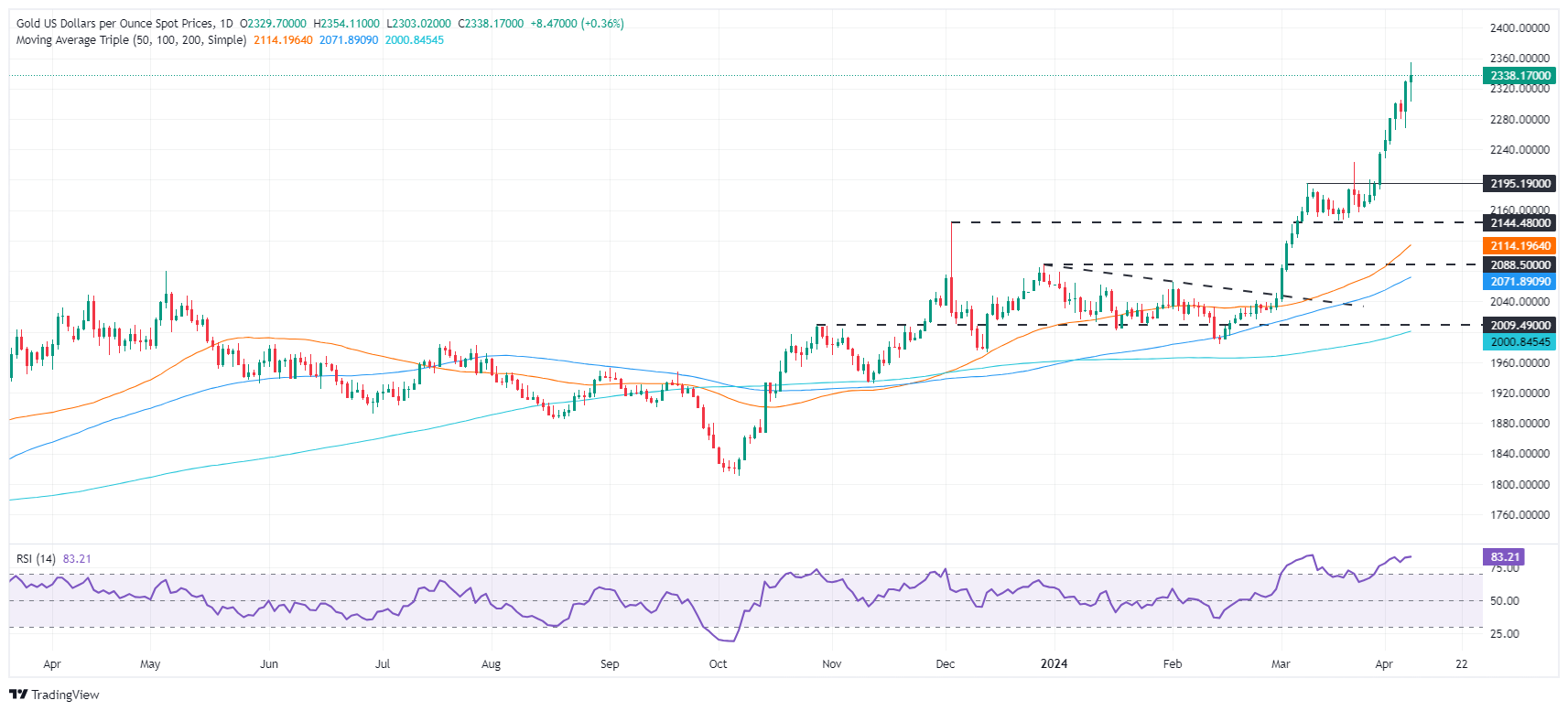
Gold’s rally is set to continue with buyers gathering momentum. The Relative Strength Index (RSI), although at overbought conditions past the 70.00 level, aims north. Usually when an asset has a strong uptrend, the 80 reading is seen as the overbought extreme.
Earlier, Gold dipped to a low of $2,303 before resuming its upward climb. With that said, the first resistance would be the all-time peak at $2,354. Once cleared, the next stop would be $2,400, followed by the $2,500 figure.
On the flip side, the first support level would be $2,300. A breach of the latter will expose $2,250, followed by the $2,200 mark.
Gold FAQs
Gold has played a key role in human’s history as it has been widely used as a store of value and medium of exchange. Currently, apart from its shine and usage for jewelry, the precious metal is widely seen as a safe-haven asset, meaning that it is considered a good investment during turbulent times. Gold is also widely seen as a hedge against inflation and against depreciating currencies as it doesn’t rely on any specific issuer or government.
Central banks are the biggest Gold holders. In their aim to support their currencies in turbulent times, central banks tend to diversify their reserves and buy Gold to improve the perceived strength of the economy and the currency. High Gold reserves can be a source of trust for a country’s solvency. Central banks added 1,136 tonnes of Gold worth around $70 billion to their reserves in 2022, according to data from the World Gold Council. This is the highest yearly purchase since records began. Central banks from emerging economies such as China, India and Turkey are quickly increasing their Gold reserves.
Gold has an inverse correlation with the US Dollar and US Treasuries, which are both major reserve and safe-haven assets. When the Dollar depreciates, Gold tends to rise, enabling investors and central banks to diversify their assets in turbulent times. Gold is also inversely correlated with risk assets. A rally in the stock market tends to weaken Gold price, while sell-offs in riskier markets tend to favor the precious metal.
The price can move due to a wide range of factors. Geopolitical instability or fears of a deep recession can quickly make Gold price escalate due to its safe-haven status. As a yield-less asset, Gold tends to rise with lower interest rates, while higher cost of money usually weighs down on the yellow metal. Still, most moves depend on how the US Dollar (USD) behaves as the asset is priced in dollars (XAU/USD). A strong Dollar tends to keep the price of Gold controlled, whereas a weaker Dollar is likely to push Gold prices up.
Author

Christian Borjon Valencia
FXStreet
Markets analyst, news editor, and trading instructor with over 14 years of experience across FX, commodities, US equity indices, and global macro markets.

















