Breaking: German CPI surprised to the downside in August

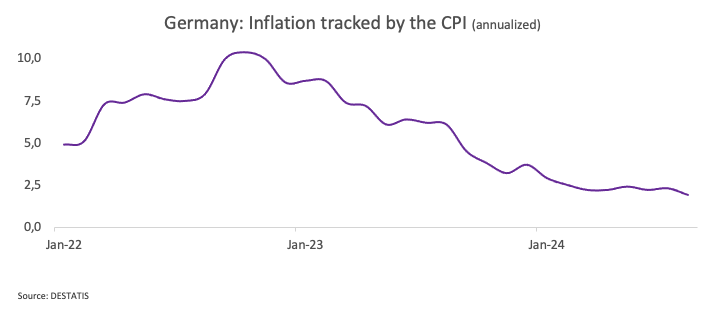
The forward-looking headline Consumer Price Index (CPI) in Germany was up 1.9% in the year to August, according to the Federal Statistics Office. The number was below the consensus and below the July gain of 2.3% year over year. For the month the Inflation Rate was down 0.1%.
Furthermore, the broader Harmonized Index of Consumer Prices (HICP) experienced an increase of 2.0% over the past twelve months, retreating by 0.2% compared to the previous month.
Market reaction
EUR/USD holds onto its bearish tone around 1.1100, recovering some momentum after touching a session low near 1.1070.
This section below was published as a preview of the preliminary German inflation report for August at 08:30 GMT.
- Germany’s statistics agency, Destatis, will publish the CPI data on Thursday.
- Headline CPI is set to rise by 2.1% YoY in August.
- The ECB is still far from decided over a move on rates in September.
The European Central Bank (ECB) is scheduled to meet next month for its monetary policy review, making the upcoming Harmonized Index of Consumer Prices (HICP) inflation data from Germany, set to be released on Thursday, particularly significant for its potential impact on the central bank’s policy decisions.
Meanwhile, the Euro (EUR) may relinquish part of its recent strong upward trend, particularly against the US Dollar (USD), if the inflation data from Eurozone economies, especially Germany, indicates a persistent disinflationary trend.
What can we expect from the upcoming German inflation report?
The Federal Statistical Office of Germany (Destatis) will release the official data on Thursday. The annual German Consumer Price Index (CPI) is projected to rise by 2.1% in August, down from the 2.3% increase reported in the previous month. Monthly CPI inflation is expected to show a humble increase of 0.1% during the reported period.
Germany’s annual Harmonized Index of Consumer Prices (HICP), in the meantime, is anticipated to drop to 2.3% in August, down from 2.6% in July. The monthly HICP is likely to come in flat last month, compared to a 0.5% increase in July.
A further cooling of inflation in Europe’s largest economy could suggest softer inflation readings for the entire Eurozone, which will be published on Friday. On this, the headline Eurozone headline CPI is expected to rise by 2.2% in the year to August, a slowdown from the 2.6% increase seen in July, while the core inflation, which strips food and energy costs, is also projected to decrease to 2.8% during the same period, down from a 2.9% uptick in the previous month.
On Tuesday, Dutch policymaker Klaas Knot argued that the European Central Bank (ECB) could gradually lower interest rates as long as inflation is expected to reach its 2% target by the end of 2025 at the latest. He expressed his comfort with gradually easing off the brakes, provided that the disinflation path continues to align with a return to 2% inflation by that time. Knot also mentioned that he would need to wait for the complete set of data and information before deciding his position on whether a rate cut in September would be appropriate.
This cautious tone followed comments from ECB Chief Economist Philip Lane over the weekend, who remarked that it is not yet guaranteed that the central bank will successfully reduce inflation back to its 2% target, indicating that a restrictive monetary policy remains necessary. Lane also emphasized that the monetary stance must remain in restrictive territory for as long as necessary to guide the disinflation process towards a timely return to the target. However, he also cautioned against maintaining high rates for an extended period, as this could result in persistently below-target inflation.
Ahead of the release, TD analysts noted: “Heavy base effects in the energy components will help headline inflation get close to target in the eurozone—in the EZ, the headline rate will likely come down all the way to 2.1% y/y, whereas German HICP inflation should fall to 2.2% y/y. Core inflation should remain sticky though, but remain on a disinflationary path."
When will the HICP inflation report be released, and how could it affect EUR/USD?
The preliminary HICP inflation report for Germany is scheduled for release at 12:00 GMT. In the lead-up to this inflation data release, EUR/USD seems to have lost some upside impulse after hitting fresh 2024 tops just above 1.1200 the figure at the beginning of the week.
Markets have now pencilled in around 100 bps of easing by the US Federal Reserve (Fed) in the latter part of the year, with the kick-start of its easing cycle coming as soon as September. However, it is not that clear that the ECB will follow suit, as per recent prudent comments from rate-setters. So far, the broader debate seems to have shifted towards the health of both economies, where the US clearly exhibits a decent advantage.
If the headline and core inflation data come in hotter than expected, it could bolster expectations for one more ECB rate hike in the next few months, lending support to the European currency and therefore opening the door to the continuation of the ongoing uptrend in EUR/USD. On the flip side, a negative surprise, that is, an acceleration of the disinflationary trend, will carry the potential to remove some strength from the Euro and thus unveil a probable reversal to lower levels.
Pablo Piovano, Senior Analyst at FXStreet.com, notes that the surpass of the 2024 peak at 1.1201 (August 26) could prompt the pair to embark on a probable trip to the 2023 high of 1.1275 (July 18), seconded by the 1.1300 milestone.
In case of bearish attempts, Pablo suggests that there should be initial contention at the weekly low of 1.0881 (August 8), which appears reinforced by the provisional 55-day SMA at 1.0879 and comes before the critical 200-day SMA of 1.0851.
All in all, the pair’s constructive bias is expected to persist as long as it trades above the key 200-day SMA, concludes Pablo.
Economic Indicator
Consumer Price Index (YoY)
The Consumer Price Index (CPI), released by the German statistics office Destatis on a monthly basis, measures the average price change for all goods and services purchased by households for consumption purposes. The CPI is the main indicator to measure inflation and changes in purchasing trends. The YoY reading compares prices in the reference month to a year earlier. Generally, a high reading is bullish for the Euro (EUR), while a low reading is bearish.
Read more.Last release: Thu Aug 29, 2024 12:00 (Prel)
Frequency: Monthly
Actual: 1.9%
Consensus: 2.1%
Previous: 2.3%
Euro PRICE Today
The table below shows the percentage change of Euro (EUR) against listed major currencies today. Euro was the strongest against the Swiss Franc.
| USD | EUR | GBP | JPY | CAD | AUD | NZD | CHF | |
|---|---|---|---|---|---|---|---|---|
| USD | 0.28% | 0.13% | 0.01% | -0.13% | -0.40% | -0.43% | 0.25% | |
| EUR | -0.28% | -0.16% | -0.26% | -0.42% | -0.68% | -0.71% | -0.03% | |
| GBP | -0.13% | 0.16% | -0.10% | -0.26% | -0.52% | -0.54% | 0.16% | |
| JPY | -0.01% | 0.26% | 0.10% | -0.14% | -0.43% | -0.48% | 0.24% | |
| CAD | 0.13% | 0.42% | 0.26% | 0.14% | -0.25% | -0.29% | 0.41% | |
| AUD | 0.40% | 0.68% | 0.52% | 0.43% | 0.25% | -0.01% | 0.69% | |
| NZD | 0.43% | 0.71% | 0.54% | 0.48% | 0.29% | 0.00% | 0.69% | |
| CHF | -0.25% | 0.03% | -0.16% | -0.24% | -0.41% | -0.69% | -0.69% |
The heat map shows percentage changes of major currencies against each other. The base currency is picked from the left column, while the quote currency is picked from the top row. For example, if you pick the Euro from the left column and move along the horizontal line to the US Dollar, the percentage change displayed in the box will represent EUR (base)/USD (quote).
Author

FXStreet Team
FXStreet
Composed of a group of economic journalists and FX experts, the FXStreet content team produces and oversees all content published on FXStreet. It provides a purely journalistic approach to the Forex market.