|

GE Stock Forecast: General Electric Company (GE) flat as Morgan Stanley raises price target

  • NYSE:GE solid earnings see Morgan Stanley raise price target to $13.
  • General Electric beats analysts revenue expectations but EPS misses.
  • GE was an underperformer in 2020 ending the year negatively.

GE Stock News update: GE shares continued to stabilise after the mixed earnings report on Wednesday. GE beat analyst expectations for sales saying power orders were up 26% but missed on EPS. GE shares are currently slightly down in Thursday's pre-market trading.

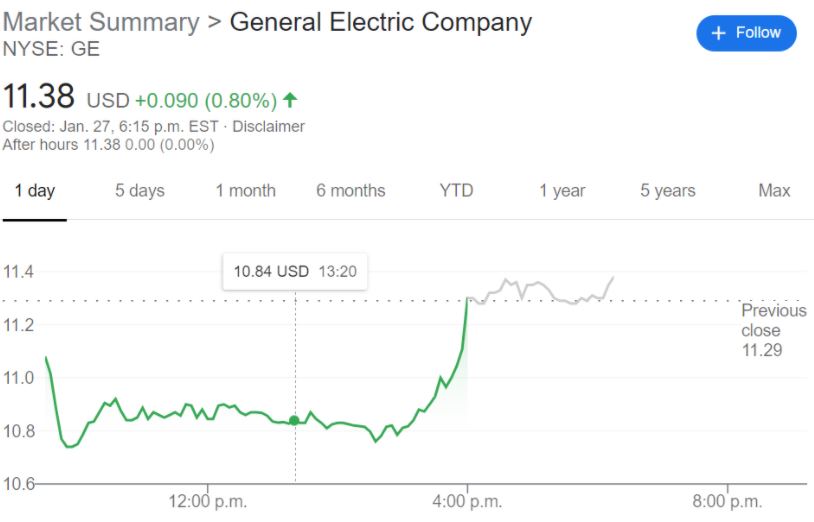
NYSE:GE has long been a forgotten company in the current market landscape, but another successful earnings report saw the stock surge on Tuesday. On Wednesday, despite a hot start to the day, General Electric finished up 0.80% and closed the trading session at $11.38. The move pushed GE above its 50-day moving average and is now firmly positioned to move towards its 52-week high price of $13.26. Had it not been for the shenanigans and short squeezes that wreaked havoc on the markets, General Electric could have potentially seen another nice day of gains.

While the earnings came in slightly lower than expected, General Electric did manage to beat Wall Street revenue estimates for the previous quarter. Perhaps the most important takeaway from its earnings call on Tuesday was that the foundational American company finds itself back in free cash flow positive territory for the first time in years. General Electric even gave 2021 free cash flow guidance, estimating that the company will be able to generate between $2.5 billion and $4.5 billion. This is particularly impressive given the current uncertainty around the aviation sector, and if commercial travel can open up at some point this year, GE may be on course for more stellar earnings reports. 

GE stock price
GE

General Electric’s balance sheet has played a role in putting it back on the radar of Wall Street analysts. Wednesday morning, Morgan Stanley raised its price target on General Electric to $13 and reiterated that many of GE’s estimates and guidance figures were very conservative. An analyst from CitiGroup also echoed these sentiments as some of Wall Street’s biggest investment firms are slowly buying back in.

Author

More from Stocks Reporter
Share:

Editor's Picks

AUD/USD flirts with 0.7000, lowest since early August amid bullish USD

AUD/USD hits a fresh low since early August during the Asian session on Friday and looks vulnerable near 0.7000 after breaking below the 200-day SMA overnight. Against the backdrop of the hawkish Fed, a two-day rally in oil prices revives inflation fears and continues to push US bond yields to multi-year highs. Adding to this, geopolitical risks lift the US Dollar to a two-month high, overshadowing RBA rate hike bets and weighing on the pair.

USD/JPY pulls back from three-week high after failing near 159.00

USD/JPY edges lower during the Asian session on Friday, stalling its recent strong move to a three-week high of 159.00 as Japanese Yen bears turn cautious amid intervention fears. Meanwhile, the US Dollar retains a strong bullish undertone as the Fed's hawkish outlook and oil-driven inflation fears continue to push US bond yields to multi-year peaks. Furthermore, the BoJ's dovish rate hike last week might cap JPY and support spot prices.

Gold treads water below $4,300

Gold grabs some buying attention and advances marginally at the end of the week, partially retracing the weekly decline, although it is still navigating below the key $4,300 mark per troy ounce. The fresh selling bias on the Greenback and the modest decline in US Treasury yields appear to support the humble advance in the precious metal.

Crypto Today: Bitcoin and Ethereum edge lower, XRP extends recovery as macro headwinds weigh

The broader cryptocurrency market is consolidating on Friday, with Bitcoin paring losses slightly above $84,000. Ethereum declines in tandem with BTC. Ripple (XRP), meanwhile, paints a different picture.


Fed vs BoJ: Both hiked. The market only believes one of them – and the chart shows which
The Federal Reserve (Fed) and the Bank of Japan (BoJ) have just done something remarkably similar. Both central banks raised interest rates by 25 basis points (bps) last week, both are confronting inflation risks, and both signal that future decisions will depend on incoming economic data.
Fed vs BoJ: Both hiked. The market only believes one of them – and the chart shows which

The Fed and the BoJ have just done something remarkably similar. Both central banks raised interest rates by 25 bps last week, both are confronting inflation risks, and both signal that future decisions will depend on incoming economic data.















