GBP/USD struggles as BoE’s hold rates, rate differential benefits USD
- GBP/USD registers losses, trading at 1.2285, following the BoE’s decision to hold rates unchanged amid slowing UK inflation.
- US economic data reveals a mixed landscape with lower-than-expected Initial Jobless Claims and a plunge in the Philadelphia Fed Manufacturing Index.
- Given the solid US economy and rate differences, GBP/USD will likely continue its downward trajectory soon.

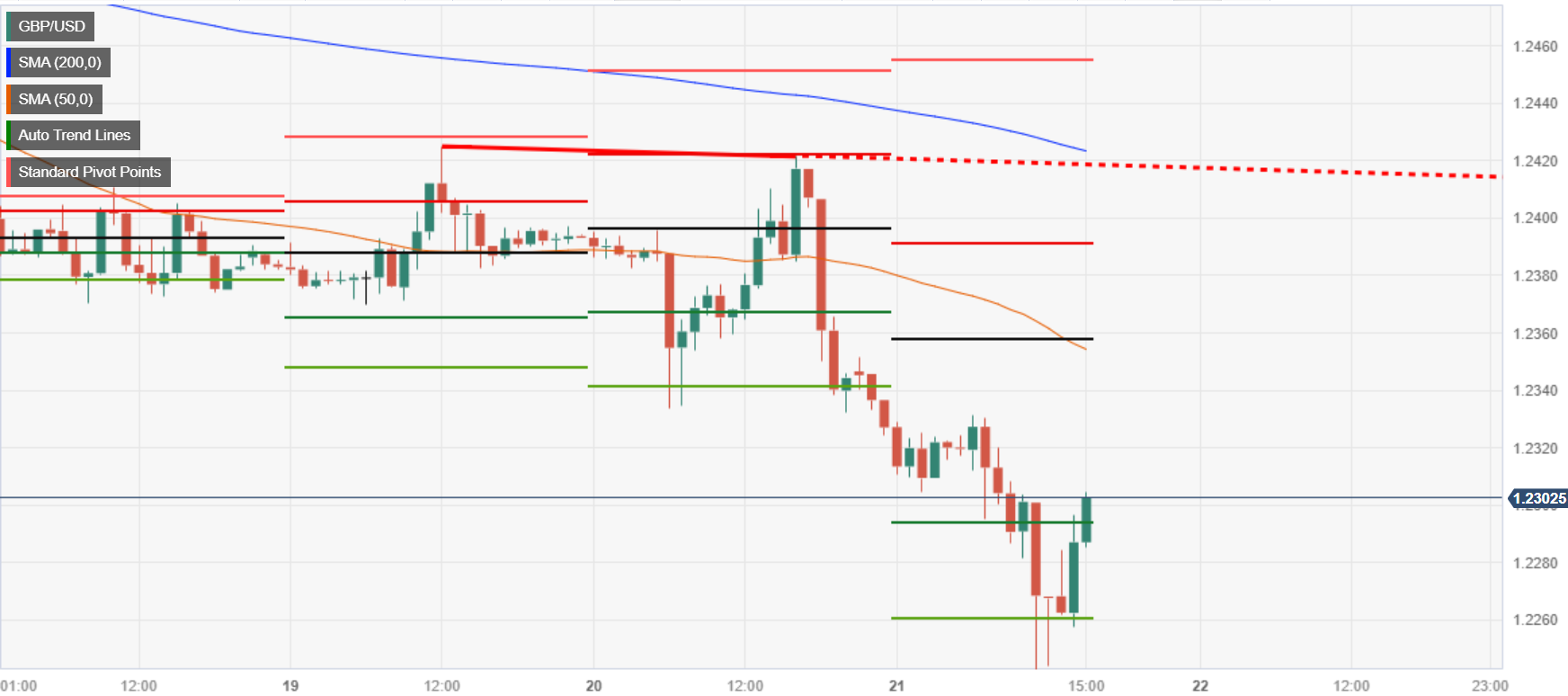
The British Pound (GBP) registers solid losses against the US Dollar (USD) after the Bank of England’s (BoE) decision to hold rates unchanged in a 5-4 vote split, with BoE’s Governor Bailey providing the decisive vote. A slowdown in UK inflation, reported on Wednesday, was the main driver behind BoE’s decision. The GBP/USD is trading at 1.2295 after hitting a daily high of 1.2331.
GBP/USD drops to 1.2300 as BoE holds rates and US economic data paints a mixed picture
Earlier, the BoE decided to hold rates unchanged at 5.25% due to the deceleration of inflation, a loosening labor market, and a deterioration in business sentiment. The BoE added that rates would remain high for an extended period and “Further tightening would be needed if evidence of more persistent inflationary pressures.”
Bailey and Co. updated their GDP forecasts, and for the Q3, the economy is expected to grow by 0.1%, below the 0.4% August estimate, underscoring that growth in the year’s second half would be weaker. The BoE would also tweak its quantitative tightening program from £80bn to £100bn.
The BoE’s decision hurt the GBP/USD upside prospects, as the pair was already downward pressured after the Federal Reserve decided to hold rates unchanged but revised the interest rates for 2024 upward. In the Summary of Economic Projections (SEP), Powell and his colleagues updated the dot plots, with most Fed officials expecting to keep rates above the 5% threshold in the next year.
Data-wise, the US economic docket featured Initial Jobless Claims for the last week, which rose by 201K below estimates of 225K, and drafts a solid labor market. Further data revealed that the September Philadelphia Fed Manufacturing Index plunged -13.5, well below forecasts for a -0.5 contraction. US Existing Home Sales data was worse than expected, at -0.7% MoM, beneath projections of 1.5% expansion.
Given the backdrop, the GBP/USD would likely continue to trend lower as the US economy remains solid. Also, the rate difference between the US and the UK suggests further downside is expected.
GBP/USD Price Analysis: Technical outlook
The daily chart portrays the pair set to extend its losses. Still, the GBP/USD must achieve a daily close below April’s 3 daily low of 1.2274 to exacerbate a March 15 daily low test at 1.2010 before testing yearly lows at 1.1802. Short term, the GBP/USD hourly chart depicts the pair recovering from daily lows reached at 1.2237, with traders eyeing a re-test of the 1.2300 figure. Given the interest rate differential between the UK and the US favors the latter, expect some selling pressure at the figure. A daily close above 1.2300 could pave the way toward 1.2400.
Author

Christian Borjon Valencia
FXStreet
Markets analyst, news editor, and trading instructor with over 14 years of experience across FX, commodities, US equity indices, and global macro markets.