GBP/USD slips as strong US jobs data cools Fed rate cut bets
- Sterling still set for weekly gain over 0.80% amid broad Greenback weakness earlier in the week.
- US economy added 139K jobs in May, beating forecasts and reinforcing Fed’s cautious stance on rate cuts.
- Dollar strength resurfaces, with DXY climbing 0.58% to 99.28, its highest in two days.

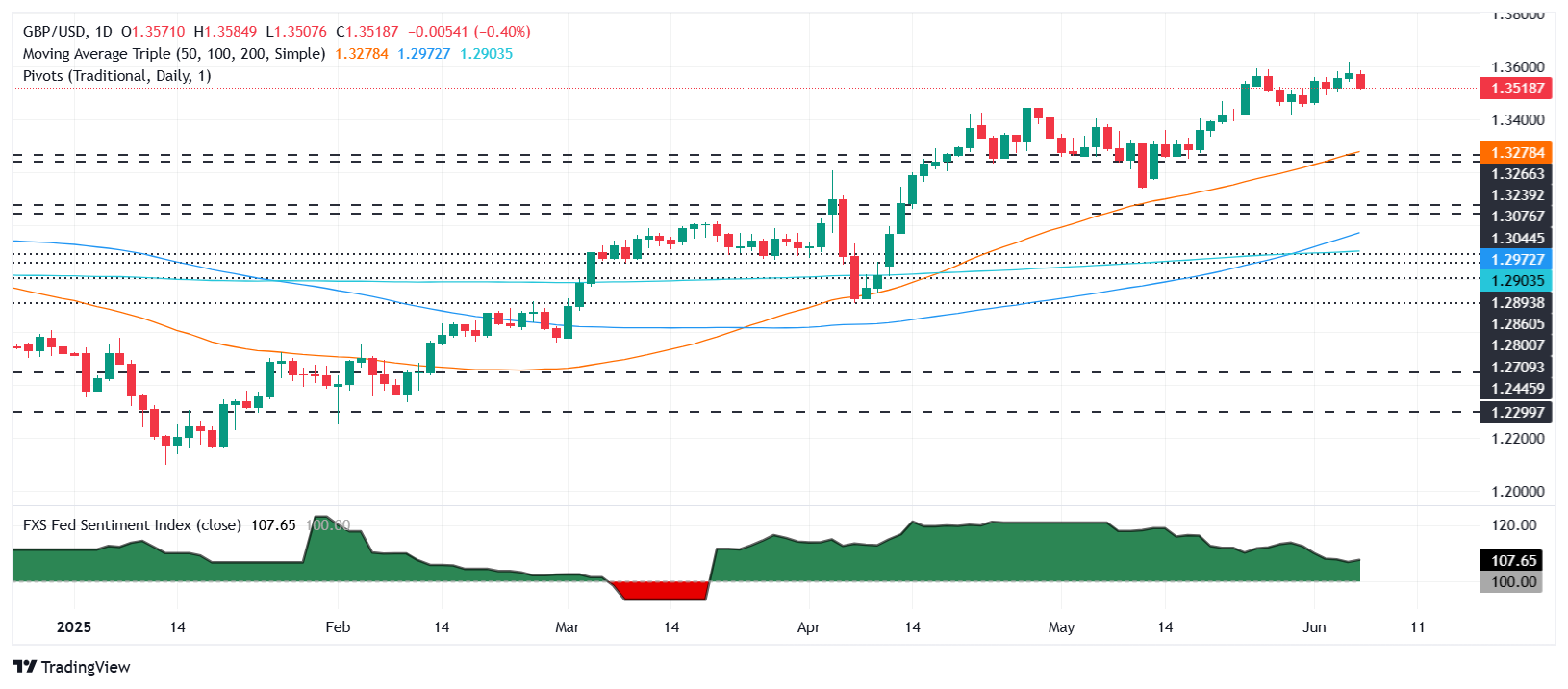
GBP/USD tumbled during the North American session, down over 0.30% after the latest jobs report in the United States (US) maintained the status quo, with the economy remaining strong. The pair traded at 1.3526 after hitting a daily high of 1.3586.
Pound retreats below 1.3550 after NFP beats estimates, lifting the US Dollar and dampening dovish expectations
US Nonfarm Payroll figures in May exceeded estimates of 130K, rising by 139K, which was below April’s downwardly revised 147K. Although the jobs market shows that it’s softening, beating economists' estimates, it pushed aside traders' bets that the US Federal Reserve (Fed) will cut interest rates in 2025.
The data revealed that the Unemployment Rate remained unchanged at 4.2%, and that the Federal Government cut 10,000 jobs in the past month.
A scarce economic docket in the UK, kept GBP/USD traders leaning onto US news. In addition, Sterling is poised to post gains of over 0.80% in the week, sponsored fy broad UA Dollar weakness.
Despite this, the buck has recovered some ground, as depicted by the US Dollar Index (DXY). The DXY, which tracks the value of the American dollar against a basket of six currencies, climbed 0.58% to 99.28, its highest level in two days.
Next week, the UK economic docket will feature jobs data and gross Domestic Product (GDP) figures for April. Across the pond, the US schedule will announce the latest Consumer Price Index (CPI), followed by the Producer Price Index (PPI) and the University of Michigan Consumer Sentiment.
British Pound PRICE This week
The table below shows the percentage change of British Pound (GBP) against listed major currencies this week. British Pound was the strongest against the Japanese Yen.
| USD | EUR | GBP | JPY | CAD | AUD | NZD | CHF | |
|---|---|---|---|---|---|---|---|---|
| USD | -0.32% | -0.40% | 0.75% | -0.35% | -0.75% | -0.76% | 0.08% | |
| EUR | 0.32% | -0.08% | 1.07% | -0.03% | -0.43% | -0.46% | 0.39% | |
| GBP | 0.40% | 0.08% | 1.22% | 0.05% | -0.35% | -0.38% | 0.46% | |
| JPY | -0.75% | -1.07% | -1.22% | -1.09% | -1.49% | -1.51% | -0.76% | |
| CAD | 0.35% | 0.03% | -0.05% | 1.09% | -0.40% | -0.43% | 0.42% | |
| AUD | 0.75% | 0.43% | 0.35% | 1.49% | 0.40% | 0.02% | 0.90% | |
| NZD | 0.76% | 0.46% | 0.38% | 1.51% | 0.43% | -0.02% | 0.85% | |
| CHF | -0.08% | -0.39% | -0.46% | 0.76% | -0.42% | -0.90% | -0.85% |
The heat map shows percentage changes of major currencies against each other. The base currency is picked from the left column, while the quote currency is picked from the top row. For example, if you pick the British Pound from the left column and move along the horizontal line to the US Dollar, the percentage change displayed in the box will represent GBP (base)/USD (quote).
GBP/USD Price Forecast: Technical outlook
The trend remains up, as GBP/USD buyers tested the 20-day Simple Moving Average (SMA) at 1.3509. If this level holds, the pair’s direction would likely resume in the short term after making successive series of higher highs and higher lows, warranting further upside.
However, momentum has taken a hit. The Relative Strength Index (RSI) is aiming lower, hints that sellers are moving in.
If GBP/USD stays above 1.3500, this opens the door for a move to 1.3584 today’s high, followed by the year-to-date (YTD) high at 1.3616. On the other hand, a daily close below 1.35 could sponsor a drop towards April’s 28 sing high turned support at 1.3443 ahead of the 1.34 mark.
Pound Sterling FAQs
The Pound Sterling (GBP) is the oldest currency in the world (886 AD) and the official currency of the United Kingdom. It is the fourth most traded unit for foreign exchange (FX) in the world, accounting for 12% of all transactions, averaging $630 billion a day, according to 2022 data. Its key trading pairs are GBP/USD, also known as ‘Cable’, which accounts for 11% of FX, GBP/JPY, or the ‘Dragon’ as it is known by traders (3%), and EUR/GBP (2%). The Pound Sterling is issued by the Bank of England (BoE).
The single most important factor influencing the value of the Pound Sterling is monetary policy decided by the Bank of England. The BoE bases its decisions on whether it has achieved its primary goal of “price stability” – a steady inflation rate of around 2%. Its primary tool for achieving this is the adjustment of interest rates. When inflation is too high, the BoE will try to rein it in by raising interest rates, making it more expensive for people and businesses to access credit. This is generally positive for GBP, as higher interest rates make the UK a more attractive place for global investors to park their money. When inflation falls too low it is a sign economic growth is slowing. In this scenario, the BoE will consider lowering interest rates to cheapen credit so businesses will borrow more to invest in growth-generating projects.
Data releases gauge the health of the economy and can impact the value of the Pound Sterling. Indicators such as GDP, Manufacturing and Services PMIs, and employment can all influence the direction of the GBP. A strong economy is good for Sterling. Not only does it attract more foreign investment but it may encourage the BoE to put up interest rates, which will directly strengthen GBP. Otherwise, if economic data is weak, the Pound Sterling is likely to fall.
Another significant data release for the Pound Sterling is the Trade Balance. This indicator measures the difference between what a country earns from its exports and what it spends on imports over a given period. If a country produces highly sought-after exports, its currency will benefit purely from the extra demand created from foreign buyers seeking to purchase these goods. Therefore, a positive net Trade Balance strengthens a currency and vice versa for a negative balance.
Author

Christian Borjon Valencia
FXStreet
Markets analyst, news editor, and trading instructor with over 14 years of experience across FX, commodities, US equity indices, and global macro markets.