GBP/USD slides below 1.3550 as US Dollar rebounds despite soft US PMIs
- GBP/USD pulls back from nearly four-month highs as the US Dollar trims losses despite softer Services and Composite PMIs.
- Fed rhetoric stays mixed, with Barkin neutral and Miran openly dovish, complicating rate expectations.
- UK Services PMI beats forecasts, but rising input prices may limit Bank of England easing prospects.

The Pound Sterling (GBP) retreats on Tuesday after reaching a daily high of 1.3567 as the US Dollar (USD) stages a recovery despite posting weaker Purchasing Managers Index (PMI) data, and neutral Federal Reserve (Fed) officials' remarks. GBP/USD trades at 1.3519, down 0.15% at the time of writing.
Sterling retreats from session highs as the Greenback stabilizes, shrugging off weaker data
Recently released US data by S&P Global revealed that economic activity is weakening, though at a moderate pace. The December Services PMI was 52.5, down from November's 52.9, while the Composite PMI index came at 52.7 for the same period, down from 53 registered in the previous month.
In the meantime, Richmond Fed President Thomas Barkin said that future rate decisions will need to be “finely tuned,” given the risks of unemployment and inflation goals. Barkin added that the current policy rate is within the neutral range and that both sides of the mandate should be watched.
Earlier, Fed Governor Stephen Miran was dovish, saying that the central bank will adjust the policy rate down, that he expects data to signal that cuts are appropriate, and that they should cut 100 basis points in 2026.
Given the backdrop, the Greenback was expected to edge lower, but so far it has trimmed some of its Monday losses. The US Dollar Index (DXY), which tracks the buck’s value against six other currencies, posts gains of 0.25% at 98.61.
Across the pond, the UK S&P Global Services PMI came in at 51.4 in December, up from 51.3 in November. Insights in the report revealed that “inflationary pressures across the service economy strengthened at the end of the year. Input prices rose to the greatest extent for seven months,” which could dent the Bank of England to resume its easing cycle in 2026.
Ahead of this week, the UK economic schedule is absent. In the US, traders will eye the ADP Employment Change, the ISM Services PMI for December, JOLTS Job Openings data and speeches by Fed officials.
GBP/USD Price Forecast: Technical outlook
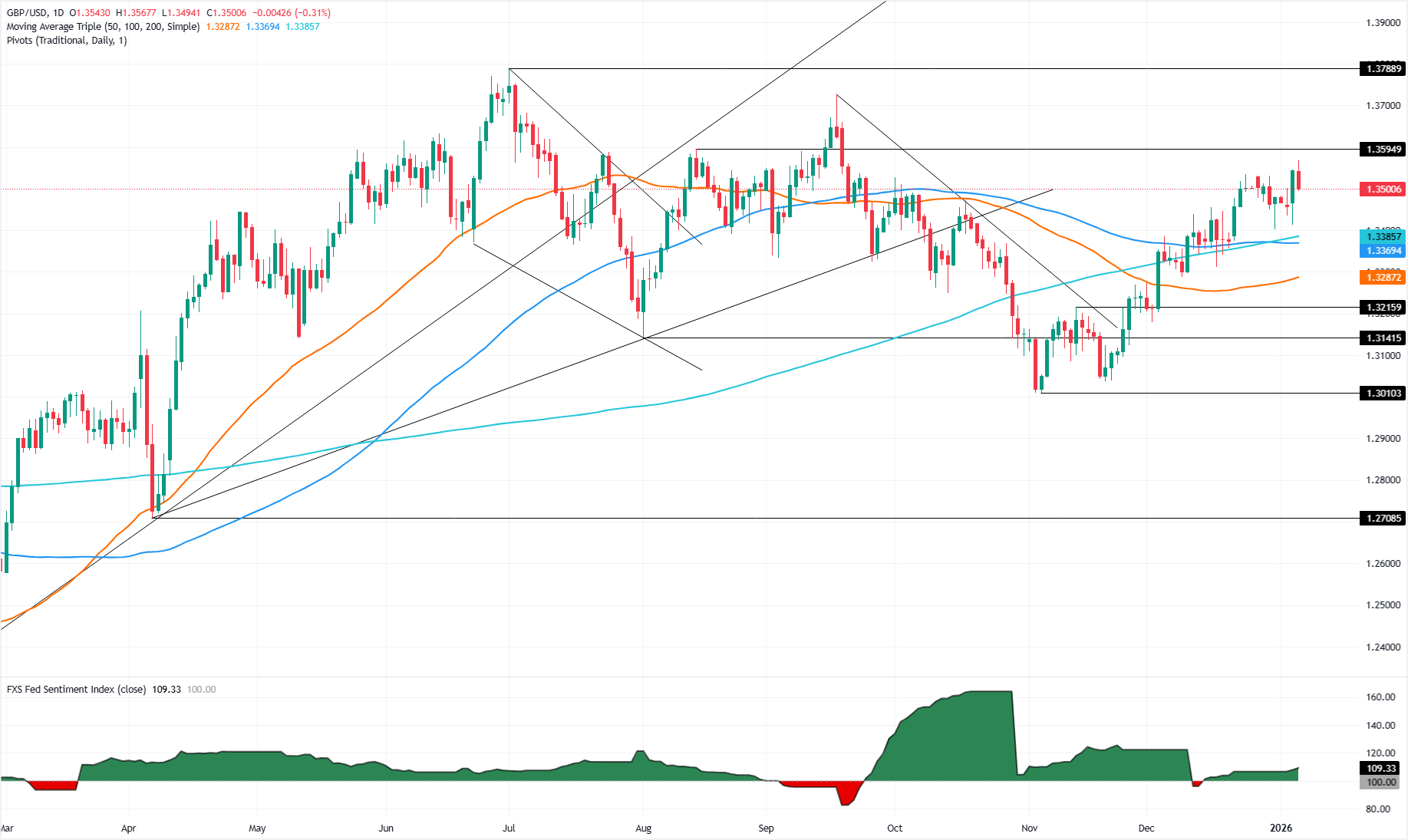
The technical picture shows GBP/USD seems poised to retreat even though momentum remains bullish. Buyers’ failure to clear the 1.3600 mark exacerbated the ongoing pullback towards the 1.3500 figure, which, if broken, paves the way for a test of the 200-day SMA key support level at 1.3385. Once surpassed, the next stop would be the 100-day SMA at 1.3369.
Conversely, if GBP/USD stays above 1.3500, bulls need to drive the exchange rate past the 1.3580 area.
Pound Sterling Price This week
The table below shows the percentage change of British Pound (GBP) against listed major currencies this week. British Pound was the strongest against the Swiss Franc.
| USD | EUR | GBP | JPY | CAD | AUD | NZD | CHF | |
|---|---|---|---|---|---|---|---|---|
| USD | 0.29% | -0.26% | -0.13% | 0.30% | -0.74% | -0.31% | 0.35% | |
| EUR | -0.29% | -0.55% | -0.37% | 0.00% | -1.03% | -0.60% | 0.06% | |
| GBP | 0.26% | 0.55% | 0.11% | 0.60% | -0.49% | -0.05% | 0.61% | |
| JPY | 0.13% | 0.37% | -0.11% | 0.41% | -0.64% | -0.20% | 0.51% | |
| CAD | -0.30% | -0.01% | -0.60% | -0.41% | -0.89% | -0.62% | 0.05% | |
| AUD | 0.74% | 1.03% | 0.49% | 0.64% | 0.89% | 0.44% | 1.11% | |
| NZD | 0.31% | 0.60% | 0.05% | 0.20% | 0.62% | -0.44% | 0.67% | |
| CHF | -0.35% | -0.06% | -0.61% | -0.51% | -0.05% | -1.11% | -0.67% |
The heat map shows percentage changes of major currencies against each other. The base currency is picked from the left column, while the quote currency is picked from the top row. For example, if you pick the British Pound from the left column and move along the horizontal line to the US Dollar, the percentage change displayed in the box will represent GBP (base)/USD (quote).
Author

Christian Borjon Valencia
FXStreet
Markets analyst, news editor, and trading instructor with over 14 years of experience across FX, commodities, US equity indices, and global macro markets.

















