GBP/USD rebounds on soft CPI, boosting Fed cut bets
- US CPI misses forecasts; softer headline and core inflation bolster case for two Fed cuts in 2025.
- UK labor market cools as wage growth slows to 5.6%, lowest since November 2024, easing BoE pressure.
- Fed-BoE policy gap narrows; GBP/USD supported by weaker Dollar and steady BoE expectations.

The Pound Sterling (GBP) recovered from Monday's losses and climbed over 0.35% against the US Dollar (USD) after the latest inflation report in the United States (US) kept traders' hopes high for further easing by the Federal Reserve (Fed). GBP/USD trades at 1.3226 after bouncing off a daily low of 1.3165.
Sterling climbs 0.35% after cooler-than-expected US inflation revives easing hopes; UK jobs data signals BoE caution
The US Consumer Price Index (CPI) in April was slightly below estimates in the monthly headline and core figures. The CPI came in at 0.2% below forecasts of 0.3%, but a touch higher than the March print of -0.1%. Core CPI stood at 0.2%, up from 0.1% but beneath forecasts of 0.3%.
At the same time, inflation rose by 2.3% YoY, a tenth below estimates and the previous month's reading, and core metrics stood at 2.8% YoY. Most analysts estimated that April's print could reflect the impact of tariffs. Still, "larger increases are in the pipeline” for inflation, according to Bank of America economists.
Across the pond, the latest United Kingdom (UK) employment figures showed the job market is cooling further, a relief for the Bank of England (BoE). The number of employees fell by nearly 33K, while wage growth in the three months to March rose by 5.6%, the slowest since November 2024.
BoE's Chief Economist, Huw Pill, crossed the wires. He stated that he remains concerned about a reacceleration of inflation, as he sees second-round effects. He remains the most hawkish member, after last week he voted against the BoE's quarter-point interest rate cut.
Central bank divergence to drive the GBP/USD lower
Meanwhile, market participants priced in two interest rate cuts by the Federal Reserve (Fed) instead of three, according to last week’s data by the Chicago Board of Trade (CBOT). As of writing, the December 2025 fed funds rate futures contract shows 54 basis points of easing.
For the BoE, the swaps market is pricing in a total of 48.6 basis points by the end of the year, with no change in policy expected at the next BoE meeting in June.
GBP/USD Price Forecast: Technical outlook
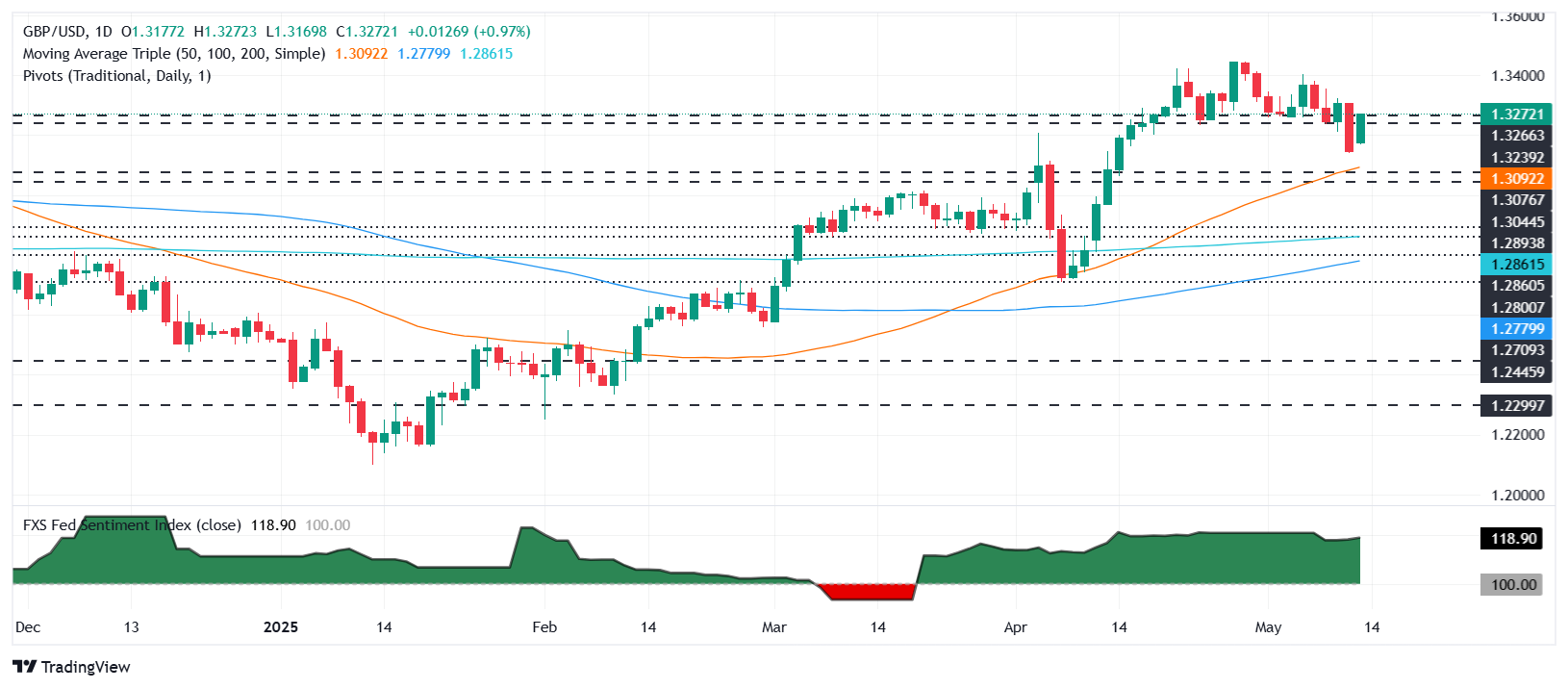
GBP/USD bullish trend remains intact despite retreating below the 20-day Simple Moving Average (SMA) at 1.3301, which now serves as the next potential resistance level. In the near term, momentum has shifted positively, as depicted by the Relative Strength Index (RSI). Hence, the pair might extend its gains.
The first resistance is the 20-day SMA. Although breached, buyers must clear the latter, followed by the 1.3350. Up next lies 1.3400. Conversely, if GBP/USD stays below 1.3301, sellers could remain hopeful of retesting the current week's low of 1.3194, ahead of the 50-day SMA at 1.3089.
(This story was corrected on May 13 at 15:51 GMT to say that the BoE Chief Economist's name is Huw Pill, not Hew)
British Pound PRICE This week
The table below shows the percentage change of British Pound (GBP) against listed major currencies this week. British Pound was the strongest against the Japanese Yen.
| USD | EUR | GBP | JPY | CAD | AUD | NZD | CHF | |
|---|---|---|---|---|---|---|---|---|
| USD | 0.72% | 0.29% | 1.08% | 0.56% | -0.68% | -0.07% | 0.84% | |
| EUR | -0.72% | -0.30% | 0.91% | 0.33% | -0.75% | -0.31% | 0.60% | |
| GBP | -0.29% | 0.30% | 1.37% | 0.63% | -0.45% | -0.08% | 0.91% | |
| JPY | -1.08% | -0.91% | -1.37% | -0.52% | -2.34% | -1.97% | -0.45% | |
| CAD | -0.56% | -0.33% | -0.63% | 0.52% | -0.97% | -0.63% | 0.28% | |
| AUD | 0.68% | 0.75% | 0.45% | 2.34% | 0.97% | 0.35% | 1.34% | |
| NZD | 0.07% | 0.31% | 0.08% | 1.97% | 0.63% | -0.35% | 0.89% | |
| CHF | -0.84% | -0.60% | -0.91% | 0.45% | -0.28% | -1.34% | -0.89% |
The heat map shows percentage changes of major currencies against each other. The base currency is picked from the left column, while the quote currency is picked from the top row. For example, if you pick the British Pound from the left column and move along the horizontal line to the US Dollar, the percentage change displayed in the box will represent GBP (base)/USD (quote).
Author

Christian Borjon Valencia
FXStreet
Markets analyst, news editor, and trading instructor with over 14 years of experience across FX, commodities, US equity indices, and global macro markets.

















