GBP/USD rebounds as Greenback pressure eases
- GBP/USD found a slight rebound to muscle back above 1.3450 on Thursday.
- Despite near-term Greenback strength on geopolitical concerns, markets took a break during the midweek US holiday session.
- Israel-Iran tensions continue to rise, and the Trump administration is drawing out a decision on getting involved directly.

GBP/USD found some room on the high side on Thursday, climbing back above the 1.3450 level after catching an early technical bounce from the 1.3400 handle. Broad-market flows have favored the US Dollar recently as Middle East tensions continue to rise, but US markets were dark for a national holiday on Thursday, giving Cable some room to breathe and easing off of USD bidding.
According to a CBS reporter posting on the X (nee Twitter) social media platform, President Donald Trump may be considering an order for American military assets to target an Iranian nuclear production facility. If the Trump administration decides to go ahead with the reported proposal, it will be the first time the US has deployed military assets in a pre-emptive manner since the 2003 invasion of Iraq. Citing an Israeli government official, The Times of Israel reported that the Israeli government expects a final decision from the Trump administration within the next 24 to 48 hours.
Reports citing three separate diplomats have confirmed that personnel within the US administration, specifically US Special Envoy to the Middle East Steve Witkoff, has been in regular contact with his Iranian counterpart, helping to temper some of the emotional fallout striking off-market traders on Thursday. Iranian Foreign Minister Abbas Araghchi reportedly signaled to US Envoy Witkoff that the Iranian government is willing to be ‘flexible’ on its nuclear plans and resume talks, but only if Israel ceases its long-range missile strikes. Iranian Foreign Minister Araghchi stated that he will travel to Geneva on Friday to meet with his European counterparts as well.
UK Retail Sales figures for May are due on Friday, but little market movement is likely to come out of the figures. Investors are broadly anticipating a contraction in Retail Sales data on a monthly basis, forecasting a print of -0.5% compared to April’s 1.2% upswing.
GBP/USD price forecast
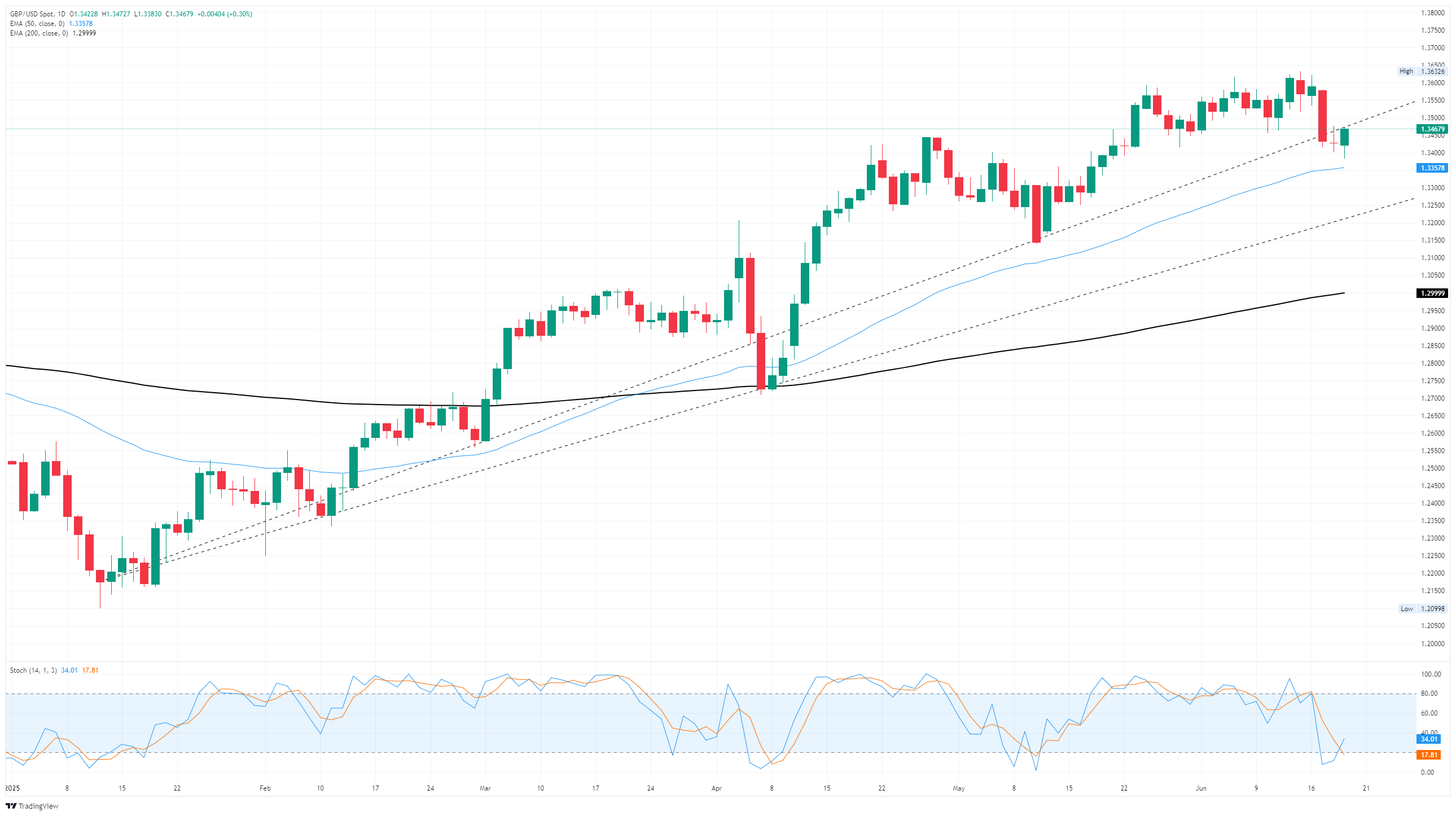
Thin Greenback volumes on Thursday gave GBP/USD a leg up, pushing the pair into a technical bounce from the 1.3400 level. The pair is still trading on the north side of the 50-day Exponential Moving Average (EMA) near 1.3355, and long-run bullish momentum still has a technical floor priced in from a rising trendline through the same area.
GBP/USD daily chart
Pound Sterling FAQs
The Pound Sterling (GBP) is the oldest currency in the world (886 AD) and the official currency of the United Kingdom. It is the fourth most traded unit for foreign exchange (FX) in the world, accounting for 12% of all transactions, averaging $630 billion a day, according to 2022 data. Its key trading pairs are GBP/USD, also known as ‘Cable’, which accounts for 11% of FX, GBP/JPY, or the ‘Dragon’ as it is known by traders (3%), and EUR/GBP (2%). The Pound Sterling is issued by the Bank of England (BoE).
The single most important factor influencing the value of the Pound Sterling is monetary policy decided by the Bank of England. The BoE bases its decisions on whether it has achieved its primary goal of “price stability” – a steady inflation rate of around 2%. Its primary tool for achieving this is the adjustment of interest rates. When inflation is too high, the BoE will try to rein it in by raising interest rates, making it more expensive for people and businesses to access credit. This is generally positive for GBP, as higher interest rates make the UK a more attractive place for global investors to park their money. When inflation falls too low it is a sign economic growth is slowing. In this scenario, the BoE will consider lowering interest rates to cheapen credit so businesses will borrow more to invest in growth-generating projects.
Data releases gauge the health of the economy and can impact the value of the Pound Sterling. Indicators such as GDP, Manufacturing and Services PMIs, and employment can all influence the direction of the GBP. A strong economy is good for Sterling. Not only does it attract more foreign investment but it may encourage the BoE to put up interest rates, which will directly strengthen GBP. Otherwise, if economic data is weak, the Pound Sterling is likely to fall.
Another significant data release for the Pound Sterling is the Trade Balance. This indicator measures the difference between what a country earns from its exports and what it spends on imports over a given period. If a country produces highly sought-after exports, its currency will benefit purely from the extra demand created from foreign buyers seeking to purchase these goods. Therefore, a positive net Trade Balance strengthens a currency and vice versa for a negative balance.
Author

Joshua Gibson
FXStreet
Joshua joins the FXStreet team as an Economics and Finance double major from Vancouver Island University with twelve years' experience as an independent trader focusing on technical analysis.