GBP/USD rebounds after BoE’s dovish hold but remains below 1.31
- GBP/USD remains above 1.3050, after touching daily highs but now faces resistance near 1.3100.
- BoE keeps Bank Rate at 4% in a 5–4 split; dissenters Dhingra, Taylor, Ramsden and Breeden favored a 25 bps cut.
- Bailey says policy is still restrictive and that more data is needed before easing further.

GBP/USD recovers some ground but trades off daily highs as the Bank of England (BoE) held rates unchanged on Thursday, on a 'dovish' hold as the vote split hints that the December meeting is open. The pair trades at 1.3080, up 0.26%.
Sterling trims gains as Bailey warns rate cuts will be gradual and data-dependent
The BoE kept the Bank Rate at 4% on a 5-4 vote split on Thursday. The four dissenters who wanted a 25-basis-point rate cut were: Dhingra, Taylor, Ramsden and, surprisingly, Breeden. BoE Governor Andrew Bailey welcomed the September inflation figure, which held steady, but warned that it was just one series and that further data is needed.
At the press conference, Bailey focused on inflation, saying that he doesn’t know where neutral rates would be and that the current policy is still restrictive.
The BoE’s Monetary Policy Committee (MPC) believes that inflation has peaked. Bailey added that, “We still think rates are on a gradual path downwards, but we need to be sure that inflation is on track to return to our 2% target before we cut them again.”
Across the pond, the US Challenger report by Gray & Christmas revealed that companies slashed over 150,000 jobs in October, the biggest reduction for the month in more than 20 years. The survey noted that industries adopting AI-driven changes are the main reason behind the layoffs.
The data moved the needle about the Federal Reserve’s (Fed) December meeting. Money markets see a 69% chance of a 25-basis-point rate cut, up from 62% a day ago, according to Prime Market Terminal data.
Chicago Fed President Austan Goolsbee said the lack of official data on inflation during the shutdown “accentuates” his caution about cutting interest rates further, he said on Thursday in an interview with CNBC.
The Chicago Fed released an estimate of the Unemployment Rate in the US, which climbed to 4.36% in October, its highest level in four years.
GBP/USD Price Forecast: Technical outlook
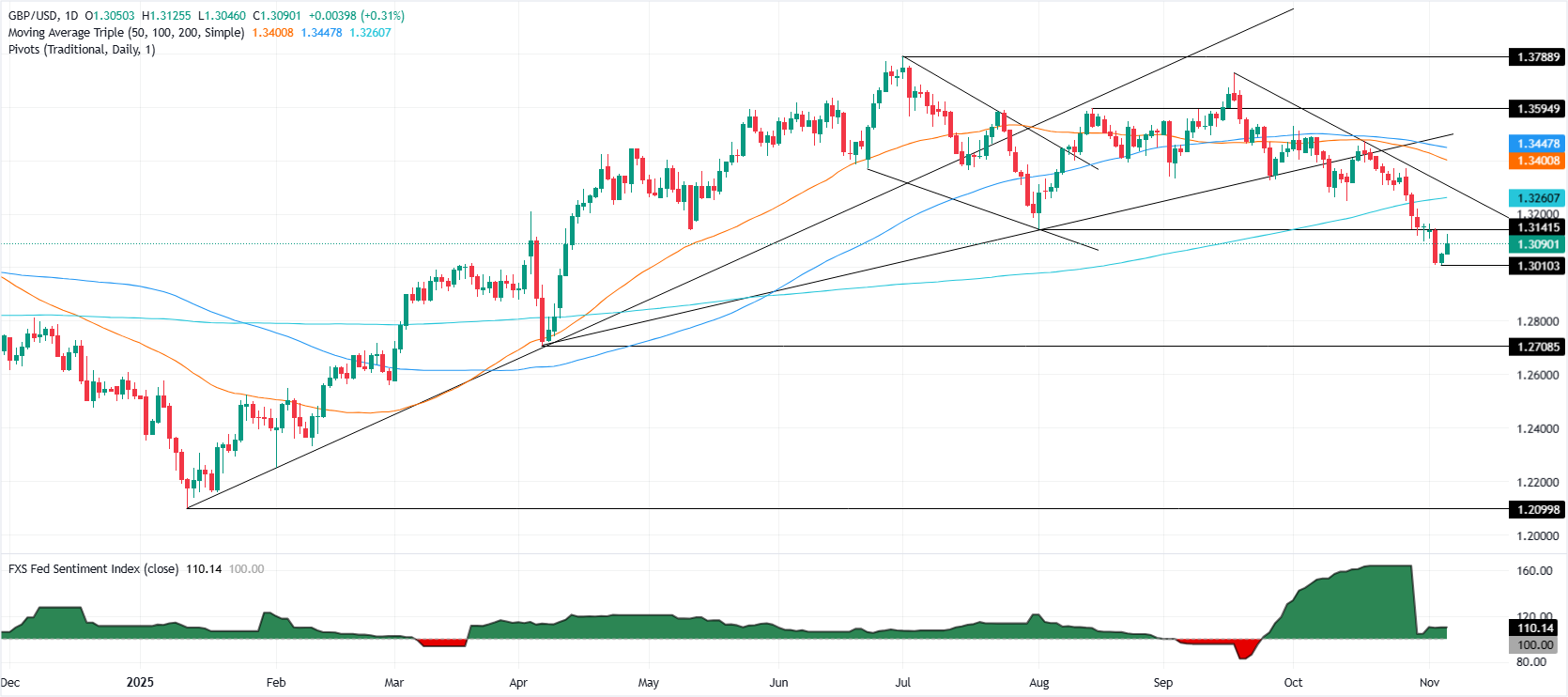
Although GBP/USD remains above 1.3000, a decisive break of 1.3100 is needed so buyers could remain hopeful of pushing spot prices towards the 200-day Simple Moving Average (SMA) at 1.3257.
Conversely, if GBP/USD ends on a daily basis below 1.3050, sellers could challenge 1.3000 as they aim to test the latest swing low of 1.2707, reached on April 8.
Pound Sterling Price This week
The table below shows the percentage change of British Pound (GBP) against listed major currencies this week. British Pound was the strongest against the New Zealand Dollar.
| USD | EUR | GBP | JPY | CAD | AUD | NZD | CHF | |
|---|---|---|---|---|---|---|---|---|
| USD | 0.05% | 0.33% | -0.52% | 0.84% | 1.21% | 1.77% | 0.42% | |
| EUR | -0.05% | 0.29% | -0.49% | 0.79% | 1.15% | 1.72% | 0.38% | |
| GBP | -0.33% | -0.29% | -0.94% | 0.50% | 0.86% | 1.43% | 0.09% | |
| JPY | 0.52% | 0.49% | 0.94% | 1.33% | 1.73% | 2.29% | 1.08% | |
| CAD | -0.84% | -0.79% | -0.50% | -1.33% | 0.32% | 0.91% | -0.41% | |
| AUD | -1.21% | -1.15% | -0.86% | -1.73% | -0.32% | 0.57% | -0.77% | |
| NZD | -1.77% | -1.72% | -1.43% | -2.29% | -0.91% | -0.57% | -1.33% | |
| CHF | -0.42% | -0.38% | -0.09% | -1.08% | 0.41% | 0.77% | 1.33% |
The heat map shows percentage changes of major currencies against each other. The base currency is picked from the left column, while the quote currency is picked from the top row. For example, if you pick the British Pound from the left column and move along the horizontal line to the US Dollar, the percentage change displayed in the box will represent GBP (base)/USD (quote).
Author

Christian Borjon Valencia
FXStreet
Markets analyst, news editor, and trading instructor with over 14 years of experience across FX, commodities, US equity indices, and global macro markets.