GBP/USD pushes back above 1.30 as the US heads into election territory
- GBP/USD rallied 0.65% on Tuesday as markets brace for US presidential election results.
- Central bank double-header due this week with 25 bps rate trims expected from both the US and the UK.
- BoE, Fed both expected to drop reference rates down to 4.75%.

GBP/USD found the gas pedal on Tuesday, ramping up another two-thirds of a percent and clawing back above the 1.3000 handle as markets brace for what is likely to be a messy outcome from the US presidential election. Widely-anticipated rate cuts are also due from both the Bank of England (BoE) and Federal Reserve (Fed) this week, giving investors plenty to chew on in what is set to be one of the busiest weeks of the rest of the trading year.
US election odds have both candidates neck-and-neck in a dead-heat race for the Presidency, with former President Donald Trump and current Vice President Kamala Harris polling within 5% of each other, depending on which poll results you reference. Equity investors, tech sector addicts specifically, appear to broadly believe former President Trump to be the preferred stock-friendly candidate, an odd choice considering the Republican candidate has strongly voiced support of a return to the Smoot-Hawley tariff era of US history. Trump has regularly suggested stiff tariffs across the board on all imported goods into the US, an incredibly inflationary economic policy proposal.
The BoE’s latest rate call, slated for Thursday, is expected to deliver another quarter-point cut to investors. The BoE’s Monetary Policy Committee is expected to vote seven-to-two to reduce the BoE’s main reference rate to 4.75% from the current 5.0%.
Another Fed rate call looms ahead this week. Fed Chair Jerome Powell is widely expected to deliver another quarter-point cut to interest rates on Thursday, bringing the Fed Funds Rate down 25 bps to 4.75%. The Fed Funds Rate peaked at 5.5% in July of 2023, and investors have been clamoring for a return to a low interest rate environment that has become familiar territory since US interest rates clattered to an all-time low near 0% in early 2009.
The University of Michigan’s (UoM) Consumer Sentiment Index is waiting in the wings and slated for release on Friday. Investors expect November’s UoM sentiment indicator to climb to a six-month high of 71.0 from the previous month’s 70.5.
GBP/USD price forecast
The GBP/USD pair is currently trading just above the 1.3000 psychological level, showcasing a promising bullish rebound after a recent dip towards the 1.2850 support area. This recovery is marked by a decisive bounce off the 200-day EMA (1.2858), which acted as a strong support level, indicating buyers are stepping in to defend this area. The 50-day EMA, positioned slightly above at 1.3045, is now in focus as the pair edges higher, presenting a potential resistance zone. If GBP/USD can sustain its current momentum and clear the 50-day EMA, it could pave the way for further gains in the near term.
The MACD indicator at the bottom of the chart reflects a bullish crossover with the MACD line crossing above the signal line. This crossover is typically seen as a signal of upward momentum, suggesting that the bullish sentiment may continue in the short term. Moreover, the histogram has shifted to the positive side, indicating that bullish momentum is gaining traction. However, traders should watch for any significant resistance near the 1.3050 area, as this level aligns with the 50-day EMA and could act as a short-term barrier.
Looking ahead, a sustained move above the 50-day EMA may open the door for GBP/USD to test the next resistance around 1.3150. Conversely, if the pair fails to hold above 1.3000, it may retest the 200-day EMA support around 1.2850. A break below this level could lead to further downside pressure, potentially targeting the 1.2700 level. Overall, GBP/USD’s technical outlook leans cautiously bullish in the near term, but it remains susceptible to volatility and possible reversals, especially around key moving averages.
GBP/USD daily chart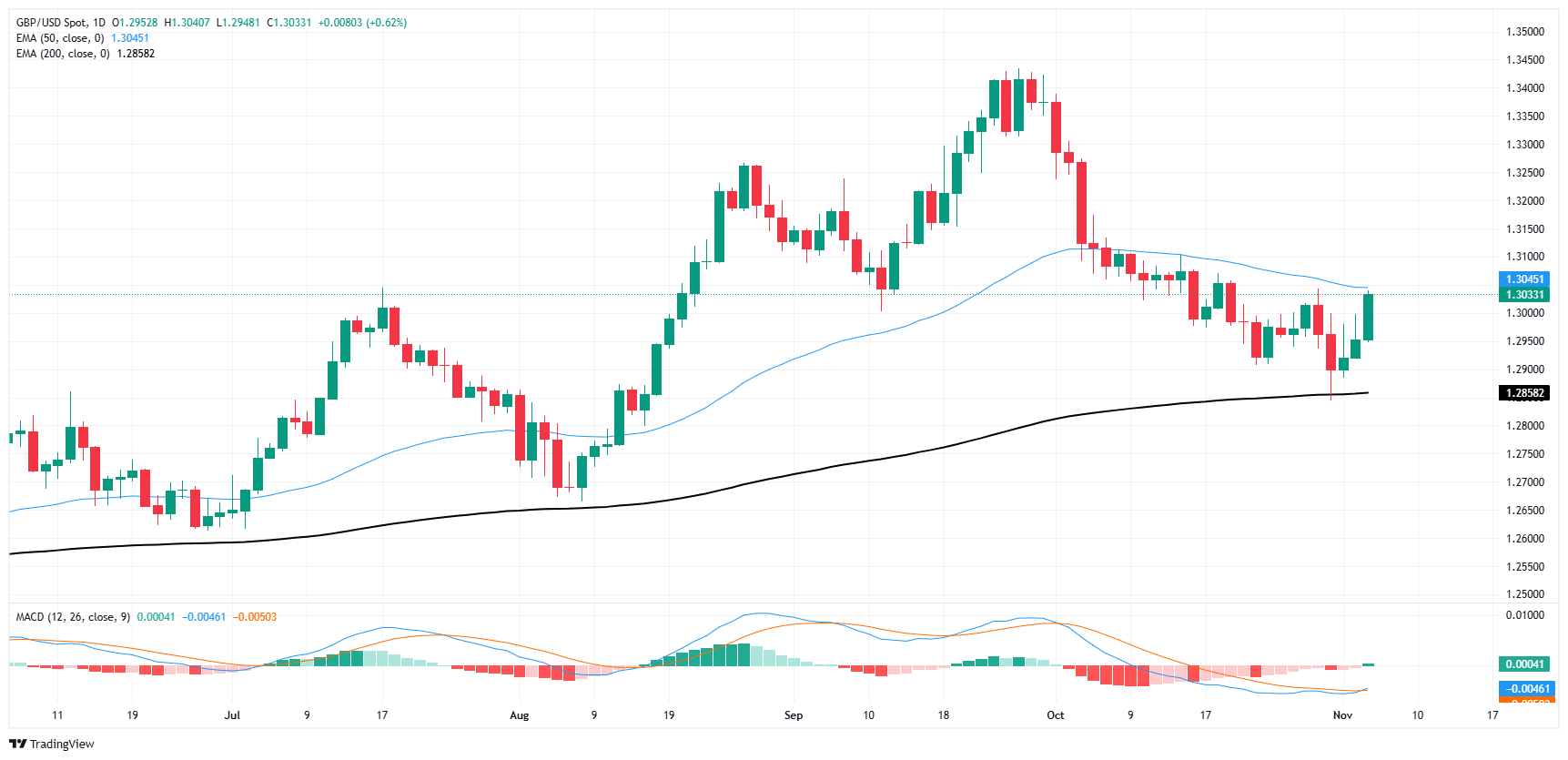
Pound Sterling FAQs
The Pound Sterling (GBP) is the oldest currency in the world (886 AD) and the official currency of the United Kingdom. It is the fourth most traded unit for foreign exchange (FX) in the world, accounting for 12% of all transactions, averaging $630 billion a day, according to 2022 data. Its key trading pairs are GBP/USD, also known as ‘Cable’, which accounts for 11% of FX, GBP/JPY, or the ‘Dragon’ as it is known by traders (3%), and EUR/GBP (2%). The Pound Sterling is issued by the Bank of England (BoE).
The single most important factor influencing the value of the Pound Sterling is monetary policy decided by the Bank of England. The BoE bases its decisions on whether it has achieved its primary goal of “price stability” – a steady inflation rate of around 2%. Its primary tool for achieving this is the adjustment of interest rates. When inflation is too high, the BoE will try to rein it in by raising interest rates, making it more expensive for people and businesses to access credit. This is generally positive for GBP, as higher interest rates make the UK a more attractive place for global investors to park their money. When inflation falls too low it is a sign economic growth is slowing. In this scenario, the BoE will consider lowering interest rates to cheapen credit so businesses will borrow more to invest in growth-generating projects.
Data releases gauge the health of the economy and can impact the value of the Pound Sterling. Indicators such as GDP, Manufacturing and Services PMIs, and employment can all influence the direction of the GBP. A strong economy is good for Sterling. Not only does it attract more foreign investment but it may encourage the BoE to put up interest rates, which will directly strengthen GBP. Otherwise, if economic data is weak, the Pound Sterling is likely to fall.
Another significant data release for the Pound Sterling is the Trade Balance. This indicator measures the difference between what a country earns from its exports and what it spends on imports over a given period. If a country produces highly sought-after exports, its currency will benefit purely from the extra demand created from foreign buyers seeking to purchase these goods. Therefore, a positive net Trade Balance strengthens a currency and vice versa for a negative balance.
Author

Joshua Gibson
FXStreet
Joshua joins the FXStreet team as an Economics and Finance double major from Vancouver Island University with twelve years' experience as an independent trader focusing on technical analysis.